
SaaS & IT Content Marketing
Do Your Buyers Still Use Google, or Do They Ask AI Search?
How search behavior changed from 2023 to 2026, and what it means for DACH companies with a German and an English site.
Are our buyers still using Google, or has that moved?
It is a fair question, and the honest answer is both. Buyers still search on Google. A growing share also ask ChatGPT, Gemini, Claude or Perplexity, and some stop at the answer without opening a single result.
Here is the part that matters if you sell from Germany, Austria or Switzerland. You probably run a German site and an English one. The English pages are what international buyers see, and what AI search tools see when someone asks a question in English. An English SaaS website can be online, indexed and professionally designed, and still fail to earn a place on a buyer’s shortlist, either because the English was never properly edited or because the English pages are hard for search engines to connect to the German ones. Whether the cost shows up in Google, in AI search or in both, the fix is the same: an English website that is clear, specific, well linked and trusted.
This article covers how search behavior changed, with German data first, why Google is not dying but search is splitting, three planning scenarios for 2027 and 2028, and how AI search finds your English SaaS website next to a German one. We cannot promise that any company will rank in AI answers, and nobody else can honestly promise it either. What we can show is the direction of travel and what improves your chances.
If you want the business case for editing translated pages first, read what an auto-translated English website costs a SaaS company.
Written by: Andres Fehrenz
What Is AI Search, and How Is It Different From Google?
AI search means finding information by asking a conversational AI tool and reading its written answer, instead of scanning a list of links. It comes in two forms. Chatbots such as ChatGPT, Claude, Gemini and Perplexity answer in a conversation and sometimes cite sources. AI summaries inside Google, such as AI Overviews, put a generated answer above the usual results.
The difference matters for a SaaS company. In classic search, the buyer picks between ten links. In AI search, the tool often does part of the picking, naming a few vendors and explaining why, based on what it can find and understand on your English SaaS website and elsewhere. Being understood and cited becomes as important as ranking first for one phrase.
Generative engine optimization, or GEO, is the work of making your content easy for these tools to find, understand and cite. It sits next to SEO, not in place of it. We explain how the two fit together in SEO vs. GEO
How AI Search Changed Buyer Behavior, Germany First
We start with Germany because that is probably where you sell from.
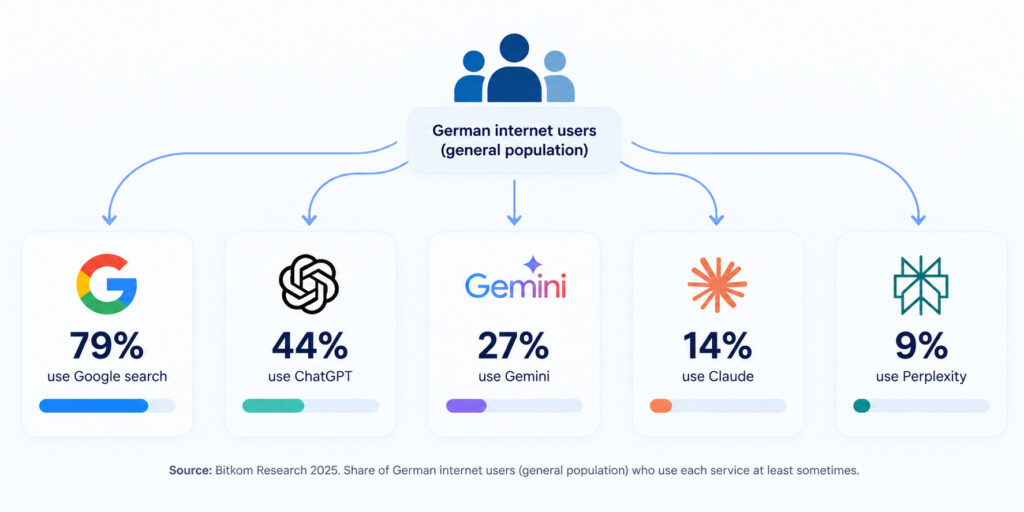
In fieldwork covering weeks 39 to 43 of 2025, Bitkom Research interviewed 1,030 internet users in Germany. Half of them (50%) said they use an AI chat at least sometimes instead of a classic search. Among 16 to 29 year olds, two thirds do. And 24% said they often read the AI summary on a search page without looking at the results below it.
That measures reported behavior. It does not mean half of all German searches now happen in a chatbot.
In the US, Pew Research Center’s February 2026 survey of 5,119 adults found that 49% use AI chatbots and 42% use them to gather information. ChatGPT use stood at 18% of adults in 2023, 23% in 2024 and 34% in 2025. Pew changed how it asked the ChatGPT question in 2026, so this year’s 44% is not directly comparable. The direction is clear. We would not draw a growth curve through four points.
For B2B software, G2’s July 2026 Buyer Behavior Report surveyed more than 1,000 software buyers and decision makers. It found that 82% had sourced software recommendations from an AI chatbot in the previous 24 months, and half said AI made the biggest difference when they were narrowing and comparing options. G2 is a software review platform with its own commercial interest, and the figure reflects recall over two years, not how most searches are run. It still fits the pattern: buyers use AI search to build a shortlist.
On the supply side, OpenAI said in February 2026 that ChatGPT had reached 900 million weekly active users, up from 800 million in October 2025. That is the company’s own number, and it says nothing about how many of those users are researching software.
What this means for your website. Whichever figure you trust, the pattern is the same. Buyers now meet your company in several places before they ever visit your website: an AI answer, a review site, a search result. Each of those gives a vague English SaaS website little to work with, and each rewards one that is clear, specific and consistently described.
Google Is Not Dying. Search Is Splitting.
Here is the counterargument, and it deserves a straight answer. If AI search is growing, why not conclude that Google is finished?
Because the same data says otherwise. In Bitkom’s survey, 47% of German internet users still use only classic search. G2’s buyers ranked review sites (38%) just ahead of AI chatbots (37%) as the biggest influence on their shortlist, the first time review sites have led. A 2026 Seer Interactive study reported that click rates on queries with AI Overviews recovered early in the year, although it does not state its sample size, so treat it as directional. And Gartner’s 2024 prediction that search volume would fall 25% by 2026 was challenged on several grounds. We found no data showing it came true.
So the accurate picture is a split. Buyers use Google, AI search and review sites, often in the same buying journey. A SaaS company that invests in only one of them is exposed in the others. That is the argument for treating SEO and GEO as one plan, applied to the same English SaaS website, not a choice between them.
Three Scenarios for AI Search in 2027 and 2028
Nobody knows how fast AI search will grow. The forecasts we found on marketing blogs show no clear method, so we will not give you a number. Here are three planning scenarios instead. They are not predictions.
Scenario | What it could look like | What a small SaaS or IT team should do |
Slower adoption | AI search stays an extra channel next to Google and review sites. | Keep strong traditional SEO. Test GEO with a fixed set of buyer questions. |
Continued adoption | More buyers use AI during research and shortlisting. | Publish content that answers real buyer questions and shows expertise. Check how AI tools describe your company. |
Faster adoption | AI-assisted discovery becomes decisive in some categories. | Widen visibility monitoring. Strengthen reviews, third-party mentions and consistency across your profiles. |
Notice what is the same in all three. The work that helps is specific, accurate, well-edited content that other sites and reviewers back up. None of the scenarios rewards a thin or awkward English SaaS website.
How AI Search Finds Your English SaaS Website Next to a German One
Many companies in the DACH region run two sites in one: German pages and English pages, often in separate folders such as /de/ and /en/. For Google, the setup is documented. For other AI search tools, it is not. We keep the two apart.
What Google documents. Google recommends separate URLs for each language version, and warns that if you change content dynamically based on language settings, it might not find and crawl all your variations. It asks you to describe the versions with hreflang, where every page lists itself and the others. The pages have to point to each other: “If two pages don’t both point to each other, the tags will be ignored.” An x-default version covers visitors whose language matches none of your versions. Google also advises against redirecting people automatically based on their assumed language or location, and suggests visible links so users can choose a version themselves.
What nobody documents. Whether ChatGPT, Claude, Perplexity and similar tools read hreflang is not stated in any official source we found. Google’s guidance is written for Google Search, and AI Overviews draw on Google’s index. For the other assistants, we treat it as unknown. So the safe approach is to make your English SaaS website easy for any tool to find: its own crawlable URLs, links from the German pages, complete content, and the same product names on both sites. That is our judgment, not a proven rule.
Is translated content a problem? Not by itself. Google does not penalize translated content as such, and AI translation is a perfectly good first draft. Google’s guidance on creating helpful content says AI-generated and AI-assisted content can be fine, but producing large amounts of text “without manual oversight or curation” is low effort. Its page on generative AI content says it is critical to manually fact-check and review AI-generated content before publishing. Neither page addresses machine translation by name, so we apply the same logic: the risk is publishing without a person who writes business English reviewing the pages that matter.
What reviewed English adds. A literal translation can keep the facts and lose the practical experience, product nuance and buyer understanding behind them. E-E-A-T stands for experience, expertise, authoritativeness and trustworthiness, and comes from Google’s quality rater guidelines. Google says rater ratings do not directly affect ranking, so this is a content quality risk, not proof of a penalty. Translated terminology also often does not match the words an English-speaking buyer types, so a page can be indexed and still fail to answer the question.
Why AI tools may cite you less. AI search tools draw on content that is clear, specific and consistent. If your product has three names across your English SaaS website, your claims are vague and your English is awkward, there is less to work with. This is a reasonable hypothesis, not a proven cause. Nobody has shown that machine translation directly lowers AI citations, and we will not pretend otherwise. Google’s guide to AI features says the best practices for SEO continue to be relevant and recommends unique, non-commodity content. We looked at why most SaaS content fails that test in why B2B SaaS content sounds the same.
The method does not decide the outcome. The finished page does. AI translation, reviewed and adapted by an expert, can be part of an excellent workflow. To spot the unreviewed kind, use our 10-check scorecard for machine-translated websites.
Why the Effort Gap Compounds for an English SaaS Website
Picture two SaaS companies selling to the same buyers. One publishes edited, specific English content, links its English and German pages properly, keeps its product language consistent, collects reviews and checks each month how AI tools describe it. The other publishes an English SaaS website that was translated once, never reviewed, and left unconnected to the German pages.
Neither is penalized. But the first collects more links, mentions and reviews over time, and each one makes it easier to be found and cited the next time. The second stays where it started. This compounding is our hypothesis, not a measured law, but it matches how search and reviews work. It also means the gap that matters is not between a good site and a bad one. Companies that keep investing can overtake companies that were already good.
A hypothetical, so you can see the exposure. A company gets 1,000 qualified visits a month, converts 2% into leads and closes 10% of them: 2 new customers a month. If qualified visits fell 20% and nothing else changed, that would be 1.6, or 0.4 fewer. Multiply by your first-year revenue per customer. This is arithmetic, not evidence that AI search or translated copy causes a 20% loss. Use your own numbers.
One more point. AI search may make shortlist inclusion matter even when fewer people click. The question is not only how many people visit your site. It is whether you are on the list when the buyer asks.
What to Check This Quarter on Your German and English Pages
The work is less about AI tricks than about the basics of a good English SaaS website: clear positioning, specific product messaging, a clean link between your German and English pages, consistent terms, and credibility beyond your own pages. Seven steps, in order. If your team is small, our piece on marketing a SaaS company with limited resources covers how to prioritize.
- Read your own English SaaS website as a buyer would. Run the 15-minute check on your homepage, pricing, signup or demo page and one trust page.
- Check that every key German page has an English page of its own. Each should have its own URL, a visible link between the two versions, and a place in your sitemap.
- Check hreflang and redirects. Every version should list itself and the others, with return links and an x-default. Remove automatic redirects based on language or location, and offer a visible language switcher instead.
- Make the English pages complete and consistent. Translating only the menu and leaving the main content in German is a poor experience. Use one name for each product, feature and plan, on both sites and across your profiles.
- Fix the pages that carry the decision first. Homepage, pricing, signup or demo, then security and privacy. Leave documentation and old posts for later.
- Ask the AI search tools. Put 15 to 20 real buyer questions to ChatGPT, Gemini and Claude each month, in English, the way your buyers would, and log whether you appear, who does, and what they say. Keep the questions fixed so months are comparable, and treat the result as directional. We cover the wider measurement question in how to measure SaaS content marketing.
- Build proof outside your own site. Reviews and credible mentions matter. G2’s data suggests review sites carry as much weight as chatbots. Also see what AI tools find about your SaaS company and how SaaS buyers research vendors in ChatGPT.
Want to Know What to Fix First on Your English SaaS Website?
Send us your English homepage and pricing page, the German pages they match, and tell us who you are trying to reach. We will come back with the three things we would fix first, covering messaging, content and how easily buyers and AI search tools can find and understand you.
Market Plus Solutions is a SaaS and IT marketing agency for small businesses in the DACH region, Liechtenstein, Luxembourg and the US, with content marketing at the core. See who we work with, or read more about our content marketing for small SaaS teams and our SaaS content marketing services in Germany.
Frequently Asked Questions - English SaaS Website
Is AI search replacing Google?
No. In Bitkom’s survey, 47% of German internet users still used only classic search, and G2’s buyers ranked review sites level with AI chatbots as a shortlist influence. Buyers use several sources, so AI search adds to Google. It does not replace it.
How many buyers use AI search?
It depends on who is asked. Bitkom found 50% of German internet users use AI chat at least sometimes instead of classic search. Pew found 49% of US adults use AI chatbots. G2 found 82% of surveyed software buyers had sourced a recommendation from a chatbot in 24 months. None of these measures the share of all searches.
Can a company guarantee a ranking in AI answers?
No. AI tools choose their sources in ways nobody outside them can control. You can improve your chances with clear, specific, consistent and well-reviewed content. You cannot buy a guaranteed place.
Will AI search find the English pages of a site that also has a German version?
It can, if the English pages are easy to find. Google documents how: its own URL for each language version, hreflang with return links, and visible links between the versions. For other AI tools there is no official guidance we could find, so make the English pages crawlable, linked and complete.
Do I need hreflang for my English and German pages?
Google recommends it for localized versions of a page, and says the tags are ignored unless the pages point to each other. It is written for Google Search. We found no official statement on whether other AI tools use it.
Does a machine-translated English SaaS website hurt AI visibility?
It is not proven. Google does not penalize translated content as such. A site that was translated and never edited does give AI tools and buyers less to trust, which is a reasonable risk to take seriously.
What should a small SaaS team do first?
Read your English homepage and pricing page as an international buyer would, check that each has a linked German counterpart, fix what is awkward or inconsistent, and start logging a fixed set of buyer questions in the AI tools each month.
Sources and notes: Figures checked in October 2026 from the linked reports. Bitkom, Pew and G2 measure different groups and should not be added together. OpenAI’s number is company-reported. The scenarios are planning aids, not forecasts. The Seer study’s sample size is not stated in the source we read. Google guidance on language versions was read in October 2026 and may change.
Is Your English SaaS Website Working as Hard as Your German One?
Send us your English homepage and pricing page, plus the German pages they match. We will read them the way an international buyer and an AI search tool would, and come back with the three things we would fix first, and why.