
SaaS & IT Content Marketing
Inbound Leads Case Study: An Introduction
A small MSP software company sold by phone. (If the term is new to you, a managed service provider, or MSP, is a company that manages IT systems and services for other businesses, usually for a recurring fee.)
This inbound leads case study follows what changed when Market Plus Solutions took on the company’s marketing in January 2025. Inbound leads are prospects who contact a company after finding it, as opposed to outbound leads, who are contacted first.
Since the company began, the team collected visiting cards and phone numbers from wherever it could and worked through them. Every call started the same way: say who they are, say what they do, and try to earn a minute of credibility from someone who had never heard of them.
When Market Plus Solutions started, nothing changed overnight. It took two months to clean up the website and settle on a structure, and the first inquiry came in during the fourth month. Even then, the team still had its lists of numbers, so the cold calls continued at first. Gradually they declined, and by the tenth month they had stopped. The company no longer needed them.
The calls that matter now are different. The person on the other end has already seen the company online, so the opening is no longer an introduction. It becomes: “How can I help you?”
This case study covers the order of work, how an inbound lead moved through the system, and what Market Plus Solutions observed in search and AI tools. It describes real work, with identifying details removed. It is a single account, not a study of several companies, and no single activity can be credited with the change.
The case study at a glance:
➜ Company: a small B2B software company that sells to MSPs.
➜ Starting point: sales built on cold calls, a static HTML website, leads in a spreadsheet.
➜ What changed: the website, the content, local and AI search, the sales pitch, and the team’s training.
➜ What was observed: the first inquiry in the fourth month, and roughly 35 to 45 inquiries a month by the tenth.
➜ What cannot be claimed: that any single step caused the change or return on investment figure.
Why Small MSP Software Companies Struggle to Get Inbound Leads
The company was stable, but stuck in one way of selling. Its buyers were MSPs, it was known locally, and the phone brought in business, but only as fast as the team could dial. Every call began with a stranger who had never heard of them. Search engines barely knew the company, and Google suggested it only for local searches. The company was open to changing all of it, as long as it would make a difference to the business. The problems were specific:
- A static HTML website. Hard to update, with a messy SEO setup.
- Leads in a spreadsheet. Prospects were tracked in Excel, not in a pipeline, so there was no clear view of where each lead stood.
- Nothing happening on the site. The site had not been touched for nearly ten years, so there was no fresh content for search engines or buyers.
- Little authority. Very few links from other websites.
- An untended LinkedIn company page. Where buyers spend time, the company told no story.
- A pitch built for the phone. It described the company and assumed a stranger who had to be convinced.
The Case Study: What Market Plus Solutions Did, in Order
The order was a decision, not an accident. Each step gave the next one something to stand on.
Step | What changed | Why then |
Rebuild the website | Moved the site from static HTML to WordPress, cleaned up the SEO problems and updated all of the content during the revamp. | Nothing works on a site the team cannot edit. |
Content | Started blogging and added calls to action across every page. | Search engines take time to recrawl and trust new content, so the foundation had to be strong first. |
Authority | Built links from other sites organically. Once the site was clean, this was the main effort. | Content alone rarely earns authority quickly. Links from other sites help. |
Cleaned up the company page and started posting. No other platform. | One channel done properly, where MSP owners already are. | |
Local search | Set the company up for local queries, often called answer engine optimization (AEO). | Local was where the company already had some visibility. |
AI search | Worked on large language model optimization (LLMO) and search experience optimization (SXO). | Clear, consistent information across the web can help AI tools understand a company. |
Sales pitch | Rewrote how the company introduces itself, and rebuilt the deck around what its customers save in time and money. | An MSP owner who finds you online arrives with different questions than one who answers a cold call. |
Training | Trained the marketing manager and the team on the customer relationship management (CRM) system and the inbound process. | The team had to be able to run it once the work was in place. |
The acronyms are labels people use in different ways. We use them as shorthand, and we explain the wider picture in SEO vs. GEO for small SaaS and IT decision-makers.
Why backlinks Were the Hard Part
Once the technical foundation was in place, earning relevant links from other websites became a major part of the work. The site had little existing authority, and we believed that was an important constraint on its visibility and on the inbound leads it could attract.
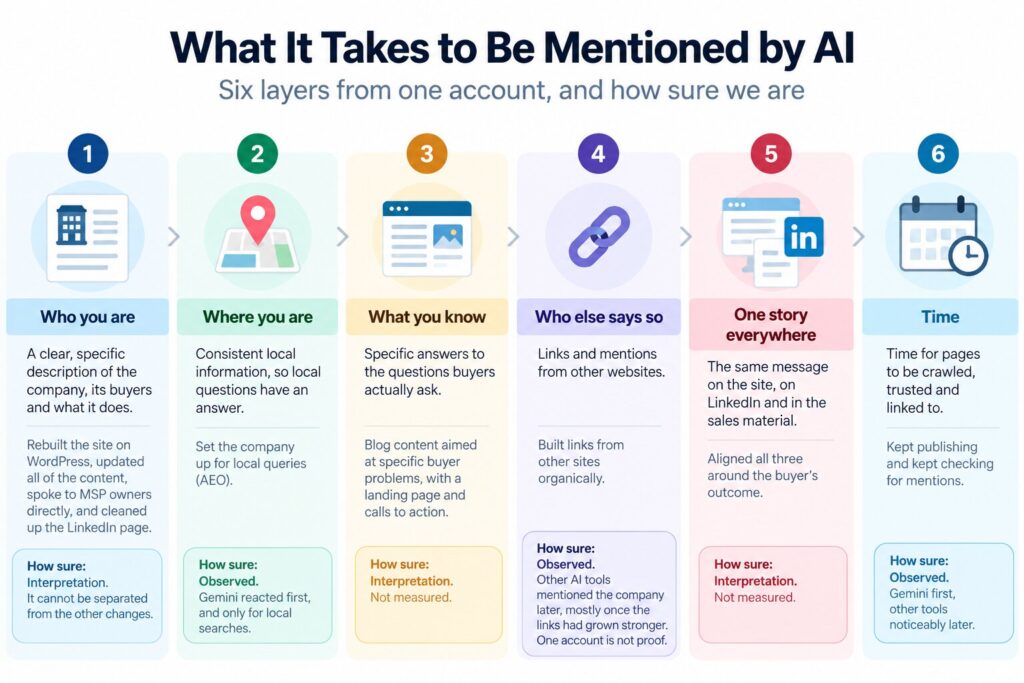
Content, the website, LinkedIn and the sales material were all changing at the same time, so Market Plus Solutions cannot isolate the effect of link building. Links were where the most effort went in this phase, and AI tools other than Gemini mentioned the company later, mostly once the backlinks had grown stronger.
How an Inbound Lead Moved Through the System
Getting inbound leads is not only publishing content. The website, the follow up, the calendar, the sales team and the CRM have to work together. Here, the process was simple, and each step had an owner.
- A reader finds a page. A blog post or a local search result brings them in.
- The call to action. “If you are interested, write to us and we will contact you within 24 hours.”
- An automated email. It arrives at once and includes a calendar link, through Calendly, to book a call.
- A scheduled call. The prospect picks a time. Trained sales team members take the call.
- A demo or a trial. From the call, prospects asked for a demo or a trial, and the CRM, new to the team, tracked what happened next.
From Cold Calls to a Different Kind of Call
In this case study, the clearest change was in the call itself. The company did not stop calling on a given day. It divided the team. Some people kept making calls from the existing lists, while others were trained internally on the new deck. The sales manager did the training. The people on the new path learned to represent the product, not to authenticate themselves.
The deck changed with it. The company first reworked how it introduces itself. Then the deck was rebuilt around what its customers can save in time and money, and what else they could do with the product. The old pitch described the company. The new one described the buyer’s outcome.
Market Plus Solutions gave the team one line: you are not selling the product to them, they want to buy your product. Cold calling builds credibility by introducing yourself. Inbound calling starts with credibility that is already there, because the buyer saw the site, the LinkedIn page and the content before speaking to anyone.
Why does that matter? Buyers often choose before they speak to a vendor. In the 6sense 2025 B2B Buyer Experience Report, based on just under 4,000 buyers, buying groups had filled 3.6 of their shortlist spots on average on the first day of the buying process, and 95% of the time they bought from a vendor on that first-day list. 6sense sells to B2B marketers and the data is self-reported, so read it as a strong signal, not a law. Market Plus Solutions covers the same shift in why SaaS buyers decide before they ever visit your website.
The content also fed the pitch. The company knew its product better than Market Plus Solutions did, but each new piece showed another way to address a buyer’s problem, and the pitch was updated to match. For what that content should contain when you sell to IT buyers, see B2B IT content marketing: what decision-makers actually want. A related sales deck rebuild is described in how we earned SaaS buyers’ trust without spending on ads.
Training the Marketing Manager and the Team
Market Plus Solutions did not only revamp the website, build links and publish content. It also trained the company’s marketing manager. The first topic was how to track content results. That mattered because the marketing manager reported directly to the managing director and needed to follow the activity without waiting for a report.
The longer job was the CRM the company had newly bought. The training ran from automating emails to tracking the pipeline, and took about three months. It covered the day to day of inbound: calls to action, how the pipeline works, the booking calendar, and where to find incoming inquiries. The weekly report still went out, but the team usually knew what was happening before it arrived, which made the work easier.
How Product Marketing Knowledge Sets Market Plus Solutions Apart
Writing content is the visible part of the work. The harder part is deciding what to say, to whom, in what order, and what to leave out. Keyword tools show what people search for. Product marketing decides what the company says once they arrive. Market Plus Solutions does not start with a content calendar. It starts with product marketing and go-to-market questions, and then builds content that answers them from the top of the funnel to the bottom. In this case, that looked like this:
Funnel stage | What the MSP owner is asking | What Market Plus Solutions built |
Awareness | Who is this company, and can I trust it? | Local search visibility, a cleaned up LinkedIn page, and blog content that answered MSP owners’ questions. |
Consideration | Does this fit my problem, and what would it change? | Content aimed at specific problems, and an organic landing page with one clear call to action. |
Decision | What will it save me, and what happens if I try it? | A deck built around time and money saved, a booking path to a demo or a trial, and a CRM that tracked each lead. |
Sales handoff | Will the person I talk to say what the site said? | A sales team trained on the new pitch, and a marketing manager trained on the inbound process. |
The Decisions Behind the Content Campaign
- Ideal customer and segments. The buyer was an MSP owner. The target started with small companies and widened later to slightly larger ones that needed extra help when overloaded, so the messaging had to fit both.
- Positioning and messaging. The old pitch described the company. The new one led with the buyer’s outcome, time and money saved, then the product, then only the proof the company could support.
- The offer. What exactly was on offer: a reply within 24 hours, a booked call, and then a demo or a trial. A low commitment first step, with a clear path to it.
- Inbound replaced outbound gradually. Content, local search and one social channel created demand, and the team phased out the calls once they were no longer needed.
- The timing worked because several things were ready together: the product, buyers who were already searching, and a team trained to take inquiries.
- What was left out. One social channel, not five. An organic landing page, not a sponsored one. No promises about conversions.
In general, before planning content, Market Plus Solutions also sizes the market it can realistically win, from the total addressable market down to the serviceable obtainable market. This case study does not report that work, and it does not show unit economics such as customer acquisition cost or payback. Those figures were not shared, so no claim is made about them. This is where the SaaS content marketing agency service begins.
What Was Observed in Search and in AI Answers
Gemini was the first AI tool to react: when asked for companies of this kind in the local area, the company began to show up more often in the checks Market Plus Solutions ran. That happened only for local searches. Other AI tools took noticeably longer. We cannot say how many inbound leads came from AI search. The founder welcomed the mentions and wanted the company to be part of AI answers.
These are observations, not measurements. AI answers change by tool, prompt and day, so a mention seen once is a signal, not proof. Market Plus Solutions explains how it tracks this in how to measure SaaS content marketing.
What Market Plus Solutions Saw in Inbound Lead Volume
We did not track conversions, and the company does not share that data, which is common in an arrangement like this one, so there is no claim about sales. What Market Plus Solutions did see is the flow of inbound leads. Before the work began, nothing came in through the website, which had not been touched for nearly ten years. The first inquiry came through the website in the fourth month, a first for the company. In the months after, the flow built to a range of roughly 35 to 45 a month, reached by the tenth month. The number varies from month to month, but it has been consistent throughout. The inquiries arrive through content marketing, not through outbound calling.
For a small team, that is enough. The company does not need more, and the goal was never the largest possible number. It was a steady flow that the team could handle properly, with enough room left to take each call well. Much more than that, and the team would need to grow.
These figures are approximate, and they say nothing about which activity produced them.
What This Case Study Suggests for Your Team
- Credibility comes before the call. If buyers have seen you online first, the conversation starts somewhere better.
- When the buyer changes, the pitch has to change. A deck built for cold calls does not suit someone who found you themselves.
- Phase out outbound gradually. Split the team: some keep calling while others train on the new pitch, and let the calls decline as inbound grows.
- Pitch the buyer’s outcome, not your company. Lead with what customers save in time and money.
- Train your own people. Give them the day to day of inbound: the pipeline, the calendar and the inquiries. If your team is small, marketing a SaaS company with limited resources covers how to prioritize.
Frequently Asked Questions
Did the cold calls stop right away?
No. The team kept calling from its lists at first, and the calls declined gradually as inbound grew. By the tenth month they had stopped, because the company no longer needed them.
Do you need links to appear in AI answers?
In this account, mentions in AI tools other than Gemini came mostly after the links had grown stronger. One account does not prove a rule, so test it before you assume it.
Is this a real case study?
Yes. It describes real work, with identifying details removed. It is a single account, not a study of several companies, and it makes no claim about conversions, revenue or return on investment.
Why no company name or outcome figures?
Market Plus Solutions keeps client work confidential, and it does not have reliable conversion or revenue figures. This case study describes the work and what was seen, and says what it cannot show.
How long does content marketing take to give results?
The answer is a range, not a promise. It cites this case: two months of cleanup, the first inquiry in the fourth month, and roughly 35 to 45 a month by the tenth. It says one account is not a benchmark, and advises planning around the shape (a slow first stretch, then a steady build) and not around a date.
How many inbound leads should a small software company aim for?
Enough that the team can handle each one well. It uses the case’s 35 to 45 a month as an example, and says to set the target from your team’s capacity and sales cycle.
What should a small software company fix first?
The foundation: a website your team can edit, with a clean SEO setup, then the order from the table.
Do you need a CRM before you start building inbound leads?
You need somewhere for every inquiry to go. The case moved from a spreadsheet to a CRM, and the setup and training took about three months, so it is worth starting before the inquiries arrive.
What This Case Study Can and Cannot Claim: This case study can say what changed, in what order, and what was observed. The engagement is ongoing, so it is work in progress, not a final result. It cannot say that any one step caused the change, because several overlapped. It has no reliable figures for conversions, revenue or return on investment, so it makes no claims about them. And it cannot say another company would follow the same path, because a different starting point changes the plan.
Struggling with Leads and Cold Calls?
Send three pages to Market Plus Solutions: your homepage, your main service page and the page you most want people to find. The team will tell you what to change first and in what order, and where your own inbound leads could start.