
SaaS Industry
Why Are Fewer Qualified SaaS Buyers Booking Demos?
That’s the question, not the diagnosis.
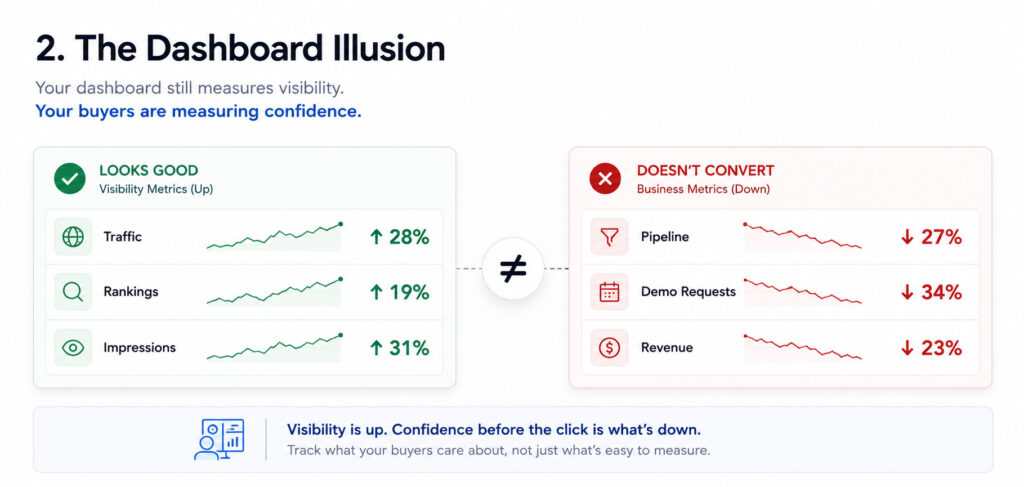
You haven’t accepted an explanation yet — you’ve just noticed the number is wrong. Traffic is up. Rankings are up. Impressions are up. Pipeline is down. Revenue is down. Nothing in Google Analytics explains why, because your SaaS buyers stopped leaving footprints there.
Your sales team probably noticed before marketing did. Prospects showing up on demo calls already knowing your competitors by name, already asking about integrations nobody prompted them toward, already halfway to a decision before the call started.
Here’s what’s actually happening, and why your website lost its most important job without anyone deciding to take it away.
What's Actually Happening To SaaS Buyers? A Growing Share of Them Never Search at All
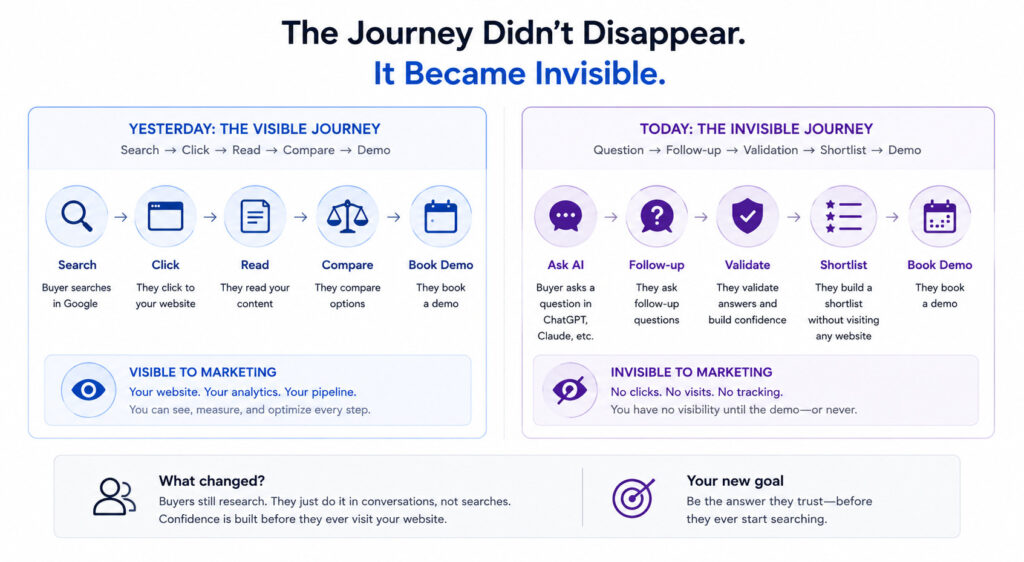
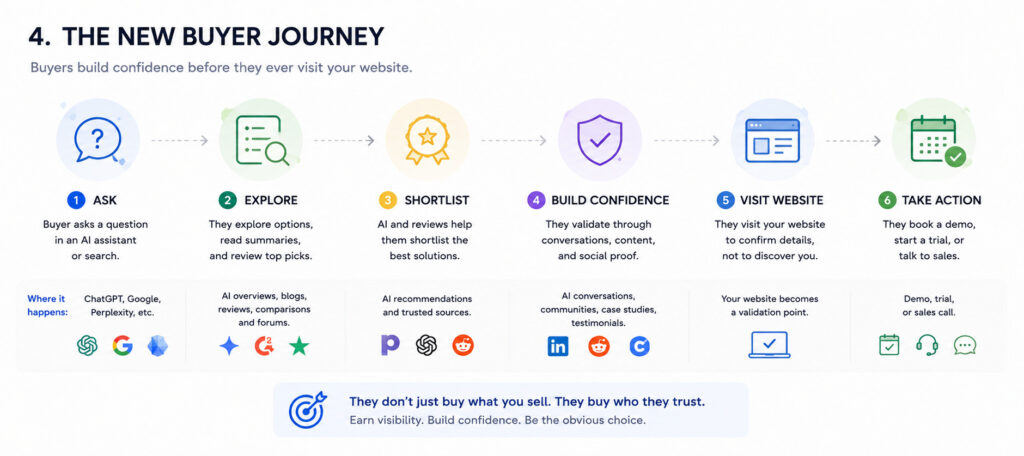
Here’s the scenario, and it’s becoming ordinary rather than exceptional: a VP evaluating software for her team doesn’t open Google. She opens ChatGPT and asks which platform fits her stack. She follows up asking what people complain about. She asks which one she should pick for a team her exact size. By the time she’s done, she has a shortlist — built entirely through a conversation, without a single click to a website.
This is increasingly common, not universal. Plenty of SaaS buyers still search the old way, and it would be overstating things to say the search journey is gone. But for a growing share of B2B buying decisions, the shift is real and it’s measurable. [Ahrefs’ research team] found that AI Overviews now cut click-through rates by 58% for top-ranking pages when they appear — nearly double what the same team measured just eight months earlier. That’s not a slow decline you can watch happen and adjust to. It’s a structural change to where the moment of decision now lives.
Your Website's Job Quietly Changed
Here’s the sentence that reframes everything else in this piece: your website is no longer where SaaS buyers discover your company. It’s where they come to confirm a decision they’ve already started making elsewhere.
Increasingly, by the time a buyer reaches your homepage, they’re not there to discover you — they’re looking for a reason to eliminate you, or a reason to stop second-guessing the choice they’ve already leaned toward. That’s a very different homepage to build than the one designed to win someone over from zero.
Content strategy, SEO, landing pages, demo-booking flows — nearly all of it was built on the assumption that a visitor arrived uninformed and left informed enough to decide. For a growing share of your prospects, that assumption no longer holds. Their site visit isn’t discovery anymore. It’s confirmation — checking whether what they already believe about you holds up.
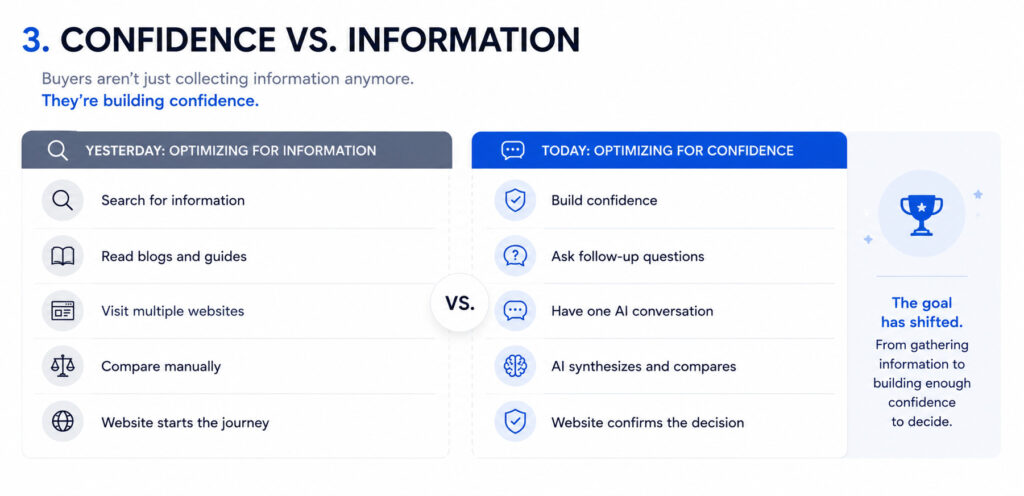
Buyers are optimizing for confidence — not information. That single shift is the reason almost everything else in this article is true.
Why "Just Optimize for AI" Isn't the Real Insight Here
SaaS Buyers aren’t optimizing for information anymore. They’re optimizing for confidence — and that’s a different thing to build for. Imagine you’re evaluating five vendors for a tool your team needs next quarter.
You don’t visit five websites and build a comparison spreadsheet from scratch anymore. You ask an assistant to do the first pass, then you ask follow-ups — what people complain about, which one fits a team your size, how support compares. Each question isn’t gathering new information so much as testing whether your growing hunch holds up. By the time you land on two finalists, you’re not researching. You’re confirming.
Every follow-up question inside that exchange is an attempt to reduce uncertainty before committing to a call. “What do people complain about?” isn’t a search query in the old sense. It’s the kind of question you’d ask someone you already trust for a straight answer. That AI has become that trusted voice for a meaningful share of buyers is the real shift — not the mechanics of which platform serves the answer.
A brand that shows up well in that exchange starts the sales conversation already ahead. A brand that doesn’t may never get invited to it.
What Happens to the Companies That Don't Adapt
Two paths are opening up, and they lead somewhere different.
Companies that keep optimizing purely for clicks will keep producing content built for a moment that’s happening less often. Their dashboards will keep looking healthier than their pipeline actually is, for longer than is comfortable, because the metrics that used to tell the truth are the ones quietly going stale first.
Companies that start optimizing for how they show up inside these conversations — not just whether they rank — get a different kind of compounding advantage: being the name that gets mentioned by default, before the prospect ever searches at all. That’s a harder position to lose once you have it, and a harder one to catch up to once a competitor gets there first.
How to Actually Show Up in a Conversation You Weren't Invited To?
You can’t participate directly in an AI conversation happening about you. But, you can shape what gets said in it.
[Research from Princeton, Georgia Tech, IIT Delhi, and the Allen Institute for AI] found that specific, verifiable, detailed content is disproportionately favored in what AI systems choose to surface and cite. Generic marketing language is effectively invisible to these systems. A claim like “our platform integrates with HubSpot, Salesforce, and Zendesk” gets picked up and repeated. “Integrates with your existing tech stack” doesn’t.Third-party mentions carry more weight than most teams assume, too. Ahrefs’ own Q1 2026 benchmark, analyzing 75,000 brands, found third-party mentions correlate more strongly with AI visibility than owned website content does. It means, your G2 reviews, your press coverage, and your community presence are functioning as citation signals now, not just trust badges.
"Our SaaS Buyers Are Enterprise CIOs — They Don't Use ChatGPT"
This is the objection worth answering directly. Why?
It’s the one most likely to be sitting in your head right now. It’s a fair challenge, and it’s less true than it sounds. The Ahrefs and Princeton research above isn’t about consumer chat habits. It is about how AI-mediated search and answer engines are reshaping the entire research layer of the internet, including the analyst reports, review platforms, and technical documentation an enterprise buyer already relies on. A CIO who’s never opened ChatGPT directly is still affected the moment their team, their procurement analyst, or the peer they ask for a recommendation used one to shortlist you. The behavior doesn’t need to be universal in your specific buyer segment to change what happens before they contact you — it needs to be present anywhere in the chain of people who influence the decision.
One honest limit worth naming: what’s demonstrated here is that AI Overviews change clicks, and that buyer behavior is shifting toward AI-mediated research. What this piece can’t claim is a controlled study proving your specific pipeline drop is caused by this rather than something else in your funnel. The click and behavior data are real and verified. The exact size of the pipeline effect for any one company is something worth investigating directly, not asserting from a general trend.
The Metrics That Are Quietly Lying to You
Rankings don’t capture whether you’re present in the conversations happening about your category. Traffic doesn’t capture whether you’re on a shortlist. Click-through rate doesn’t capture the buyer who had a conversation about you and went straight to your demo-booking page without touching a single piece of your content on the way.
The question worth asking in your next marketing review isn’t “how many visitors did we get.” It’s “are we showing up in the conversations our SaaS buyers are already having, whether we’re in the room or not.” Those used to be roughly the same question. They aren’t anymore.
Search created visitors. Conversations create decisions.
Author: Andres Fehrenz
SaaS Buyers: Frequently Asked Questions
Why do SaaS buyers arrive at my website already decided?
Because a growing share of B2B SaaS buyers now build confidence in a shortlist through AI-mediated research — asking an assistant questions, getting comparisons, and forming a point of view — before ever visiting a vendor’s website. By the time they arrive, they’re often confirming a decision already largely made rather than starting research from scratch.
How do I know if my buyers are doing this?
Ask your sales team what prospects already know when they show up to a demo call. If people are arriving with informed opinions about your competitors, specific integration questions, and a point of view they didn’t get from your site, they’ve likely already had that conversation elsewhere.
Can I influence what AI says about my company?
Indirectly, yes. These systems build answers from what’s publicly available and verifiable — specific claims, named integrations, documented outcomes, third-party reviews and coverage. Generic marketing copy doesn’t give them anything to work with.
Does my website still matter if SaaS buyers decide before visiting it?
Yes — its job changed rather than disappeared. It needs to be built to confirm a decision convincingly, with the specific detail a buyer is checking for, not just to introduce your company from zero.
What should I track instead of just traffic?
Demo requests and pipeline sourced per piece of content, your presence in AI answers across ChatGPT, Claude, Gemini, and Perplexity for your category’s key questions, and third-party mentions as a leading indicator of AI visibility.