

SaaS Industry
The Reality of Marketing a SaaS Company With Limited Resources
Most advice on marketing a SaaS company assumes you have a team, a budget, and time to experiment. Run paid ads, test channels, hire a content person, build a community. That advice isn’t wrong. It’s just written for a company that doesn’t have the actual problem you have, the one we’ve written about directly in our guide to affordable content marketing for SaaS and IT companies.
The framework below is based partly on our work with early-stage SaaS and IT clients, including an engagement where the client had no marketing budget for the first several months, and every decision had to be made as if it were the only one we’d get to make. That experience is the backbone of everything below, though the specific framework has been generalized well beyond that one case.
If your SaaS startup has limited marketing resources, the first question is not which channel to try. It is which one problem to solve first.
The Real Problem Isn't Traffic. It's Prioritization
Marketing a SaaS company with limited resources is not primarily a traffic problem. It’s a prioritization problem: deciding which unanswered buyer question is most likely to prevent a sale, then using the smallest effective marketing asset to address it.
Everything that follows is one version of that same decision, applied to a different constraint each time.
The Real Challenges of Marketing a SaaS Company With Limited Resources
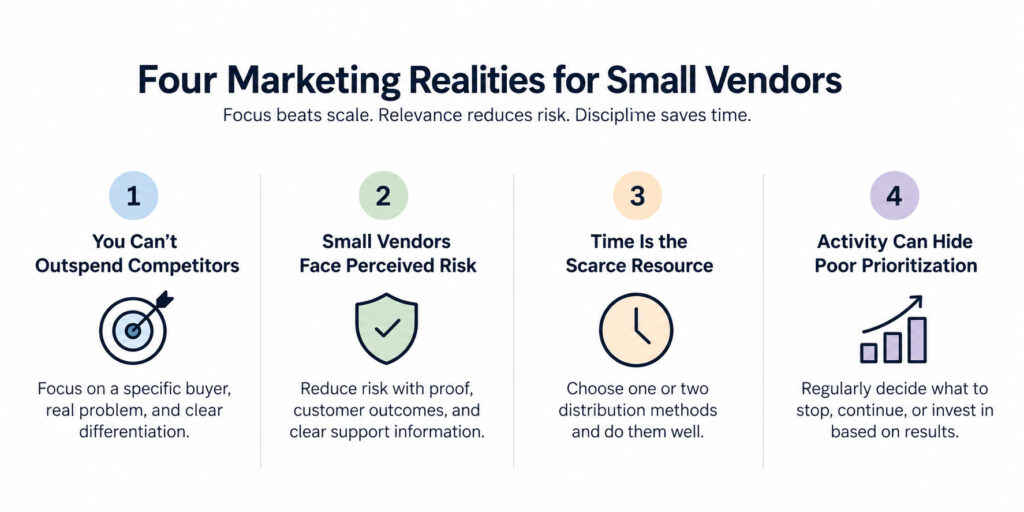
Challenge One: Limited Budget Makes Broad Competition Inefficient
You will not outspend a funded competitor on ads, sponsorships, or paid placements, and trying to is how limited resources disappear fastest. A buyer comparing you to a bigger competitor isn’t asking who spent more on marketing. They’re asking who understands their actual problem.
Practical response: begin with a clearly defined customer type, a painful business problem, a specific use case, and a credible reason the product is meaningfully different for that buyer, the same discipline that underlies real product-market fit for SaaS. “Businesses that need better IT management” is too broad to write anything specific for. “IT teams at growing companies that need to manage employee devices without adding another full-time administrator” gives you an actual person and an actual reason to keep reading.
This isn’t just a nice theory for resource-constrained teams to console themselves with. Research covered in Zylo’s 2026 SaaS trends report, citing McKinsey’s Technology Outlook, points to the same pattern at the market level: “Industry-focused SaaS providers are growing nearly twice as fast as their horizontal counterparts.” — McKinsey, via Zylo’s 2026 SaaS Trends Report
Specificity isn’t a consolation prize for companies that can’t afford to go broad. It’s an actual competitive advantage, and one a resource-constrained company is better positioned to use than a company trying to serve everyone, especially in a market where most B2B SaaS content already sounds the same.
Challenge Two: Small Vendors Face Perceived Risk
A buyer evaluating a small, relatively unknown vendor is really asking a different question than the one they say out loud: if this company struggles or disappears, what happens to what I’ve already built on top of it? That has nothing to do with product quality.
Practical response: create proof and risk-reduction assets instead of vague reassurance, specific customer outcomes instead of generic praise, named customer roles where you have permission, clear upfront information about onboarding and support, transparent limitations stated before a buyer has to ask, and a straight answer to “what happens if something goes wrong?” None of this works by pretending to be larger than you are. It works by making the buying risk easier to understand.
That’s not just an intuition about buyer psychology. TrustRadius’s 2026 B2B Buying Disconnect Report, based on a global survey of 1,862 technology buyers, found that when buyers verify a vendor’s claims, they’re not looking at the vendor’s own materials: “Those citations resolve to customer reviews, independent publications, and peer accounts, not vendor collateral.” — TrustRadius 2026 B2B Buying Disconnect Report, via MarketScale
A small vendor’s own claims will never be the thing that closes the trust gap. Third-party proof is.
Challenge Three: Time Is the Scarce Resource, Not Money
Whoever on your team is doing marketing is almost certainly also doing something else, and every hour spent on one channel is an hour not spent building trust somewhere else.
Practical response: choose only one or two repeatable distribution methods and do them properly, rather than keeping every channel alive at low effort. A cold-email cadence that gets no replies, a social presence that posts without a strategy, a blog that publishes without a plan: none of it is free, even though no money changes hands.
Challenge Four: Activity Can Disguise Poor Prioritization
The hardest part of marketing with limited resources isn’t finding new tactics. It’s having the discipline to stop old ones, especially ones a team has convinced itself are working because they’re active, not because they’re producing anything.
Practical response: run every activity through a stop, continue, or invest decision on a fixed schedule, rather than letting inertia decide. If something has no clear connection to a buying decision, it should be reviewed before more time is invested in it, rather than kept alive by default. Paid ads are the usual answer to a tight budget, and for many early-stage companies they do not pay back. We look at the numbers in are SaaS ads profitable.
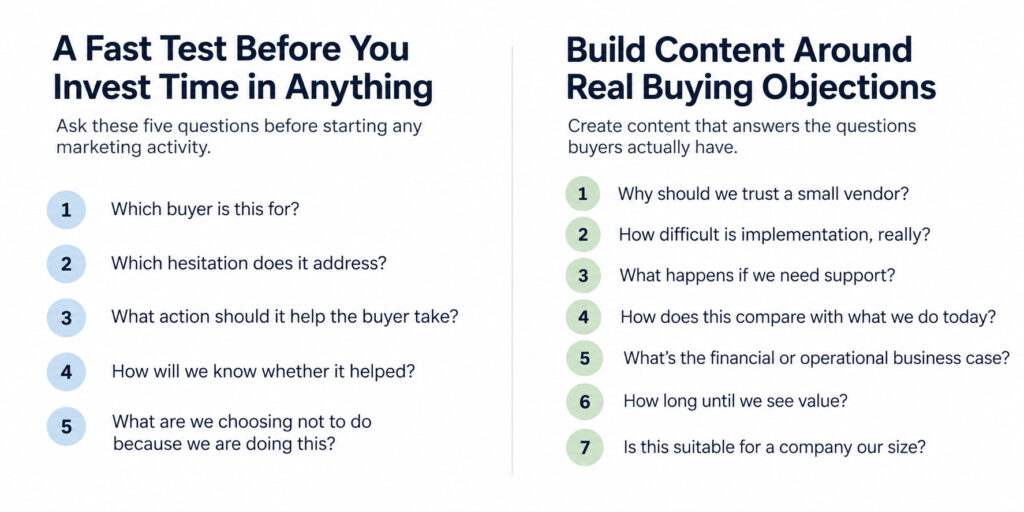
A Fast Test Before You Invest Time in Anything
Before investing time in a marketing activity, ask:
- ➜ Which buyer is this for?
- ➜ Which hesitation does it address?
- ➜ What action should it help the buyer take?
- ➜ How will we know whether it helped?
- ➜ What are we choosing not to do because we are doing this?
That last question is the one most teams skip, and it’s the one that makes resource constraints explicit instead of implicit.
Build Content Around Real Buying Objections
Once you know the audience and the hesitation, build content that answers it directly:
- ➜ Why should we trust a small vendor?
- ➜ How difficult is implementation, really?
- ➜ What happens if we need support?
- ➜ How does this compare with what we do today?
- ➜ What’s the financial or operational business case?
- ➜ How long until we see value?
- ➜ Is this suitable for a company our size?
That’s a sharper brief than “create valuable content,” and it’s the difference between a content calendar and a set of answers a buyer is actually looking for.
Use Customer Conversations as Your Research Channel
Founders without a research budget already have the raw material for great marketing sitting in conversations they’re having anyway: interview existing customers directly, ask sales prospects why they did or didn’t move forward, review support questions for recurring patterns, ask salespeople which objections keep coming up, and turn the customer’s exact language into headlines, FAQs, and landing-page copy.
A small company’s advantage isn’t a bigger budget. It’s proximity to the customer that a larger competitor has lost.
Choosing a Channel: Start Where the Buying Process Already Is
Start with the channel closest to an existing buying process. If customers already find you through search, improve the pages that support their questions. If sales conversations generate most of your opportunities, turn recurring objections into sales assets. If trusted partners already reach your audience, test a focused co-marketing activity. Don’t add a channel merely because another SaaS company uses it.
A Minimum Viable System for Marketing a SaaS Company With Limited Resources
Put together, a resource-constrained SaaS team needs less than it thinks. In practice, that’s:
- ➜ One clearly defined audience and use case
- ➜ One strong conversion destination
- ➜ A small set of objection-focused assets
- ➜ One or two realistic distribution channels
- ➜ A simple measurement routine
- ➜ A regular decision to stop, improve, or expand
That’s a tangible picture of what limited-resource marketing looks like in practice, not a philosophy to aspire to.
Case Study: Reducing Content and Changing the Commercial Model
One of our early-stage IT clients faced all four of the challenges above at once. We wrote the fuller story in this case study; the engagement details beyond what’s below stay under NDA.
Problem | Existing content attracted attention but didn’t help buyers decide |
Decision | Reduce and refocus the content library around real buyer questions |
Signal | Traffic increased, but qualified conversations did not |
Interpretation | Visibility hadn’t resolved the underlying trust problem |
Commercial response | Changed the engagement structure itself, not just the content |
Lesson | Marketing activity has to be evaluated against the buying process, not against traffic |
We’re not claiming that removing most of a website is a general SEO best practice. It isn’t, and it depends entirely on what’s actually on the site. In this specific case, a large share of the existing content was designed around search visibility rather than the questions buyers needed answered before making a purchase, and the team chose to reduce and refocus around a smaller set of pages built for those real questions instead.
That content had accumulated over years without generating meaningful engagement or qualified buyer activity, so the reduction wasn’t a loss of working assets, it was clearing space for ones that could actually work.
A Practical Framework for Marketing a SaaS Company With Limited Resources
The prioritization logic that came out of that engagement is the one I’d hand to any team marketing a SaaS company with limited resources today.
Step 1: Identify the Main Buying Hesitation
Choose the single issue most likely to prevent your ideal customer from moving forward: lack of trust, unclear ROI, implementation complexity, security concerns, poor differentiation, fear of switching, or uncertainty about support.
Step 2: Choose One Asset That Addresses It
Match the specific hesitation to a specific asset, rather than producing generic content and hoping it lands on the right objection:
Buyer Hesitation | Useful Asset |
“Will this work for a company like ours?” | A relevant customer story |
“Is implementation difficult?” | An implementation guide |
“Why should we choose you over the alternative?” | A comparison or alternatives page |
“Can we justify the cost?” | An ROI or business-case explanation |
“Can we trust this vendor?” | Detailed proof, documentation, and transparent company information |
“What happens after purchase?” | An onboarding and support overview |
Step 3: Measure Commercial Signals, Not Just Traffic
Track relevant organic impressions and click-through rate, but weight them behind qualified website visits, demo or consultation requests, sales conversations, qualified opportunities, and customers influenced or acquired, the same logic that should sit behind any real content marketing ROI calculation for SaaS. Traffic shouldn’t be dismissed. It just shouldn’t be treated as the final measure of success.
Step 4: Review and Remove
On a monthly or quarterly rhythm, ask what attracted the right audience, what actually helped a buyer move forward, what generated activity without commercial value, which objections are still unanswered, and what you should stop doing.
How SEO Fits Into Marketing a SaaS Company With Limited Resources
SEO is most worth prioritizing when your target buyers are already searching for the problems, use cases, alternatives, or categories connected to your product. It’s less attractive as an immediate priority when the market doesn’t yet know it has the problem, search demand is minimal, or the site doesn’t have a clear conversion path for the traffic it would earn. Our own SaaS SEO checklist covers the fuller technical picture; the short version relevant here is below.
Where SEO does make sense, a resource-constrained SaaS company generally gets more from a small number of high-intent pages than from a large volume of general ones: product and use-case pages for your highest-value scenarios, a comparison or alternatives page, problem-focused educational content, and implementation or migration guides, all linked together so the site reflects how the topics actually connect. Kept practical, the rest comes down to a short list:
- ➜ Use the language customers actually use, not the language a keyword tool suggests
- ➜ Answer the main question directly and early on the page
- ➜ Include original examples and first-hand experience, not recycled summaries
- ➜ Measure relevant impressions, clicks, and conversions in Search Console
- ➜ Update content when the product, market, or customer objections change
Clear structure and original experience also make content easier for modern search and answer systems to understand, although no structure guarantees rankings or citations.
Remove Hesitation. Don't Manufacture Demand.
Marketing a SaaS company with limited resources isn’t about doing more with less. It’s about being honest that you can’t do everything, and choosing the few things that actually move a buyer from curious to confident.
Start with your last ten sales conversations. Identify the question, concern, or risk that came up most often. Create one useful asset that answers it better than your current website or sales process does. Put that asset in front of the right audience, measure the resulting conversations, and use the evidence to decide what to do next.
If your SaaS company has accumulated content that attracts attention but doesn’t help buyers decide, Market Plus Solutions can help you identify what to keep, what to remove, and what to build next. Honestly speaking, marketing a SaaS company with limited resources is about understanding your customers’ pain points, not competing with your competitors.
Written by Andres Fehrenz
Frequently Asked Questions: Marketing a SaaS Company With Limited Resources
How do you manage limited marketing resources in a SaaS startup?
Pick the one buying hesitation that costs you the most deals, build one asset that addresses it, measure commercial signals and not just traffic, then review and remove what does not help. The four steps above show how, and the same order holds whether you have a team of one or five.
How can a SaaS company market itself with no marketing budget?
Start with customer research, founder-led content, existing customer proof, focused website improvements, partnerships, and referrals, aimed at one realistic distribution channel rather than several at once. The goal is to use time deliberately, not to attempt every free tactic available.
What is the best marketing channel for a small SaaS company?
There is no universal best channel. Start with whichever one is closest to your existing buying process: search if buyers are already researching the problem, sales enablement if conversations already drive most opportunities, or partnerships if a trusted partner already reaches your target audience.
How much content should a small SaaS company create?
Only as much as is needed to answer important buyer questions, support a buying decision, or strengthen a specific business goal. A small number of genuinely useful assets is more manageable, and usually more effective, than a large publishing schedule.
Should a small SaaS company invest in SEO?
Yes, when the target audience already searches for the problems, use cases, alternatives, or categories connected to the product. Start with a small number of high-intent pages and measure qualified outcomes, not rankings or traffic alone.
Ready to Market a SaaS Company With Limited Resources the Right Way?
No flat retainers required to start. If your marketing budget is tight, tell us where it's tightest, and we'll show you where to focus first.