

SaaS & IT Content Marketing
How to Measure SaaS Content Marketing (Before You Buy a Dashboard)
Ask a SaaS marketing team how they measure content marketing, and most will open Google Analytics and point at a traffic graph going up and to the right. Now, ask them a harder question, the one that actually matters, and the room goes quiet: which piece of content touched your last closed deal?
So how do you measure SaaS content marketing without lying to yourself with a traffic graph?
You start by admitting how much of the buyer’s actual research you’ll never see. 6sense’s 2024 buyer research study, based on a survey of more than 900 B2B buyers who’d made a purchase over $10,000 in the prior two years, found buyers spend roughly 70% of their buying journey doing independent research before they ever talk to a vendor. Most of that research, including the content that shapes it, happens with no tracking pixel in sight, which is also why so much of it now happens inside a chatbot instead of a search bar you could at least see in your referral traffic. Any measurement system that only starts counting once a form is filled is already missing most of the story.
If you can’t answer that in under ten seconds, you don’t have a measurement problem yet. You have a tracking-discipline problem, and no dashboard fixes that until it’s solved first. That’s the gap most guides on how to measure SaaS content marketing skip past on their way to a metrics checklist.
Here’s the direct answer.
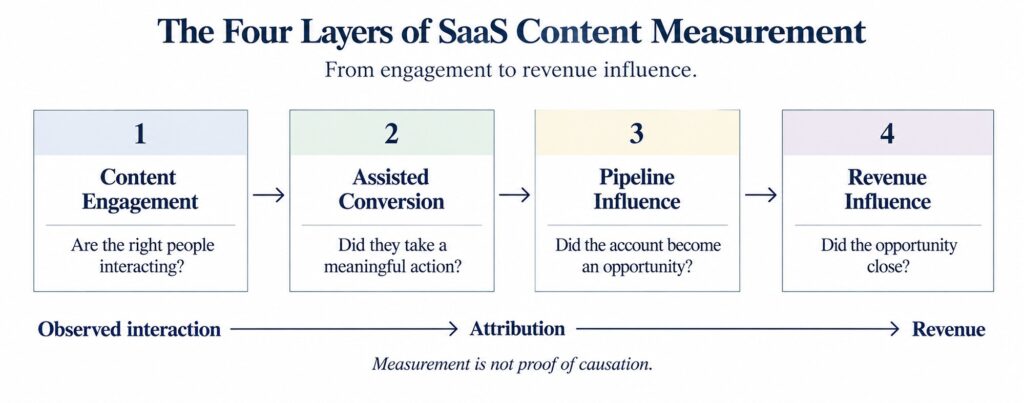
SaaS content marketing measurement means tracking how content contributes to the buyer journey, from discovery and engagement through conversion, pipeline and revenue, while keeping the limits of attribution explicit.
Engagement → conversion → pipeline influence → revenue influence.
Traffic and pageviews tell you reach. They don’t tell you whether a buyer moved because of what you published, and reach is the easiest number to report precisely because it’s the least connected to whether the content did its job.
Before you build a dashboard, answer these four questions
➜ Can you name the last piece of content that touched a closed deal?
➜ Do you know which of your last five articles led to zero pipeline contact, not just zero traffic?
➜ If a stakeholder asked “what did content produce last quarter,” could you answer in revenue terms, not just page views?
➜ Does your sales team know which content exists well enough to send it themselves?
If you can’t answer two or more of these, the fix isn’t more tracking software. It’s the minimum-viable system further down this page.
What Most SaaS Teams Actually Measure (and Where It Falls Short)
Content Marketing Institute’s 2026 B2B Content Marketing Trends research surveyed 1,015 B2B marketers between June and August 2025, and asked exactly the question this article opened with: how do you measure whether your content is working? The research doesn’t isolate SaaS companies specifically, so treat these figures as directional rather than SaaS-only benchmarks. But they’re still the clearest available picture of how B2B teams, SaaS included, actually measure content versus how they’d describe it in a strategy deck.
The answers split cleanly, and the split explains the problem:
➜ 80% measure audience engagement — views, downloads, shares
➜ 63% measure business impact — leads, pipeline influence
➜ 40% measure audience feedback — client or prospect sentiment
➜ 38% measure brand authority — speaking invitations, media citations
A note on the data: the CMI survey covers B2B marketers broadly, not a SaaS-specific sample, so read these as directional patterns rather than SaaS benchmarks.
We’ve built this chain by hand, on a real account, without a dollar of paid ad spend to buy me shortcuts. When we worked with the device-management client behind our SaaS Buyers Trust case study, the only way to know content was working was to trace it manually: which webinar attendee had read which article, which follow-up conversation referenced which piece, which of those turned into a paying account. There was no dashboard doing that for us. There was a spreadsheet and a weekly conversation with the person doing sales. That’s not a limitation of small teams. It’s the actual mechanism underneath every attribution platform’s dashboard, just visible instead of hidden behind a UI.
The gap between the top two numbers is the whole article.
Almost everyone tracks what’s easy to pull from an analytics dashboard in thirty seconds. Fewer than two-thirds trace the thing a CFO actually asks about: did this content touch a deal.
And the same research found that among pacesetters — the highest-performing teams in the survey — business-impact tracking jumps to 75%, and brand-authority tracking to 51%. The best teams aren’t running more measurement. They’re running different measurement, weighted toward outcomes instead of attention. 33% of B2B marketers cite “measuring content effectiveness” as one of their top three content marketing challenges — Content Marketing Institute, B2B Content & Marketing Trends: Insights for 2026
This isn’t a knowledge gap. Every marketer in that survey knows what pipeline influence is. It’s a system gap: most teams have never built the plumbing that connects a blog post to a CRM record, so they default to the metric that doesn’t require plumbing. Demand-gen analyst Chris Walker has made a similar argument for years: B2B teams tend to over-invest in whatever channel is easiest to measure, like paid search and direct conversions, and under-invest in the channels, like content and community, that actually shape a buyer’s decision but leave a weaker paper trail. Easy-to-measure and important-to-measure are not the same list, and most reporting decks quietly treat them as if they were.
The Four Layers of SaaS Content Measurement
If you’re figuring out how to measure SaaS content marketing from scratch, or rebuilding a system that’s currently just a traffic report, these are the four layers, in order of how directly they connect to revenue. They’re not a prediction model, they’re a measurement hierarchy: each layer is harder to build than the one before it, and cheap-to-track doesn’t mean unimportant.
1. Content Engagement
Did the right audience engage with the content? This layer includes organic clicks, engaged sessions, scroll depth, return visits, internal link clicks, and known-contact content interactions where you have them. This is the cheapest layer to measure and the one almost every team already has, whether or not it’s connected to anything downstream.
2. Content-Assisted Conversion
Did someone who engaged with the content subsequently convert, such as a demo request, trial signup, or contact form submission, within a reasonable window? This is where most teams stop, and it’s a real step forward from engagement alone. But a conversion following a content touch still isn’t proof the content mattered. It’s proof the content was present.
3. Pipeline Influence
Did that contact or account become a qualified opportunity your sales team actually worked? This is the layer our own SaaS content marketing ROI breakdown goes into in more depth, including the honest limits of what any attribution model can claim with certainty.
4. Revenue Influence
Did the opportunity close, and can you trace which content the account engaged with along the way? This is the number a CFO respects, and it’s also the hardest to build cleanly with a small team’s tooling. That’s fine. You don’t need to reach layer four to have a real measurement system. You need to stop pretending layer one is layer four.
Measurement is not proof of causation
If an opportunity engaged with three articles before becoming an opportunity, you can honestly report that those articles were associated with, or influenced, the opportunity under your chosen attribution model. You cannot honestly claim that any single article caused the deal unless you have evidence that actually supports that conclusion. A buyer who read five of your articles may also have spoken to sales, sat in a webinar, and taken a recommendation from a colleague before buying. Content measurement should distinguish observed interaction from attribution, and attribution from causation, rather than quietly collapsing all three into one number.
This is also why so much B2B content ends up generic: when a team can’t trace which specific article moved a specific deal, they can’t tell which topics or angles are actually earning attention, and they end up guessing. We wrote about that pattern separately in why B2B SaaS content sounds the same. Weak measurement and generic content are usually the same underlying problem wearing two different names.
How to Calculate the Numbers That Matter
Knowing what to measure isn’t the same as knowing how to calculate it. Three formulas cover most of what a SaaS content team needs, each with the honest caveat attached:
Content-to-lead conversion rate
Content-influenced leads ÷ unique relevant visitors × 100
Example: 800 relevant visitors to an article produce 16 demo, trial, or contact-form conversions from named contacts. That’s a 2% content-to-lead conversion rate for that piece.
Content-influenced pipeline
Add up the value of every opportunity that had a recorded content interaction under your attribution window. If 10 opportunities interacted with your content, averaging €20,000 each, that’s €200,000 of content-influenced pipeline.
This does not mean the content generated €200,000 of pipeline. It means €200,000 of pipeline had a recorded content interaction under your chosen attribution model. Say it that way, not the shorter, more impressive-sounding way.
Content ROI
(Content-attributed gross profit − content cost) ÷ content cost × 100
This formula looks simple. The hard part is the numerator, because “content-attributed gross profit” depends entirely on the attribution model you chose in the pipeline-influence step above, and different models produce different answers from the same underlying data. If this is where your team gets stuck, that’s usually the point at which it’s worth talking to a SaaS content marketing agency that builds the tracking, not just the content.
Example: How a Small SaaS Team Could Measure One Article
This is an illustrative example to show the mechanics, not a Market Plus client result.
A SaaS company publishes an article called “How to Reduce SaaS Customer Churn.” Over the next 90 days:
➜ 1,200 organic visits (engagement)
➜ 94 engaged visitors click through to a product page (engagement)
➜ 18 people request a demo (assisted conversion)
➜ 7 become qualified opportunities (pipeline influence)
➜ 2 deals close, totalling €24,000 in new ARR (revenue influence)
This doesn’t prove the article created €24,000 in ARR. It shows the article was part of the recorded buying journey for those two deals, at four different levels of the funnel, each with a different confidence level attached.
How to Measure SaaS Content Marketing Without Expensive Software
If your team is small, and most SaaS marketing teams are, you don’t need an attribution platform to fix this. We covered the resourcing reality behind that in Marketing a SaaS Company With Limited Resources, and the same principle applies here: build the smallest system that produces a trustworthy answer, not the most complete one.
➜ Tag every content page in your CRM or marketing automation tool so a visit is logged against a known contact, not just an anonymous session.
➜ Ask sales one question in every deal-review call: “did this account read anything of ours before they booked a call?” Log the answer, even informally, for 90 days before you build any dashboard.
➜ Choose a conversion window deliberately and apply it consistently. 30 days can be a practical starting point for shorter SaaS buying cycles, but there’s no universal SaaS attribution window; enterprise or longer-cycle deals may need 60 to 90 days. The number matters less than picking one and sticking to it, so month-over-month comparisons mean something.
➜ Report business impact and audience engagement side by side, not business impact instead of engagement. Engagement tells you what’s getting attention; impact tells you what’s getting deals. You need both to know where to invest next.
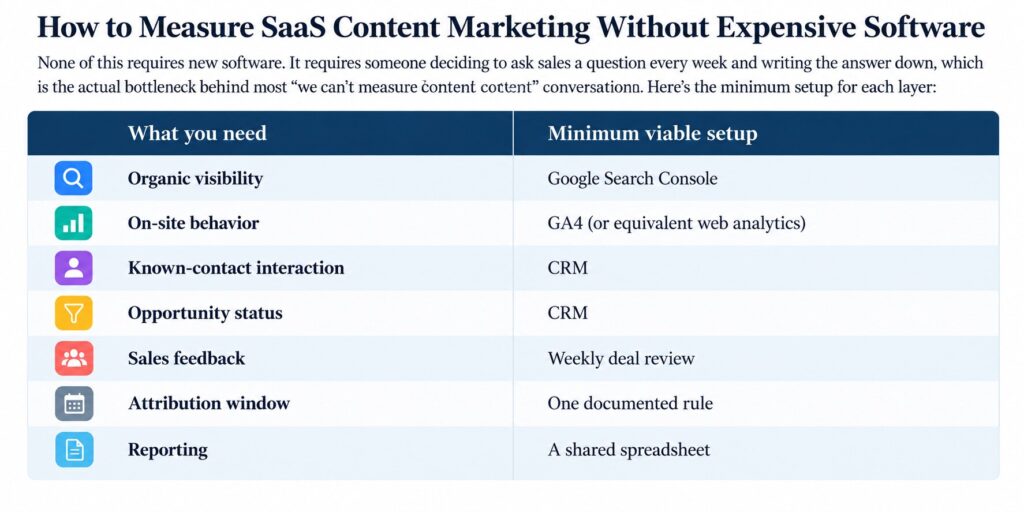
None of this requires new software. It requires someone deciding to ask sales a question every week and writing the answer down, which is the actual bottleneck behind most “we can’t measure content” conversations. In table form, here’s the minimum tool for each layer:
What you need | Minimum viable solution |
Organic visibility | Google Search Console |
On-site behavior | GA4 (or equivalent web analytics) |
Known-contact interaction | CRM |
Opportunity status | CRM |
Sales feedback | Weekly deal review |
Attribution window | One documented rule |
Reporting | A shared spreadsheet |
This is close to what we found writing about why B2B SaaS buyers decide before they visit your website: content’s job increasingly happens before a form is ever filled. If your measurement system only starts counting at the form, you’re missing the part of the journey where content is doing the most work.
FAQ: How to Measure SaaS Content Marketing
What is SaaS content marketing measurement?
SaaS content marketing measurement is the practice of tracking how a piece of content contributes to a buyer’s path toward a purchase decision, from engagement through to revenue, while being explicit about what each layer can and can’t prove. It answers two separate questions: what content is getting attention, and what content is getting deals.
Do I need to know how to measure SaaS content marketing before I scale content production?
Yes, ideally before, or at least alongside. Publishing more without a way to measure what’s working is how teams end up with the exact problem we cover in marketing a SaaS company with limited resources: a growing content library and no clear read on which pieces are worth the time to keep producing.
How do you measure SaaS content marketing with a small team?
Start with two metrics: content-to-lead conversion (did a specific piece of content precede a form fill or demo request from a named contact) and sales-cited influence (does your sales team mention this content in deal notes or calls). Both are achievable without dedicated attribution software.
Is website traffic a bad metric for content marketing?
Not bad, incomplete. Traffic tells you reach and topic relevance, which matters for planning what to write next. It tells you nothing about whether a buyer moved closer to a decision, which is why it can’t be your only metric.
How long should a content attribution window be for B2B SaaS?
There’s no universal SaaS attribution window. 30 days is a workable starting point for shorter buying cycles; longer or enterprise-oriented cycles may need 60 to 90 days. Choosing a window deliberately and applying it consistently matters more than which specific number you pick.
Do we need marketing attribution software to measure content marketing?
No. A CRM field that logs which content a contact engaged with, combined with a weekly sales conversation, covers most of what a small team needs. Attribution software becomes worth the cost once you’re tracing revenue across many concurrent campaigns, not before.
What's the difference between content ROI and content measurement?
Measurement is the ongoing practice of tracking content’s effect on pipeline. ROI is a specific calculation, cost against return, usually done periodically to justify budget. You need measurement running continuously to ever calculate ROI honestly. We go deeper on the ROI side specifically in our SaaS content marketing ROI piece.
Can't Answer What Your Content Produced Last Quarter?
Market Plus helps small SaaS and IT teams build a measurement system that connects content engagement to leads, pipeline, and revenue, without starting with an enterprise attribution platform. Build your measurement framework.