
SaaS & IT Content Marketing
IT Content Marketing vs SaaS Content Marketing
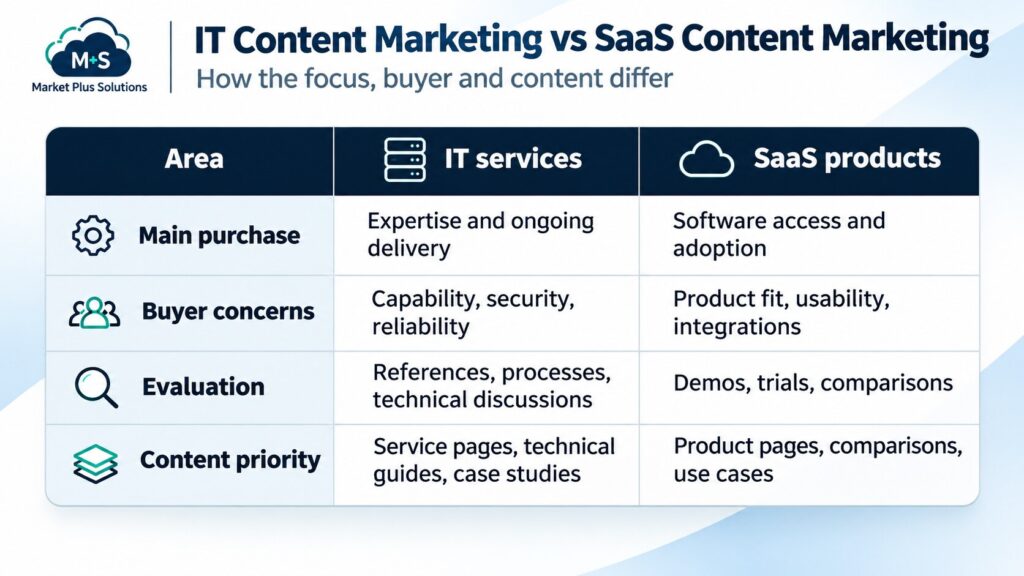
IT content marketing and SaaS content marketing share the same foundations, but they differ in what buyers need to understand before they buy. Buyers of IT services typically need evidence of technical competence, delivery capability and ongoing reliability. Software buyers typically need to understand product fit, workflows, implementation and adoption.
The line is not sharp. Many SaaS companies are IT companies, and a complex software purchase can involve the same technical and procurement reviews as an IT service. In this article, IT companies means providers that sell expertise, implementation, infrastructure or ongoing support, such as managed service providers and security firms. SaaS companies sell a software product by subscription. Your content should reflect what you sell and how your customers actually decide.
Area | IT services | SaaS products |
Main purchase | Expertise and ongoing delivery | Software access and adoption |
Buyer concerns | Capability, security, reliability | Product fit, usability, integrations |
Evaluation | References, processes, technical discussions | Demos, trials, comparisons |
Content priority | Service pages, technical guides, case studies | Product pages, comparisons, use cases |
These are typical patterns, not fixed rules.
Who Is Buying in IT Content Marketing and SaaS
When a company buys IT services, several people usually take part, and each wants something different. A technical evaluator checks whether the provider can do the work. The person who will live with the service day to day asks how it runs. A budget holder asks whether it is worth the cost, and procurement or compliance reviewers ask whether it meets their rules. Content that speaks to only one of them leaves the others without an answer.
Software buyers vary more. In some deals a team lead or end user tries the product and recommends it, and a budget owner approves. In larger deals the process can look much like buying a service. Which pattern applies depends on the product and the buyer, so find out how your own customers actually buy before you plan the content. For software specifically, why SaaS buyers decide before they visit your website covers why buyers often form a view before the first conversation.
How the Buying Decision Shapes Your Content
Buying a service is closer to choosing a partner than choosing a feature set. The buyer may ask for references, review security and process documents, and read contract terms before agreeing to anything. Content has to survive being forwarded to someone who was not in the first conversation, so it needs to make sense on its own.
Software evaluation often runs through demos, trials and comparisons, so content that explains how the product fits a workflow does more work. Smaller SaaS teams cannot cover every stage, so marketing a SaaS company with limited resources looks at what to prioritise first. This article gives no average sales-cycle lengths, because they vary too much by deal size and category to be useful.
What Counts as Proof in IT Content Marketing
This is where the two differ most. The examples below are illustrations, not universal rules.
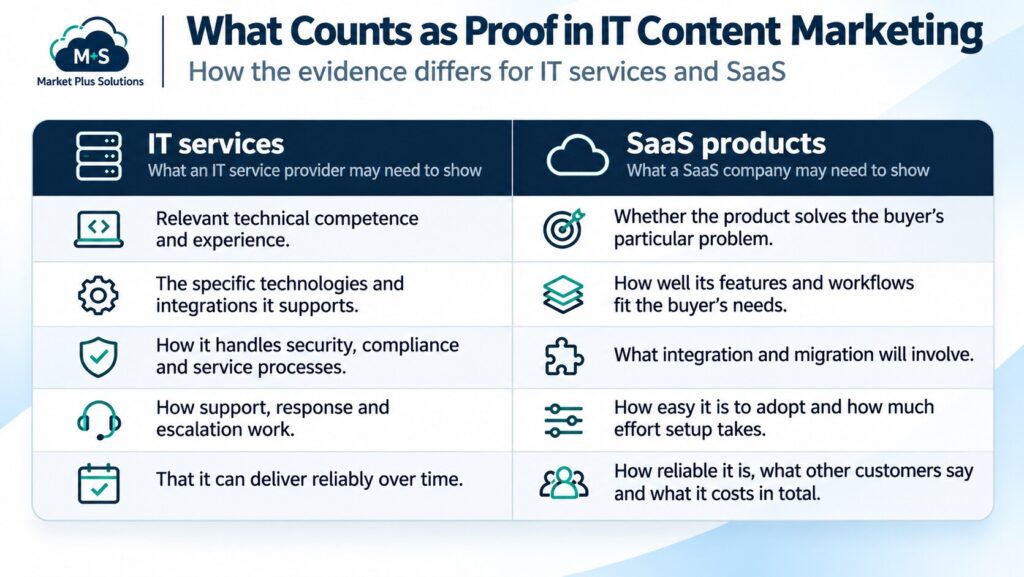
What an IT service provider may need to show
- Relevant technical competence and experience.
- The specific technologies and integrations it supports.
- How it handles security, compliance and service processes.
- How support, response and escalation work.
- That it can deliver reliably over time.
What a SaaS company may need to show
- Whether the product solves the buyer’s particular problem.
- How well its features and workflows fit the buyer’s needs.
- What integration and migration will involve.
- How easy it is to adopt and how much effort setup takes.
- How reliable it is, what other customers say and what it costs in total.
The two lists overlap. A cybersecurity SaaS vendor, for example, may need to show much of the same technical and compliance evidence as an IT services provider. Use the lists as a starting point, not a sorting rule.
In both cases, specific beats broad. Say what you support and what you do not. A technically accurate page is not automatically a useful one. An IT company can describe its infrastructure, security tools and service processes in detail and still not answer the buyer’s real question: what will this provider take responsibility for, and what happens if something goes wrong?
Recognised standards give buyers a shared reference. ISO/IEC 27001 sets out requirements for managing information security, and the NIST Cybersecurity Framework is guidance for reducing cybersecurity risk. Naming the standards you follow, and being clear about the ones you do not, is part of honest proof. Never imply a certification you do not hold.
Pages that compare options fairly, such as a comparison page for IT software, help a buyer evaluate. For the formats that suit technical readers, see our guide to B2B IT content marketing. Technical evaluators also tend to search for specifics, such as a named technology or a compliance requirement, not a general category, which SEO for small IT companies covers.
Whatever you publish, check whether it is working. How to measure SaaS content marketing explains what to track beyond traffic.
What Stays the Same in IT and SaaS Content Marketing
Some things do not change. Buyers in both groups research before they contact a vendor. 6sense’s 2024 Buyer Experience Report found that B2B buyers are nearly 70% through their purchasing process before engaging with sellers, though it describes B2B buying in general, not IT or SaaS specifically.
Both groups benefit from pages that say plainly what the company does and for whom, which is also the direction of Google’s guidance on creating helpful, reliable, people-first content.
The same applies to AI-assisted discovery. IT and SaaS buyers may ask an assistant to explain a problem, compare providers or build a shortlist before they visit any site. Google’s own guidance on AI features in Search says special markup, llms.txt files or rewriting content for AI are not needed for Google Search, so the practical work is the same: clear, accurate pages and consistent descriptions. Our guide to why a B2B SaaS company is not showing up in ChatGPT explains how to test what assistants say about your company, and the same testing approach applies to IT service providers. SaaS AI brand reputation covers how to correct what you find, and SEO vs GEO for decision-makers explains how the two disciplines relate.
IT Content Marketing in Practice: A Software Company That Sells to MSPs
One account sits between the two categories: a small B2B software company that sells to managed service providers. Our inbound leads case study describes the work in order, and our work for IT companies is described on the IT content marketing agency page.
Treat the case study as one example, not a rule. It is a single account and the engagement is ongoing, so it is work in progress. It cannot show that any one step caused the change, because several overlapped, and it has no reliable figures for conversions, revenue or return on investment. It also cannot show that another company would follow the same path. What it can show is the sequence of work and what was observed along the way.
Which Content Marketing Approach Fits Your Company
If you sell IT services, start with the proof a technical evaluator will ask for, and see how IT content marketing works at Market Plus Solutions. If you sell a software product, start with how it fits the buyer’s workflow, and see our SaaS content marketing agency page. If you are a DACH company publishing in English, SaaS content marketing services in Germany covers what to consider. If you are deciding how to buy ongoing content support, is a content marketing retainer worth it for SaaS startups explains how to decide. Whichever market you serve, content works best when it answers what buyers need to establish before they trust a provider or choose a product.
FAQ: IT Content Marketing vs SaaS Content Marketing
What is the main difference between IT content marketing and SaaS content marketing?
What buyers need to understand before they buy. IT service buyers typically want evidence of technical competence, delivery and reliability. Software buyers typically want to know whether the product fits their workflow. The foundations, clear pages and honest information, are shared.
Can one content strategy work for both IT and SaaS companies?
Parts of it can. The foundations carry over, but the topics, the formats and the proof differ, so a single plan usually needs adjusting for each. Start by finding out what your buyers ask before they speak to you.
Why is proof different in IT content marketing?
A service is delivered over time by people, so a buyer is judging whether they can rely on the provider as well as what it offers. That is why technical competence, security and support processes tend to matter more.
Where should an IT company start with content marketing?
With the pages that state what you do, for whom, and the proof a technical evaluator will look for. Then check how your company is described in search and in AI assistants.
Want an Outside View of Your Content?
Send us three pages from your site, such as your homepage, a service or product page and one article. We will read them the way your buyer would and tell you, in writing, what a technical evaluator or a budget holder would still be missing.