

Digital Marketing for Small Business
Why Small SaaS Teams Need Different Keywords
Which should a SaaS company target first, zero volume keywords or low competition keywords? Most small SaaS teams need both, for different jobs.
Low competition keywords are terms you can realistically rank for now. Zero volume keywords are phrases that keyword tools show as having no searches, even though real buyers use them. This guide explains the difference, how to find each type and how to choose between them.
Whether you are scaling an established platform or introducing a new product, securing visibility on search engines without leaning heavily on paid ads is vital. Yet, achieving high rankings is rarely straightforward.
Keyword research often feels like navigating a shifting landscape. It demands time, precision, and continuous adjustments. Even then, SEO outcomes are never guaranteed.
As part of a robust SEO approach, two keyword strategies have gained traction—Zero Volume keywords and Low Competition Keywords.
We’ve previously explored SaaS zero volume keyword strategy in detail (Zero Volume Keywords: SEO for Small Businesses and Zero Search Volume Keywords: A SaaS SEO). These hyper-specific terms, while often absent in search volume tools, can attract highly qualified leads, especially for niche SaaS offerings.
On the other hand, low competition SaaS keywords offer a different path. These terms have measurable search volume but face less competition, making them more accessible for small SaaS companies with limited resources.
The real question for SaaS startups and small teams is: Which approach drives sustainable growth?
Understanding the strengths and limitations of zero volume keywords and low competition keywords is key to developing a SaaS SEO strategy that supports long-term success. Let’s break it down:

Long tail keywords, which are often less competitive, account for approximately 70% of all search traffic (explodingtopics).
What Are Low Competition Keywords?
Low competition keywords are search terms where the pages already ranking are relatively weak, so a newer site has a fair chance of reaching the first page. Tools express this as a keyword difficulty score, which is an estimate often based mainly on how many sites link to the pages in the results.
Two cautions apply. A low score does not mean a high-value keyword, so check that the searcher would plausibly buy. And the score is only an estimate, so open the results page and look at who actually ranks.
Why Do Low Competition Keywords Matter for SaaS SEO?
Low competition SaaS keywords are a practical starting point for small SaaS businesses. These niche SaaS keywords offer a way to gain online visibility without the uphill battle of competing against larger brands with bigger budgets and stronger domain authority.
Take, for example, the keyword “CRM software.” Competing for this broad term is difficult for most startups because industry giants dominate the top search results. Instead, targeting a more specific, long-tail query like “collaborative CRM software for remote teams” gives small SaaS startups a better chance to reach potential customers searching for exactly that solution.
Low competition SaaS keywords also often have high purchase intent, which increases the likelihood of conversions. Beyond driving relevant traffic, low competition keywords support broader SaaS SEO goals:
- Quick Wins: Small SaaS teams can secure rankings faster, boosting confidence and building momentum.
- Domain Authority: Ranking for easier terms helps build credibility with search engines, gradually improving your overall site authority.
- Sustainable Growth: These keywords lay the groundwork for expanding into more competitive search terms later.
While some startups manage this process independently, others work with the best SaaS SEO agency to fast-track their results. Regardless of your approach, low competition SaaS keywords form the foundation of a search strategy that drives sustainable growth.

Targeting low competition keywords is not just theory. Businesses focusing on these terms have reported a 338% increase in organic traffic within a year and a 166% increase in page-one rankings (blurredbylines).
What Are Zero Volume Keywords?
Zero volume keywords are phrases that keyword tools report as having no monthly searches. That is not proof that nobody searches them. Tools work from limited data, and new or very specific phrasings usually show a zero first.
For SaaS, these are often the most useful queries: specific questions from buyers who already know what they need. Few competitors write for them because the tools say there is nothing to win.
But this can be misleading. It doesn’t mean no one is searching for them. It simply means the demand is so niche or new that it hasn’t been picked up by traditional SEO tools yet.
For small SaaS businesses, this presents a hidden opportunity.
These keywords often reveal specific pain points, emerging trends, or hyper-targeted product needs—the kind of searches made by decision-makers when no clear solution is available.
Think of a startup offering an API testing platform. Competing for a broad term like “API testing software” would pit them against industry giants. Instead, targeting a phrase like “API testing platform for microservices startups”—which tools might report as zero search volume—could match exactly what a CTO at a growing startup is typing into Google.
Why Should SaaS Businesses Care About Zero Volume Keywords?
Because they deliver results where it matters most—qualified leads and faster growth.
Users who type highly specific search queries often know exactly what they need. They are decision-makers actively seeking a solution, not casual browsers. Capturing even a handful of these high-intent visitors can drive real revenue for small SaaS businesses.
Zero volume SaaS keywords also offer a first-mover advantage. These queries often emerge before broader trends appear in search tools. By ranking early, small SaaS businesses can establish authority in their niche before competitors catch on.
There’s another benefit, many zero volume SaaS keywords face little to no SEO resistance, allowing smaller businesses to secure top positions faster. This reduces reliance on paid ads and builds organic visibility efficiently.
Ignoring zero volume keywords means risking missed opportunities. That next high-value client might be searching right now—and if you’re not there, a competitor will be.
Between 16% and 20% of all queries entered into Google each day are new searches, underscoring the potential of zero volume keywords to capture emerging trends.
Zero Volume Keywords vs. Low Competition: Key Differences
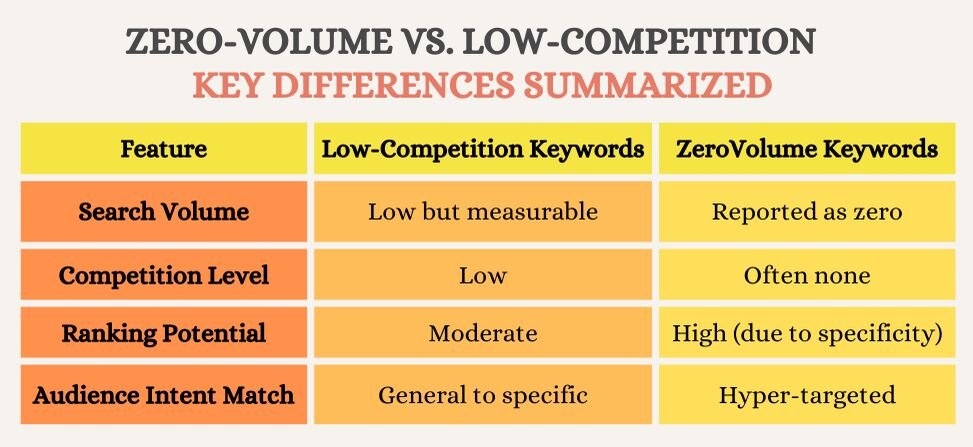
Both zero volume keywords and low competition keywords can drive valuable traffic to your SaaS website. But they work differently. Knowing when to prioritize each can shape your SEO success—whether you’re seeking quick wins or positioning for long-term growth.
On one hand, zero volume SaaS keywords help you tap into emerging demand and niche pain points before competitors catch on.
On the other hand, low competition SaaS keywords help you capture existing search traffic more quickly, often with lower SEO effort.
Combining both zero volume keywords and low competition keywords can create a balanced SaaS SEO strategy—securing immediate visibility while building topical authority for future growth. The chart below breaks down the key differences so you can decide when and how to use each:
| Low competition keywords | Zero volume keywords | |
|---|---|---|
| What they are | Terms with weaker pages ranking | Phrases tools show with no searches |
| How you find them | Keyword tools and difficulty scores | Your own conversations and data |
| Main risk | Low difficulty, but also low buyer value | No data to confirm demand |
| Best use | Topics you can rank for soon | Specific questions that match real buyers |
When to Focus on Zero Volume and Low Competition Keywords
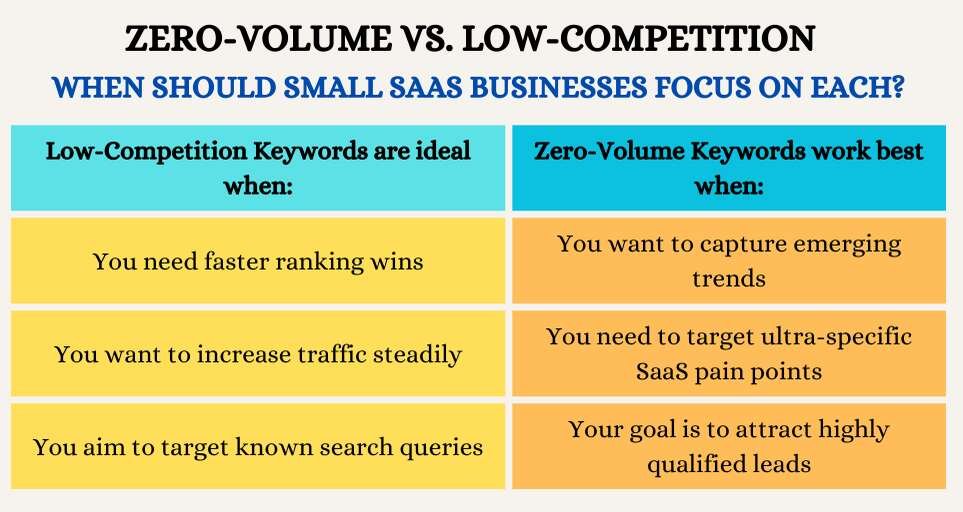
Choosing the right keyword approach can determine whether your SaaS content consistently attracts qualified traffic—or struggles to gain traction. Both low competition keywords and zero volume keywords can drive results, but knowing when to prioritize each is key to scaling organic growth.
Your business stage, target audience, and SEO goals should guide this choice. Sometimes, quick wins with low competition keywords make sense; other times, zero volume keywords open doors to emerging demand before others catch on.
The chart below helps you decide when each approach is most effective for your SaaS SEO strategy:
Why SaaS Businesses Need Both Zero Volume and Low Competition Keywords
Successful SaaS SEO isn’t about choosing low competition keywords or zero volume keywords. It’s about leveraging both to create a search strategy that drives traffic today while securing long-term growth.
Low competition SaaS keywords offer steady search visibility, while zero volume keywords help you capture unmet demand early.
Together, these two strategies work as a system.
They build authority, satisfy existing search demand, and open doors to future opportunities—ensuring your SEO strategy can adapt and thrive as your industry evolves.
How to Balance Both for SaaS SEO Growth
Combining low competition keywords and zero volume keywords is how small SaaS businesses build sustainable organic growth:
- Start with low competition SaaS keywords to secure foundational traffic and gain quick visibility.
- Layer in zero volume keywords for niche content that speaks to specific pain points and emerging needs.
- Track performance closely—identify the keywords bringing in qualified leads, and double down on what works.
- Optimize your content with LSI keywords to strengthen topical authority and improve overall search relevance.
This balanced approach keeps your SEO efforts agile, allowing you to meet current search demand while staking your claim on future opportunities.
How to Find Low Competition SaaS Keywords
Identifying low competition SaaS keywords can help small SaaS businesses gain organic traffic without the struggle of competing against well-established brands. For SaaS startups, this means focusing on search terms that align closely with product features, user needs, and specific use cases—while avoiding broad, highly competitive terms.
Here are practical steps to find low competition SaaS keywords suitable for SaaS businesses:
- Use Keyword Research Tools with Context: Platforms like Ahrefs, SEMrush, and Ubersuggest provide data on search volume and keyword difficulty. Look for terms with low difficulty that relate directly to your SaaS product, features, or customer pain points.
- Prioritize Long-Tail SEO for SaaS Startups: Longer, more specific search phrases, such as “CRM software for remote teams,” often signal user intent and face less competition. These queries may attract fewer visitors but are more likely to bring in decision-makers who are ready to engage.
- Analyze Competitors for Gaps: Review the content and keyword strategies of other SaaS companies targeting a similar audience. Look for areas where they are not covering user needs in detail, or where their content is outdated. Providing better information can improve your chances of ranking.
- Evaluate Search Results for Weak Content: Search your target terms and assess the quality of the top-ranking content. If you see outdated blog posts, forum threads, or thin content, it can indicate an opportunity to publish better, more authoritative content that addresses the query thoroughly.
- Focus on Content Depth and User Needs: Even if a keyword appears competitive, content that is more detailed and better aligned with user needs can often rank well. Publishing clear, well-researched content that directly addresses user pain points can outperform weaker competitors.
Focusing on low competition SaaS keywords allows small SaaS teams to increase their search visibility, attract qualified leads, and reduce reliance on paid ads as they build domain authority.


How to Identify Zero Volume Keywords
Zero volume SaaS keywords often capture emerging needs and niche pain points that traditional keyword tools overlook. For SaaS businesses, these search terms can surface highly qualified leads—from decision-makers seeking specific solutions that aren’t yet reflected in search volume data.
Here’s how to spot these opportunities:
- Listen to Customer Conversations: Sales calls, support tickets, and product demos often reveal patterns in the language your customers use. Take note of recurring questions or pain points, as these phrases frequently align with search queries that SEO tools miss.
- Engage with SaaS Communities: Platforms like Reddit, Indie Hackers, Quora, and SaaS-specific forums often highlight concerns, comparisons, or feature gaps. These real-world discussions can lead to content ideas addressing queries that haven’t yet appeared in keyword tools.
- Monitor Product and Industry Trends: New technologies, competitor updates, or regulatory changes often trigger new search behaviors. Staying ahead of industry developments allows you to create content that aligns with future search demand.
- Rely on Your Product Expertise: As a SaaS founder, marketer, or product specialist, you often spot gaps before they appear in search data. Trust your understanding of the product and user journey—create content addressing known challenges, even if tools report zero search volume.
- Analyze Internal Search Queries: If your SaaS website has a search function, review what users type in. These queries often reveal product-related concerns or feature gaps, providing keyword insights that external tools overlook.
SaaS SEO: Common Mistakes to Avoid
Combining low competition SaaS keywords and zero volume keywords can strengthen your SaaS SEO strategy, but common missteps can undermine results. Here’s what to watch for:
- Focusing Solely on Search Volume: Chasing high-volume terms like “CRM software” often leads SaaS startups into highly competitive spaces, where larger brands dominate. Overlooking low competition SaaS keywords and zero volume SaaS keywords can cause you to miss out on high-intent searchers seeking niche solutions.
- Ignoring Search Intent: Ranking is not success—relevance is. If the keyword drives traffic but doesn’t match your product’s capabilities or your audience’s needs, visitors won’t convert. For every keyword, ask whether the content directly answers the query and aligns with your SaaS offering.
- Neglecting Performance Tracking: SEO requires ongoing validation. Publishing content is only the start—monitor rankings, traffic quality, and lead conversions. Assess which keywords attract qualified visitors, then adjust your approach based on performance data. This ensures your SaaS SEO efforts stay focused on growth, not vanity metrics.
Conclusion: Final Thoughts
There is no universal best approach. The real strength lies in understanding when to apply each strategy. For small SaaS and IT businesses, combining low competition keywords and zero volume SaaS keywords is often the difference between struggling for visibility and building a search presence that drives business growth.
Low competition SaaS keywords provide a steady stream of organic traffic and help establish search authority. Zero volume keywords uncover emerging opportunities and connect you with decision-makers actively seeking solutions. Together, they form the foundation of a future-proof SEO strategy.
Successful SaaS SEO is not about quick wins—it is a long-term investment. It requires patience, experimentation, and a deep understanding of your audience’s pain points. Businesses that commit to data-driven keyword research while listening to their customers are the ones that consistently attract not just traffic, but high-intent visitors who convert into loyal customers.
If navigating this balance feels challenging, partnering with a SaaS SEO agency experienced in integrating low competition SaaS keywords and zero volume keyword strategies can accelerate your progress. Specialists can help you build sustainable organic visibility, ensuring your business remains discoverable today and well-positioned for future demand.
frequently asked questions
How to Find Zero Search Volume Keywords in SaaS
The most reliable source is your own business, not a keyword tool. Start with these:
- Sales calls. Note the exact questions prospects ask before they buy, in their own words.
- Support tickets and onboarding questions. Customers ask what the website should have answered.
- Search Console. Open the Queries report and look for long questions with one or two impressions. Those are real searches that no tool counted.
- “People also ask” and related searches. Run your main topics through Google and write down the questions.
- Competitor headings. Read what rivals cover and, more usefully, what they skip.
- AI assistants. Ask ChatGPT or Gemini the questions a buyer would ask and see what comes back. [Link: guide on B2B SaaS companies not showing up in ChatGPT]
Zero Volume Keywords and the Questions People Ask AI Tools
Many buyers now describe their situation to an AI assistant in a full sentence instead of typing a short keyword. Those questions rarely show up in a keyword tool, so they look like zero volume. They are also the most specific version of what a buyer wants.
You can’t rely on a tool to list them. Look in your sales calls, your support tickets and the long queries in Search Console. Then answer each question directly under a heading that matches it.
How to Find Low Competition SaaS Keywords
- Start from what you already rank for. In Search Console, filter for queries at positions 11 to 30. These are the closest wins.
- Check the results page. If forums, thin pages or old posts rank, the field is open. If established brands and their product pages rank, it isn’t.
- Match the intent. Choose terms where the searcher is comparing, deciding or solving a specific problem, not just looking for a definition.
- Use a tool for a first pass. Filter for lower difficulty, then judge each result yourself.
When to Use Which
Use low competition keywords when you need pages that can rank soon and you have a clear buyer in mind.
Use zero volume keywords when the question is specific and matches what your sales team hears. These pages may bring few visits, but the visitors are often further along.
Use both when you have limited time. Plan each article around one buyer question, add the closest variations as headings and see which cluster of queries starts to appear in Search Console.
SaaS SEO: Common Mistakes to Avoid
- Treating a zero as proof that nobody searches the phrase.
- Choosing a keyword only because its difficulty score is low.
- Writing one thin page for every variation instead of one strong page for a cluster.
- Ignoring what already ranks before you commit to a topic.
- Measuring only traffic, when a few visits from the right buyer can matter more. [Link:
/saas-seo-checklist/]
Want to Compete Without Big Budgets? Focus on the Right Keywords.
Let’s Talk. We’ll Help You Find the Right Starting Point.