

SaaS Industry
Per-Seat Pricing for SaaS
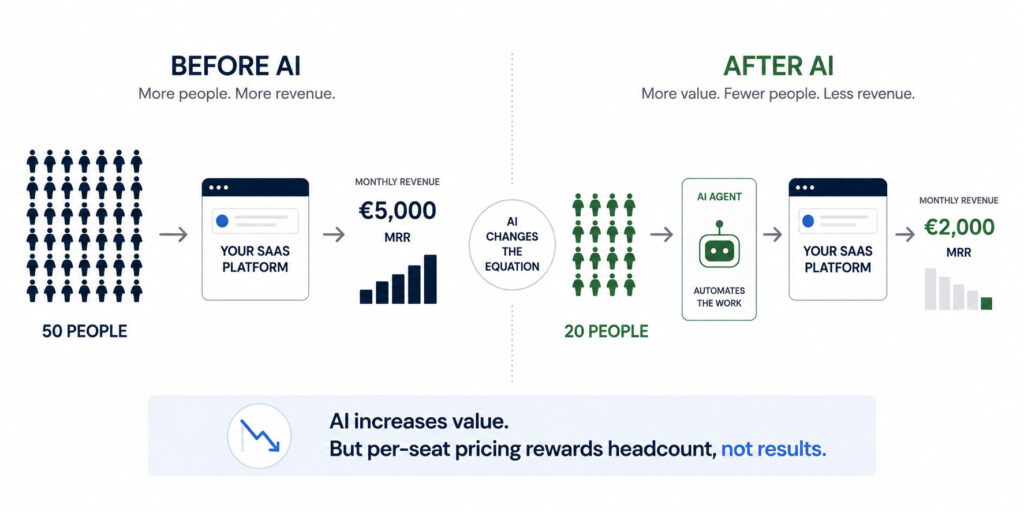
Imagine this! A SaaS company charges €99.99 per user, per month. A customer with 50 employees on the platform generates roughly €5,000 in monthly recurring revenue. Then the company ships an AI agent that automates a large share of the workflow those employees used to do by hand. The customer now needs 20 people on the product instead of 50.
The customer is getting more value than before. You’re collecting less revenue for delivering it. Sit with that for a second, because it’s not a bug in one company’s pricing sheet. It’s what happens to per-seat pricing the moment AI starts doing the work instead of assisting the person doing it.
Every SaaS company shipping serious AI features is going to hit this same wall. The question isn’t whether it happens. It’s whether you decide what to charge for on your own terms, or find out at renewal that a customer has already done the math for you.
There’s no single formula that fixes this for every company, and anyone who hands you one is selling something. What follows isn’t a universal answer. It’s the questions, the evidence, and the worked example that should get you to your own answer faster than starting from a blank page would.
Why AI Is Breaking Per-Seat Pricing
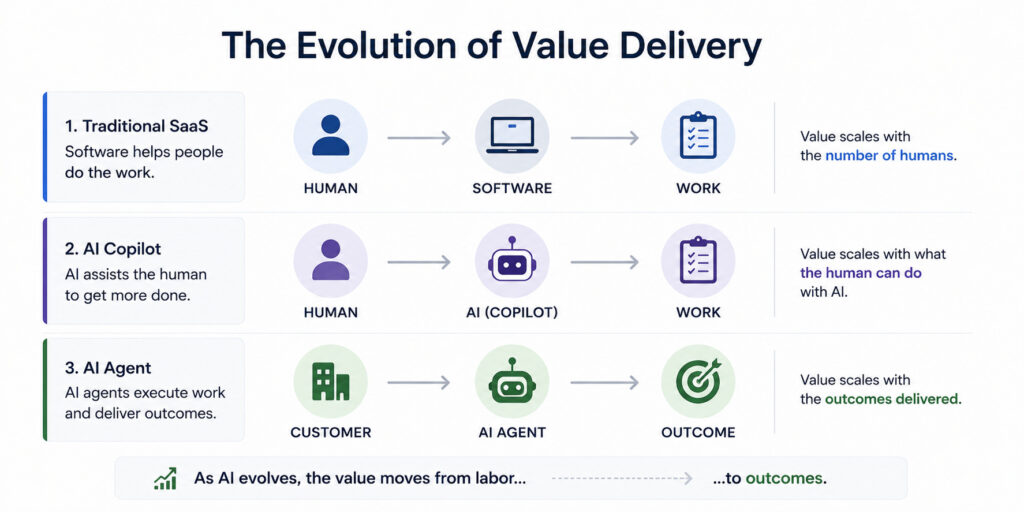
Per-seat pricing was never really about seats. It was a proxy. Traditional SaaS made humans more productive at the work they were already doing, and the number of humans doing that work was a reasonable stand-in for the value being created.
That relationship looked like this:
Human → Software → Work
AI changes the shape of it. It now looks like this instead:
Human → AI → Work
and, in the more advanced cases, this:
Customer → AI agent → Outcome
Once software does the work instead of helping a person do it, the number of people logging in stops tracking the value being delivered. This is the proxy breaking, not bending. Per-seat pricing wasn’t built to survive it. As pricing analyst Kyle Poyar put it plainly in his own research on this shift: “AI is moving from a copilot that assists people to agents executing work autonomously.” — Kyle Poyar, Growth Unhinged That’s the whole problem in one sentence. Copilots kept the human, and the seat, in the loop. Agents don’t need either.
Where Per-Seat Pricing Actually Breaks
Per-seat pricing isn’t dead. Treating it that way oversimplifies a problem that has a precise shape. It becomes a liability under five specific conditions:
- AI performs work that used to require a person
- Customers need fewer employees to get the same or better results
- A single user can now produce dramatically more output than before
- Customers start to perceive additional seats as a penalty for adopting your product, not a sign of using more of it
- Usage and value keep growing while headcount doesn’t
Here’s the sentence worth sitting with: a pricing metric becomes dangerous the moment it moves in the opposite direction from the value you create. If your AI feature is working, it’s shrinking the very number you charge against. One pricing infrastructure founder summed up the absurdity of ignoring this: “Charging per-seat for an agent is like charging per-parking-space for a self-driving car fleet.” — Flexprice
The Three Pricing Models That Replace Per-Seat Pricing
Most SaaS companies default to per-seat pricing by inertia, not by deliberate choice. Before you touch your pricing page, get specific about what the three real alternatives actually assume about how value gets created.
1. What Is Per-Seat Pricing?
Per-seat pricing charges for the number of people with access to the product. It works well when humans are the primary users, value scales with the number of people collaborating, and usage per person is fairly consistent. Its weakness is structural: automation that reduces headcount directly reduces your revenue base.
2. What Is Usage-Based Pricing?
Usage-based (or consumption) pricing charges for activity: API calls, transactions, documents processed, workflows executed, AI credits consumed. Revenue scales with how much of the product gets used rather than how many people are logged in, which makes it a natural fit for AI-heavy workflows. The trade-off is predictability. Customers who can’t estimate their usage in advance often find the billing model stressful, even when the total cost is fair.
3. What Is Outcome-Based Pricing?
Outcome-based pricing charges for results: qualified leads, resolved support cases, completed financial reports, successful transactions, automated processes closed out. This is the model that sits closest to the value a customer actually experiences. It’s also the hardest to run well, because attribution (did your product cause the outcome, or just touch it?) and margin management get significantly harder as soon as money is tied to results you don’t fully control.
This Isn't a Theory — It's Already Happening
None of this is speculative anymore. IDC forecasts that 70% of software vendors will move away from pure per-seat pricing by 2028, driven directly by AI agents reducing how many human seats a customer needs. Bessemer’s tracking shows pure per-seat pricing already fell from 21% to 15% of SaaS companies in a single 12-month stretch, while hybrid models (seats plus a usage or outcome layer) jumped from 27% to 41% over the same period. Bessemer’s own AI pricing research doesn’t hedge on where this is heading: “AI-native companies are abandoning seat-based SaaS pricing in favor of usage-based models.” — Bessemer Venture Partners
The specific moves are public, and you can go look at every one of them. Salesforce’s Agentforce charges per conversation rather than per seat: an outcome-based model built around agent interactions, not license count. Intercom’s Fin AI charges $0.99 per resolved conversation. HubSpot cut its own Customer Agent pricing to $0.50 per resolved conversation earlier this year. These aren’t experiments buried in a pricing FAQ. They’re the pricing pages of category-leading vendors.
Put plainly, once an AI agent can resolve a customer issue without a human touching it, asking “how many seats does this account have” stops being a useful question. As one operator breakdown of the shift framed it: “The new question is how many tickets got resolved, and what did each cost.” — Automation Atlas
There’s also a capital-markets consequence worth knowing about, because it’s the argument that gets a board’s attention faster than any framework: usage-based and hybrid pricing models are now showing roughly a 13-point net revenue retention advantage over pure seat-based pricing, per Benchmarkit’s 2026 B2B SaaS metrics research. Analysts have started calling out “AI seat risk” directly in earnings coverage, because per-seat SaaS has always leaned on expanding seat counts to justify its valuation multiple. When AI agents replace seats instead of adding to them, that expansion motion breaks, NRR drops, and multiples compress. One AI-pricing breakdown put the underlying math bluntly: “No business model survives that math.” — MindStudio
Harsh, but accurate. This is why the pricing question isn’t really about pricing philosophy. It’s about which side of that NRR gap your company ends up on.
The Real Question Behind Per-Seat Pricing
Founders tend to frame this as “should we switch to usage-based pricing?” Wrong first question. The right one is: what is the economic unit of value we actually create?
Answer that, and a simple hierarchy tells you where to price against it:
User → Activity → Workflow → Outcome
The further right you move on that hierarchy, the closer your pricing sits to the value the customer is getting. You don’t need to jump straight to outcome-based pricing. You need to stop pricing against a unit your own product is actively shrinking.
The AI Agent Problem: A New Case Against Per-Seat Pricing
This is where the pricing conversation moves into genuinely new territory, not a variation on an old debate.
Historically, a customer buying software bought seats: 100 seats, 100 people. In an AI-native product, that same customer buys 20 human seats and 10 AI agents doing the rest of the work.
So what is an AI agent, from a pricing standpoint? A seat? A usage unit? A worker? A feature bundled into the platform fee? An outcome generator priced on what it produces?
There is no settled answer yet, and every SaaS company shipping agentic features has to pick a position. Here’s the sharper version of the question: should software companies start pricing digital labor the way they used to price software seats? That’s the real strategic fork. The companies that answer it deliberately will out-price and out-position the ones that back into an answer by accident, six months after a customer already asked why they’re paying for empty seats.
Don't Abandon Per-Seat Pricing Too Quickly
None of this makes per-seat pricing finished. It still works when collaboration is the actual value being delivered, when every employee genuinely needs access, when usage per seat stays consistent, when customers already understand the model, and when seat count still correlates with value received.
The claim worth making isn’t “per-seat pricing is dead.” It’s that per-seat pricing should no longer be the default you reach for without checking whether it still fits. That’s the defensible position, and the useful one for a founder actually making this call.
A Practical Framework for Rethinking Per-Seat Pricing
Before repricing anything, answer five questions, in order:
- Who creates the value? Human, AI, or both?
- What actually scales when the customer gets more value: users, usage, workflows, or outcomes?
- Does AI reduce the number of seats the customer needs to get results?
- Does your current pricing reward automation, or quietly punish it?
- Can your customers predict what they’ll pay each month?
If customers can achieve significantly more while using fewer seats, that is the signal. Revisit your pricing metric before a competitor, or your own AI feature, forces the question for you.
Applying This to the Scenario We Opened With
Take the example from the start of this article: 50 seats at €99.99/month, €5,000 MRR, dropping to 20 seats once an AI agent automates part of the workflow. Run it through the five questions:
Value is now created jointly by the human and the AI agent, not by headcount alone. What scales with customer value is workflow volume completed, not logins. AI has directly cut the seat count from 50 to 20. Current per-seat pricing punishes the customer for adopting the AI feature; it charges less for the exact outcome the product was built to improve. And a usage or outcome layer, priced against workflows completed rather than seats, would let revenue track actual value delivered instead of shrinking alongside it.
A workable repricing here isn’t “switch to pure usage-based pricing overnight.” It’s a hybrid: keep a lower-cost per-seat base (say, a €60/seat platform fee that covers access and collaboration) and add a usage layer priced per workflow the AI agent completes. If the AI now handles the volume that 30 departed seats used to cover, price that volume directly. Done well, this can leave the customer paying a comparable or lower total, while the vendor’s revenue no longer collapses every time the AI feature does its job.
Common Questions on AI and Per-Seat Pricing
Is per-seat pricing dead?
No. It’s shrinking as a default, not disappearing. Bessemer’s tracking shows pure per-seat still accounts for roughly 15% of SaaS companies, and it remains the right model wherever collaboration, not automation, is the primary source of value.
What should I charge for AI agents?
There’s no single standard yet. The three live approaches are treating an agent as a premium add-on seat (Microsoft’s approach with Copilot), pricing it per outcome or resolved task (Salesforce Agentforce, Intercom Fin, HubSpot’s Customer Agent), or bundling agent usage into a consumption tier. The right choice depends on whether you can reliably measure and attribute the outcome the agent produces.
How fast do SaaS companies need to move on this?
Faster than most pricing decisions get made. Analysts are already tying seat-based exposure to compressed valuation multiples through net revenue retention, which means this is now a board-level question, not just a product marketing one.
The Bigger Shift Behind the Per-Seat Pricing Debate
Zoom out and this stops being a pricing article. It’s a question about what SaaS companies are actually selling.
The old model sold access to software. The current shift sells access to intelligence and automation. What comes after that is selling completed work itself: business outcomes, not the tools used to produce them.
The question for SaaS founders isn’t whether per-seat pricing eventually disappears. It’s whether your pricing model still makes sense once your software does the work instead of simply helping people do it.
The AI-native SaaS companies that win this decade won’t be the ones with the most impressive AI features. They’ll be the ones that decided, on purpose, what to charge for once software became part of the workforce.
Your Pricing Model Isn't the Only Thing That Needs to Change
A repriced product still needs a market that understands why the new price is fair. If your AI features are strong enough to justify moving off per-seat pricing, your website, sales deck, and content need to make that case just as clearly as your invoice does — most SaaS companies update the pricing page and leave everything else explaining the old model.