

SaaS & IT Content Marketing
Why Your IT Software Needs a Product Comparison Page
You know your product is different. Your team knows how it works, why it was built and where it beats the alternatives.
But can a buyer tell? That is the question a good product comparison page for IT software exists to answer.
Many software websites use the same words: powerful, flexible, seamless, scalable. We looked at why so much content ends up this way in why B2B SaaS content sounds the same. When a buyer compares you with a competitor, those words settle nothing. The buyer wants to know whether the product fits their infrastructure, what implementation involves, where the limits are and whether the price is justified.
If your website does not answer those questions, the comparison still happens, just somewhere else: in several browser tabs, on review sites, or on a call with your sales team. Either way, someone else frames it.
Your sales team probably already knows the questions buyers keep asking. Your engineers may have explained the same differences many times. Your website should not leave every prospect to start that conversation from scratch.
A product comparison page does that work for the buyer. Your real advantages may be invisible today because nothing explains them next to the alternatives. The page puts them there. It shows where you fit, what makes you different, what the trade-offs are and who should choose another option.
Many founders will also recognise a second problem. You know good content when you see it, but you cannot say how to brief it. You point at a page and say: this, we want to sound like this. A comparison page is a good standard to point at, because it cannot hide behind adjectives.
This guide shows how to write one: what it is for, the three types, a structure that holds up with technical readers, the German rules on comparative advertising, how to make the page easy for AI search tools to quote, when not to build one, and a one-page template. We cannot promise that any page will rank or be cited, and nobody else can honestly promise it either. What we can show is what makes a comparison page useful to the people who read it.
In short: A product comparison page for IT software works when it gives an honest verdict, compares how work gets done, replaces adjectives with specifics, speaks to each reader in the buying group, and shows its date and method. In Germany, the comparison must also be objective and verifiable.
What Is a Product Comparison Page?
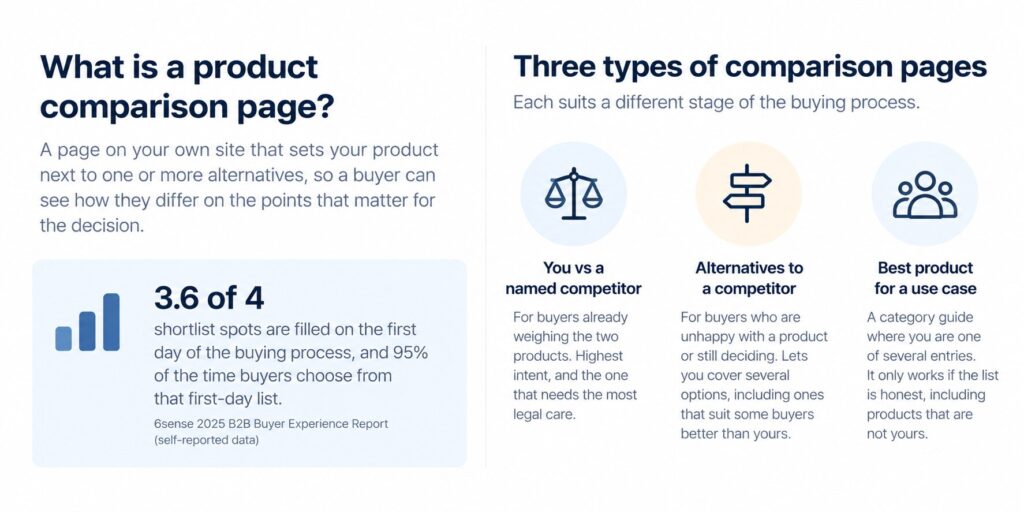
A product comparison page is a page on your own site that sets your product next to one or more alternatives, so a buyer who is building a shortlist can see how they differ on the points that matter for the decision.
Why it matters: shortlists form early. In the 6sense 2025 B2B Buyer Experience Report, based on just under 4,000 buyers who had spent at least $25,000 in the previous two years, buying groups had filled 3.6 of their shortlist spots on average on the first day of the buying process, and 95% of the time they bought from a vendor on that first-day list. 6sense sells to B2B marketers and the data is self-reported, so read it as a strong signal, not a law. A comparison page is where a vendor already on the list gets tested. For a vendor not on it, being found early is what matters.
IT purchases also involve more than one reader. One practitioner guide (from a software vendor, so read it with that in mind) points out that these pages get forwarded inside the buying group, so the engineer, the security lead and the budget holder each read them for different reasons. We come back to that below. It is part of the wider shift we describe in why SaaS buyers decide before they ever visit your website. For the IT side of that, see what IT decision-makers actually want from content.
Three Types of Comparison Pages, and When Each Fits
- ➜ You vs a named competitor. For buyers already weighing the two products. Highest intent, and the one that needs the most legal care (see the German rules below).
- ➜ Alternatives to a competitor. For buyers who are unhappy with a product or still deciding. It lets you cover several options, including ones that suit some buyers better than yours.
- ➜ Best product for a use case. A category guide where you are one of several entries. It only works if the list is honest, including products that are not yours.
Start with the competitor you meet most often in real deals. One practitioner guide from DataDab, a B2B SaaS marketing firm, recommends prioritising by win and loss data. That is sensible advice, and your sales team already holds the answer.
How to Structure an IT Software Comparison Page for Technical Readers
IT software buyers test claims. The evaluator tries the product, the security lead reads the fine print, and the budget holder skims for the cost. A page that works for all three has eight parts.
- Open with an honest verdict. Two or three sentences on who each product suits, including when the competitor is the better choice. Both practitioner guides we read recommend this.
- Put a summary table early, and do not make it all green. A grid where your product wins every row reads as marketing. Buyers distrust it, and an honest table with a few rows in the competitor’s favour is more believable.
- Compare how work gets done, not how many features exist. For IT software that means deployment model, data handling, pricing model and integration depth, shown through a real task such as setting up a user or restoring a file. A count of tick marks tells the reader very little.
- Use specifics instead of adjectives. See the example below. If you cannot state a number, a limit or a named integration, the claim does not belong on the page.
- Write for each reader in the buying group. Give the engineer the architecture and limits, the security lead the data handling and certifications you can document, and the budget holder the pricing logic. Short labelled blocks are enough.
- Show pricing basics and the limits. You do not need every tier, but hiding the pricing model entirely pushes buyers toward the competitor who shows it. State what is included, what costs extra and what has a cap.
- Date the page and say how you compared. Add the date, the product versions you looked at, and where the competitor information came from, such as public documentation or a trial. This protects you legally and shows the reader how much weight to give it.
- Offer one next step. A trial, a demo or a short call, matched to what a reader at that stage wants. One clear option beats five. Then track demo or trial requests that start on the page, not visits to it. We cover how in how to measure SaaS content marketing.
Hypothetical example, not a real product.
Weak: “Powerful integrations with all your tools.”
Stronger: “Native connectors for two directory services and three ticketing tools. Everything else goes through the REST API. There is no write-back to the ticketing tool, so teams that need it should look at Product B.”
The second version can be checked, tells a reader who should leave, and is far more likely to be forwarded to a colleague.
The Rules You Need to Know in Germany
If you sell from Germany or to German buyers, comparative advertising is regulated. This is general information, not legal advice, so ask a lawyer about your specific page.
Section 6 of the German Act Against Unfair Competition (UWG) defines comparative advertising as any advertising that identifies a competitor or its offers. It is allowed unless one of the conditions in § 6 Abs. 2 UWG applies. A comparison is unfair if it:
- ➜ does not compare products that meet the same need or serve the same purpose;
➜ is not objectively based on essential, relevant, verifiable and typical features, or on price;
➜ creates a risk of confusion between you and a competitor, their offers or their trademarks;
➜ exploits or damages the reputation of a competitor’s trademark in an unfair way;
➜ denigrates or disparages the competitor’s products, services or business circumstances;
➜ presents your product as an imitation of a product sold under a protected trademark.
A summary from the legal-information site IT-Recht Kanzlei (written in 2020) adds a useful point: naming a competitor, or saying your product is better, is not disparagement by itself. Blanket put-downs and untrue statements of fact are. In practice, for a comparison page, that means:
- ➜ compare features a buyer would actually use to decide, and make each one something you can check;
➜ take competitor facts from public sources, date them and keep a record of where they came from;
➜ keep the tone factual, with no sweeping verdicts such as “the worse option”;
➜ make clear whose product is whose.
Using a competitor’s name or logo raises trademark questions that are separate from the rules above, and other countries have their own rules. Check both with a lawyer before you publish.
How to Make the Page Easy for AI Search to Quote
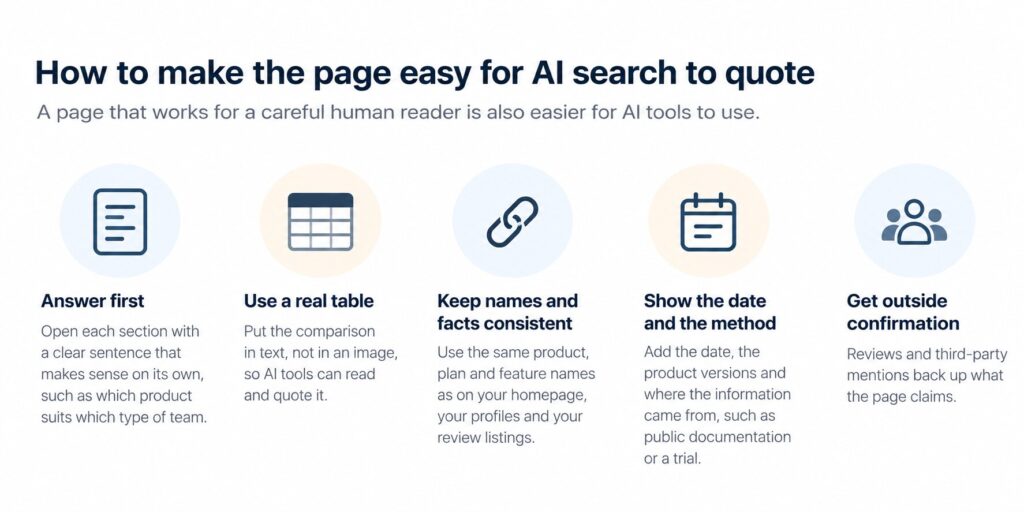
Buyers now ask ChatGPT, Gemini, Claude and Perplexity for shortlists. In G2’s 2026 survey of more than 1,000 software buyers, 82% said they had sourced a recommendation from an AI chatbot in the previous 24 months. That is recall, not a share of all searches. We cannot tell you how these tools choose their sources, and we found no official guidance on it. Google’s guide to its AI features says the best practices for SEO continue to be relevant, which covers Google only. We explain how SEO and GEO fit together in SEO vs. GEO. What we can say is that a page built for a careful human reader is also easier for a tool to use. Our approach, as judgment and not proven rules:
Answer first. Open each section with a self-contained sentence that makes sense on its own, such as “Product A suits teams that need X; Product B suits teams that need Y.”
- ➜ Use a real table. Put the comparison in text, not in an image.
➜ Keep names and facts consistent. Use the same product, plan and feature names here as on your homepage, your profiles and your review listings.
➜ Show the date and the method. A dated page with sources is easier to trust and to update.
➜ Get outside confirmation. Reviews and third-party mentions back up what the page claims. See what AI tools find about your SaaS company and how SaaS buyers research vendors in ChatGPT.
One practitioner argues that pages admitting when a competitor is the better choice are cited more often by AI tools. We could not find independent evidence for that, so treat it as a hypothesis. It is also what a human buyer trusts, which is the better reason to write the page that way.
When Not to Build a Comparison Page
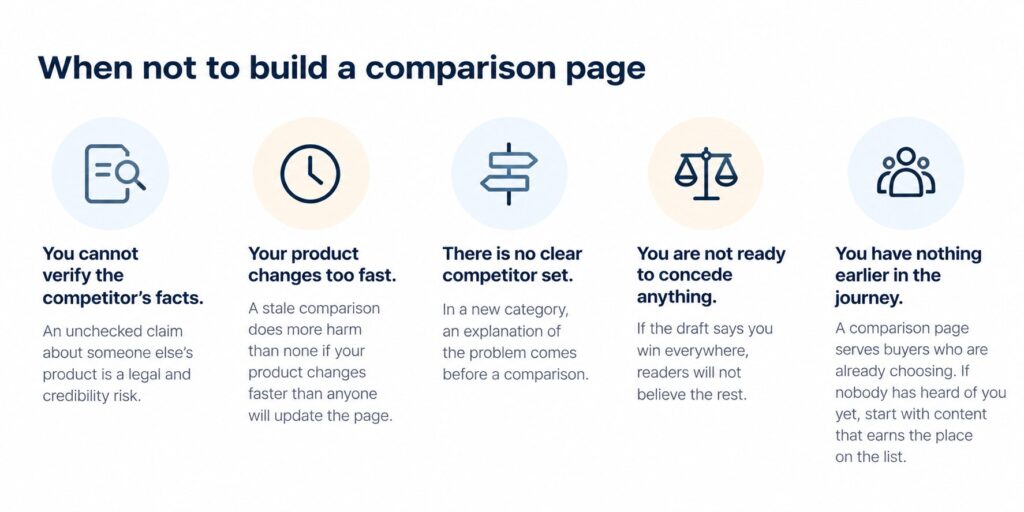
- ➜ You cannot verify the competitor’s facts. An unchecked claim about someone else’s product is a legal and credibility risk.
➜ Your product changes faster than anyone will update the page. A stale comparison does more harm than none.
➜ There is no clear competitor set. In a new category, an explanation of the problem comes before a comparison.
➜ You are not ready to concede anything. If the draft says you win everywhere, readers will not believe the rest.
You have nothing earlier in the journey. A comparison page serves buyers who are already choosing. If nobody has heard of you yet, start with the content that earns the place on the list. Our piece on why B2B SaaS content sounds the same explains what stops most content from doing that.
A One-Page Template for IT Software Comparison Pages
Use this as a starting outline for any of the three page types.
Section | What goes in it |
Verdict | Who each product suits, and when to choose the competitor. |
Summary table | 6 to 8 rows that matter for the decision, with honest results in both directions. |
How it works | One real task shown in each product, and the architecture and deployment model. |
Specifics | Named integrations, limits, supported platforms, certifications you can document. |
Pricing | Pricing model, what is included, what costs extra, any caps. |
By reader | Short blocks for the engineer, the security lead and the budget holder. |
Proof | Reviews, customer quotes and sources, with dates. |
Method and date | What you compared, which versions, where the information came from, last updated. |
Next step | One option: trial, demo or call. |
FAQ | Migration, data export, support, contract terms. |
You Know What Good Content Looks Like. Let's Work Out What Yours Needs.
Perhaps you have seen a competitor explain a complicated product in two paragraphs and wondered why your website cannot do that. Or you have read a comparison page that made the decision feel obvious, while your own product still takes a sales call to explain.
You do not need a perfect content brief. Start with three pages you admire, from your industry or from somewhere completely different. We will identify what makes each one effective, what could work for your product and your buyers, and which page or content problem we would tackle first. The review is free, and you will get our reply within one week of sending the pages.
Market Plus Solutions is a SaaS and IT marketing agency for small businesses in the DACH region, Liechtenstein, Luxembourg and the US, with content marketing at the core. Read more about our B2B content marketing for IT companies or see who we work with.
Frequently Asked Questions
What is a product comparison page?
It is a page on your own site that compares your product with one or more alternatives, so a buyer building a shortlist can see the differences that matter for the decision.
What should an IT software comparison page include?
An honest verdict, an early summary table, a comparison of how work gets done, specifics instead of adjectives, short blocks for each reader in the buying group, pricing basics, a date and method, and one next step.
Is a competitor comparison page legal in Germany?
Comparative advertising is allowed under § 6 UWG unless one of the listed conditions applies, such as an unobjective comparison, confusion, or disparagement. Naming a competitor is not unlawful in itself. Check your specific page with a lawyer.
Is a competitor comparison page legal in Austria?
Yes, in principle. Austria’s UWG (§ 2a) allows comparative advertising that identifies a competitor, unless it breaks the general rules on unfair, aggressive or misleading practices. So the page must be accurate and not misleading, and in some cases you may have to prove your factual claims. Check your specific page with a lawyer.
Is a competitor comparison page legal in Switzerland?
Yes, if the comparison is not incorrect, misleading, unnecessarily disparaging or an improper ride on the competitor’s reputation (Art. 3 Abs. 1 lit. e UWG). In practice that means correct facts, a fair comparison, and no put-downs that your point does not need. Check your specific page with a lawyer.
Is a competitor comparison page legal in the UK?
Yes, if it meets the conditions in regulation 4 of the Business Protection from Misleading Marketing Regulations 2008. The comparison must not be misleading under those regulations or under the consumer provisions of the Digital Markets, Competition and Consumers Act 2024. It must cover products that meet the same needs, and objectively compare material, relevant, verifiable and representative features, which can include price. It must not confuse people about who is who, discredit or denigrate a competitor, take unfair advantage of its trade mark or name, or present your product as an imitation. Check your specific page with a lawyer.
Is a competitor comparison page legal in the US?
Yes. The Federal Trade Commission encourages truthful comparative advertising that names competitors, as long as it is not misleading and the basis of the comparison is clear. It has said that disparaging advertising is permissible so long as it is truthful and not deceptive. Competitors can also sue under the Lanham Act if an advertising statement misrepresents the nature, characteristics or qualities of goods or services, so every claim should be accurate and backed by evidence. Check your specific page with a lawyer.
Is a competitor comparison page legal in Canada?
Yes, in principle, but your claims must hold up. Under the Competition Act (s. 74.01), a representation to the public that is false or misleading in a material respect is reviewable conduct. A claim about a product’s performance must also be based on an adequate and proper test, and the proof lies on the person making the claim. Using a competitor’s trademarks raises separate questions. Check your specific page with a lawyer.
Can I use the same comparison page in every country?
Not automatically. A page that is acceptable in one country may not be in another, and which country’s law applies depends on the markets you target, so ask a lawyer. A practical approach is to keep one shared set of verified, dated and sourced facts, then check the claims, wording, trademark use and legal requirements for each market.
Should I name competitors on the page?
For a “you vs competitor” page, yes, because that is what the buyer searches for. Source and date every fact about them, and keep the tone factual. If you are unsure, an “alternatives” or category page carries less risk.
Should I mention where the competitor is better?
Yes. Pages that concede a point or two are more believable, and a buyer who finds the weakness elsewhere will trust the rest of your page less.
How often should I update it?
Whenever either product changes in a way that matters to the decision, and on a regular schedule even if nothing seems to have changed. Show the last-updated date on the page.
Do comparison pages help in AI search?
We found no proof either way. A clear, dated, honest page with a real table and outside confirmation is easier for people and tools to use, but nobody can promise a citation.
You Know What Good Content Looks Like. Let’s Work Out What Yours Needs.
You do not need a perfect content brief. Send us three pages whose voice you admire, from your industry or any other. We will tell you what makes each one work, what would fit your product and your buyers, and which page or content problem we would tackle first.
Sources and notes: The legal answers summarise the statutes and official guidance linked above for Germany, Austria, Switzerland, the United Kingdom, the United States and Canada, plus a German legal-information site for Germany. They are general information, not legal advice. Laws change, so check the current text and your specific page with a lawyer in each market. For Switzerland we read the 2022 version of the text, and for Canada only the main misleading-representation provision. The structure advice comes from two practitioner guides published by software and marketing firms with commercial interests; we use them for structure, not as research, and we left out statistics in them that we could not trace to a primary source. The shortlist figures come from 6sense’s own report, a self-reported survey by a company that sells to B2B marketers. The example is hypothetical.