
SaaS & IT Content Marketing
The Hidden Cost of Running Your English Website on a Translation Plugin
If your German, Austrian or Swiss SaaS or IT company runs an auto-translated English website, you probably saved weeks of work and a lot of budget. You may also be paying for it in international buyers, search visibility and AI citations that your analytics never show you. This article explains what an automated translation plugin does to an English website, what Google and AI search say about it, and what a small DACH company can do instead without hiring an English-speaking marketing team.
It usually starts like this. You install a translation plugin. You flip the switch. Your German website is now, technically, an English website. It took fifteen minutes.
You don’t have an English-speaking marketing team, you don’t have the budget to build one, and international buyers need to find you in English. A plugin appears to solve all three problems at once. The trouble starts when “translated” quietly becomes your entire English marketing strategy.
The question worth asking before you call that “done” isn’t whether the plugin worked. It’s whether the result competes for an international buyer’s attention the way a page written in English would. Those are two different questions, and most companies only ever answer the first one.
This article is part of our guide to English content marketing for DACH SaaS and IT companies. If you want the full picture first, start with SaaS content marketing services in Germany
What Is an Automated Translation Plugin, and What Does It Actually Produce?
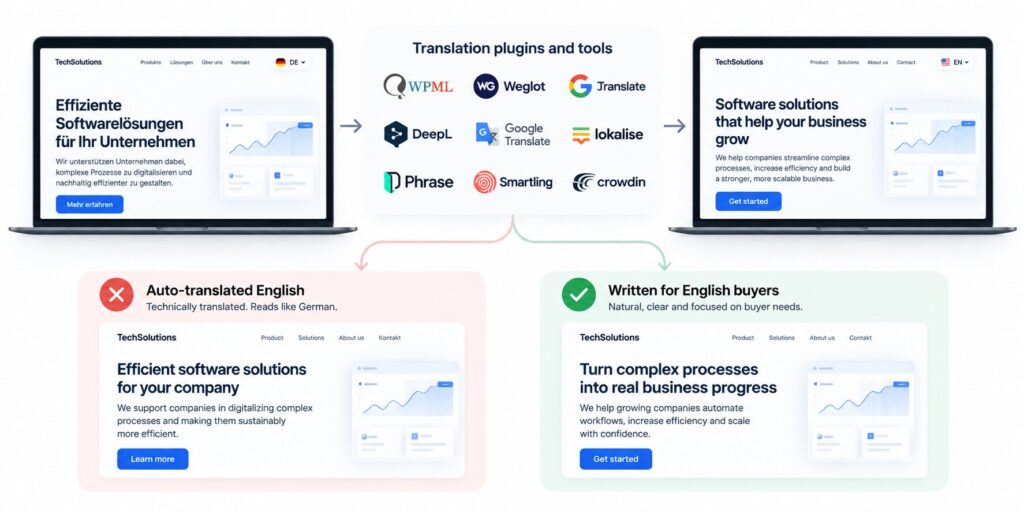
An automated translation plugin, such as WPML, Weglot or GTranslate, runs the content of your website through machine translation to create versions in other languages, usually in minutes and at a fraction of what a human translator would cost. What it produces is a first draft: a faithful conversion of your words, with no view on whether those words work for a buyer who searches, reads and decides in English. An auto-translated English website is that first draft published as if it were finished.
Why an Auto-Translated English Website Isn't the Same as an English Website
There’s a gap between “available in English” and “written for English-speaking buyers,” and it’s where most of the real cost in this article lives. A page can pass every technical check, correct hreflang tags, an English URL, grammatically sound sentences, and still carry German sentence structure, German business formality and German product naming into a language where the reader notices all three.
That’s not a translation problem in the narrow sense.
It’s a business problem wearing a translation plugin’s output. The rest of this article is about where that gap actually costs you: in how Google treats the page, in whether AI engines cite it, and in whether an international buyer trusts the company behind it.
Does Google Penalize an Auto-Translated English Website?
This is worth getting precise about, because the common version of this claim, “Google penalizes automated translations”, isn’t accurate, and saying it erodes the credibility of the real argument.
Here’s what Google has actually said.
Asked directly in 2019 about auto-translating content between languages, Google’s John Mueller replied, “I don’t think that would trigger manual actions, but if the translations are bad, then it’s bad content in general.” He also flagged that machine-generated text which reads as “low-quality machine-generated gibberish’y content” can cross into manual-action territory, and recommended having the output reviewed by native speakers before it goes live.
Google’s current spam policies point the same way. They name “translating” among the automated transformations used in scaled content abuse, meaning many pages generated “where little value is provided to users.” That policy is aimed at scraped, mass-produced pages, not at a company translating its own website. But the test it applies, value to the user, is the same one a careless auto-translated page has to pass.
The accurate version of the argument: Google doesn’t give you a free pass because a plugin generated the text. It evaluates the result the same way it evaluates anything else. A plugin doesn’t lower the bar, it just makes it much easier to publish content that doesn’t clear it.
The Real Risk Is the Translation Nobody Reviews
The bigger problem is what happens after the translation is generated. Weglot, one of the larger players in this space, reports that roughly two-thirds of its own customers never edit the machine-translated output before publishing it.
That’s the mechanism worth paying attention to, not a claim that machine translation is inherently unreliable. On an auto-translated English website run by a small team without an English-speaking marketer, skipping the review step is the default, because nobody on the payroll is in a position to do it. A workflow with no review step has no way to catch the mistranslated feature name, the awkward call to action, or the sentence that’s grammatically fine but reads like software wrote it, because in a very literal sense, it did.
What Does an Auto-Translated English Website Cost You?
This is where the real cost shows up, and it’s a different failure mode than “bad grammar.” A translation can be correct by any dictionary definition and still undersell your product. On DACH SaaS and IT websites, these are the usual suspects:
➜ Long, nested sentence structures carried over from German, where the main point arrives at the very end
➜ A formal, distant tone that reads as stiff or bureaucratic in English, when buyers expect plain, direct language
➜ Feature and product names translated literally, when the market expects the original term
➜ The same term rendered two ways on two pages, such as “Auftragsverarbeitung” coming out as “order processing” in one place and “data processing” in another, which matters most on legal and security pages
➜ A call to action that is grammatically correct but that no English-speaking marketer would write
➜ German idioms and compound-noun logic rendered word for word, landing as nonsense or unintended comedy
➜ Pricing and plan descriptions that become ambiguous once converted out of their original phrasing
➜ Mixed UK and US spelling, and inconsistent date and number formats, across pages
None of these trigger a manual action from Google. All of them chip away at the same chain: comprehension, then conversion, then trust. A buyer who has to work to understand your pricing page, or who notices your call to action doesn’t sound like something a native speaker would write, doesn’t conclude “this company uses a translation plugin.” They conclude the company isn’t serious about customers like them, and they take that conclusion to a competitor’s site.
Does Auto-Translation Hurt Your AI Search Visibility?
Search visibility used to mean one thing: ranking in Google. It no longer does. BrightEdge’s AI referral data from September 2026 shows ChatGPT referral traffic up 101% between January and August 2026, with total AI referral traffic across platforms up roughly 73% year over year. AI-generated answers are now sending substantially more referral traffic to vendor sites than they were earlier in 2026.
That data shows AI-mediated discovery is growing. It doesn’t, on its own, prove that AI engines penalize machine translation specifically, and this article isn’t going to claim more than the evidence supports. What it does mean is simple: if an AI answer is doing part of your buyer’s research for them, the clarity and usefulness of the content available for AI systems to interpret and potentially cite becomes part of your international visibility strategy, right alongside your Google ranking.
There’s a second, more pointed data point worth knowing. A separate BrightEdge analysis found that ChatGPT named 28% fewer brands per answer in B2B Tech in September 2026 than it did in March. Shortlists are getting shorter. When an AI answer names fewer companies, being one of the companies it clearly understands, and can confidently describe, matters more than it did when the list was longer. That’s a question of what an AI engine surfaces and cites, and a page full of awkward, half-translated sentences makes that job harder, not easier.
If the difference between ranking in Google and being cited by an AI system is new to you, our piece on SEO vs. GEO explains how the two differ.
How an International Buyer Sees Your English Site
Picture a prospect in the UK, the US or the Nordics who has already shortlisted three vendors for a problem your software solves. She lands on your English pricing page and finds inconsistent terminology, a call to action that doesn’t quite sound right, and a couple of sentences that are understandable but obviously translated from somewhere else.
She doesn’t need to conclude your software is bad. She just has one more reason to wonder how seriously your company takes international customers, at the exact moment she’s deciding which of three vendors to call. That’s the reputation cost, and it’s a more accurate argument than quoting a percentage of buyers who “distrust machine translation,” because a credible, current number for that doesn’t exist yet. The scenario doesn’t need one to make the point.
Credibility is what a small vendor is really selling at that moment. We saw how much it matters in practice in our case study on earning SaaS buyers’ trust without spending on ads.
Should You Get Rid of Your Translation Plugin? No.
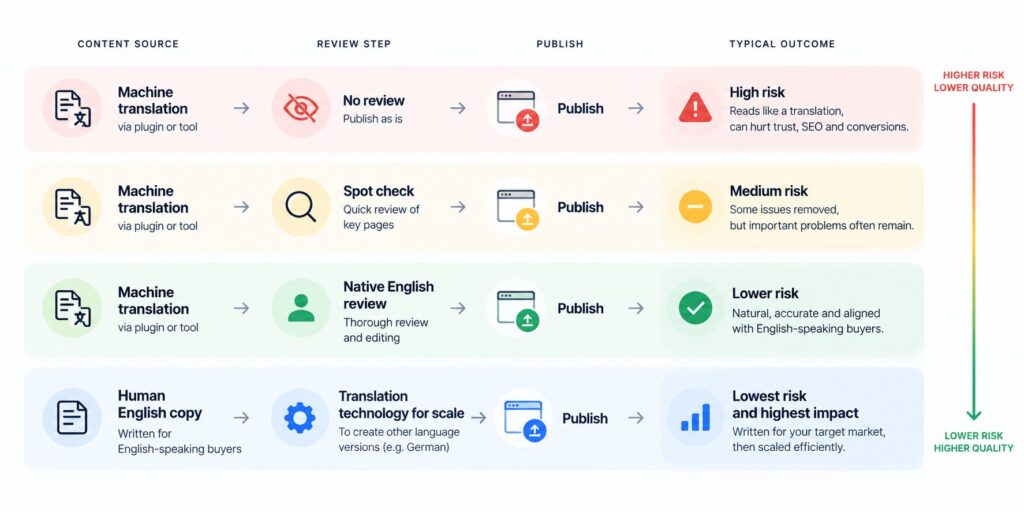
The plugin isn’t the problem. The workflow around it is. WPML, Weglot, and GTranslate all do what they’re built to do: make a site multilingual quickly. The risk isn’t in using one, it’s in treating its output as finished rather than as a first draft, which is how an auto-translated English website ends up published.
Where the risk actually sits:
Workflow | Risk Level |
Machine translation, published automatically, no review | Highest |
Machine translation with occasional spot-checks | Moderate |
Machine translation with key pages reviewed by a native English speaker | Lower |
English written by a human, translation tech used for scale | Lower |
Native English copywriting for strategic pages | Maximum control over how you sound to international buyers |
What Should You Write in English First?
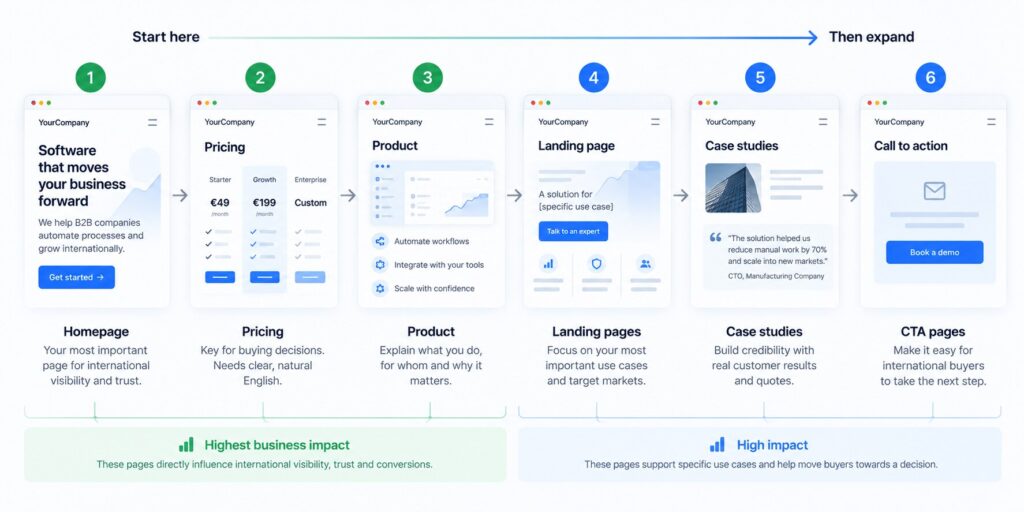
Nobody is suggesting you rewrite four hundred pages by hand, least of all a small team without an English-speaking marketer. You don’t need human attention everywhere, you need it where a mistake is expensive. In order of priority:
➜ Homepage
➜ Pricing page
➜ Product or service pages
➜ Key landing pages for paid or organic campaigns
➜ Case studies
➜ About / company page
➜ Calls to action and form copy
➜ Your highest-traffic organic pages
➜ Pages already showing up in AI search citations
➜ Legal, security and compliance pages where terminology precision matters most
You don’t need to humanize every page. Humanize the pages that can win or lose a customer. |
Everything else can reasonably stay on machine translation while you work down that list. The goal isn’t zero automation, it’s making sure a human has looked at the pages actually responsible for winning or losing a customer.
The Alternative: Automate the Translation, Not the Judgment
Translation software can make a website available in English in minutes. It can’t decide whether your positioning lands with an international buyer. It can’t tell you whether your call to action sounds credible or slightly off. And it shouldn’t be the final word on the pages responsible for winning customers.
If you’re a small SaaS or IT company in Germany, Austria or Switzerland, the obvious objection is that the alternative is out of reach: an English-speaking marketing team, or a large agency. That’s exactly the gap we work in.
English isn’t a compromise for a DACH company. In a 2012 Harvard Business Review article, Tsedal Neeley listed SAP among the multinational companies that have mandated English as their corporate language, and advised companies with global reach to do the same to ensure good communication with customers, suppliers and partners.
A translation plugin can give your DACH SaaS company an English website. It can’t give you an English marketing presence.
You don’t need another translation provider, and you don’t need to build an English marketing team. You need English content built from your own team’s expertise, and someone who can tell you what actually matters first.
English Content for DACH SaaS and IT Companies: What Market Plus Solutions Does
Market Plus Solutions GmbH is a Hamburg-based content marketing agency that writes English website content, SEO content and content marketing for small SaaS and IT companies in Germany, Austria and Switzerland.
Who is this for? Small SaaS and IT companies and startups in Germany, Austria and Switzerland that need an English website and English marketing content, but don’t have an English-speaking marketing team or the budget for a large agency.
What do we do? Market Plus Solutions provides English website content, SEO content and content marketing for DACH SaaS and IT companies. We take what your team already knows about your product and your customers and turn it into English content that international buyers and AI search engines can understand and trust.
What problem does it solve? It lets a small company build a credible English-language presence without hiring a full marketing team or paying for a large agency.
What makes it different? Many marketing agencies in Germany are built around German-language work. English content is what we specialize in, and we know the DACH SaaS and IT market you’re coming from. Our English content is written and edited by a native English speaker who also reads your German source material.
For the wider picture, see our piece on SaaS content marketing services in Germany. If you’re trying to work out whether your current content is producing anything measurable, start with how to measure SaaS content marketing.
Frequently Asked Questions
1. Does Google penalize an auto-translated English website?
Not automatically. Google’s John Mueller has said auto-translating content won’t by itself trigger a manual action, but “if the translations are bad, then it’s bad content in general.” Poor-quality machine translation can still rank poorly or, in extreme cases, be treated as low-quality machine-generated content. An auto-translated English website faces the same quality bar as any other page.
2. Should I remove my translation plugin?
No. Tools like WPML, Weglot, and GTranslate aren’t the problem, they do what they’re designed to do. The risk is in the workflow around them: publishing their output automatically, with no human review, especially on pages that influence a buyer’s decision.
3. What should I write in English first on my SaaS website?
Start with the pages that carry the most commercial weight: your homepage, pricing page, product pages, key landing pages, case studies, and calls to action. Lower-traffic or informational pages can reasonably stay on machine translation while you prioritize the pages that can win or lose a customer.
4. Does an auto-translated website affect how AI search engines cite my site?
There’s no direct evidence yet that AI engines penalize machine translation specifically. What’s measurable is that AI-mediated discovery is growing significantly, and AI answers are naming fewer brands per response. Clear, well-written English gives an AI system more to work with when deciding what to cite.
5. Can a small DACH SaaS company get good English content without hiring an English marketing team?
Yes. The product and customer expertise already exists inside your team. What’s usually missing is the capacity to turn it into strong English content and SEO. An external partner can do that without you building a team or hiring a large agency, which is the work Market Plus Solutions does for small SaaS and IT companies in Germany, Austria and Switzerland.
Is Your English Website Good Enough to Compete?
Send us your English homepage and pricing page, and tell us who you're trying to reach.