

SaaS Industry
Your B2B Thought Leadership Gap Is Not a Topic Gap
I’ve spent 20 years on both sides of the interview table. Ten of those as a journalist and editor, interviewing leaders and representatives from more than 50 countries, alongside a long list of Fortune 500 companies and startups and scale-ups that hadn’t made it there yet. The last nine have been spent building content and marketing programmes for B2B SaaS and IT companies. Both roles taught me the same lesson from opposite directions: the content that actually lands is never the content anyone could have written.
Every SaaS company I’ve worked with has a list of content ideas. Blog posts, whitepapers, LinkedIn articles, newsletter issues. The calendar is full. The problem isn’t that there’s nothing to write about. The problem is that the content getting written could have been written by anyone, and that’s exactly why it means nothing coming from you specifically.
The real gap in your B2B thought leadership strategy isn’t a topic gap. It’s a person gap.
The Only Person Who Can Write Real B2B Thought Leadership
The most valuable B2B thought leadership your company could publish lives in one place: your founder’s or your leadership’s head. Not the marketing team’s interpretation of it. The actual thing. The specific, hard-won, sometimes uncomfortable opinions that come from building something for years.
When I was an editor, the interviews that mattered were never the ones where an executive recited a prepared line. They were the ones where I asked a follow-up question and got a real answer: the pricing model that backfired, the deal they lost to a worse competitor and knew exactly why, the belief about their own industry that put them at odds with everyone else in the room. That’s thought leadership. It’s the content nobody else can write, because nobody else has lived it.
Why B2B Thought Leadership Never Gets Written
The people with the ideas don’t have the time. The people with the time don’t have the ideas.
I’ve sat on both sides of this gap.
Founders and executives are running companies; the specific window of attention required to sit down, form a coherent argument, and write it to publication standard doesn’t exist in their calendar. So one of two things happens. Either the B2B thought leadership doesn’t get written at all. Or a content team writes something that sounds like what the leader might say: hedged, safe, stripped of the specific opinions that made it worth reading in the first place.
The result is content that fills a calendar without building any credibility. Every company in a category publishes the same five best-practices article. The buyer reads it, nods, and forgets it immediately.
What Leaders Actually Have That Content Teams Don't
Three things a briefing document can’t manufacture, and that separate real B2B thought leadership from filler:
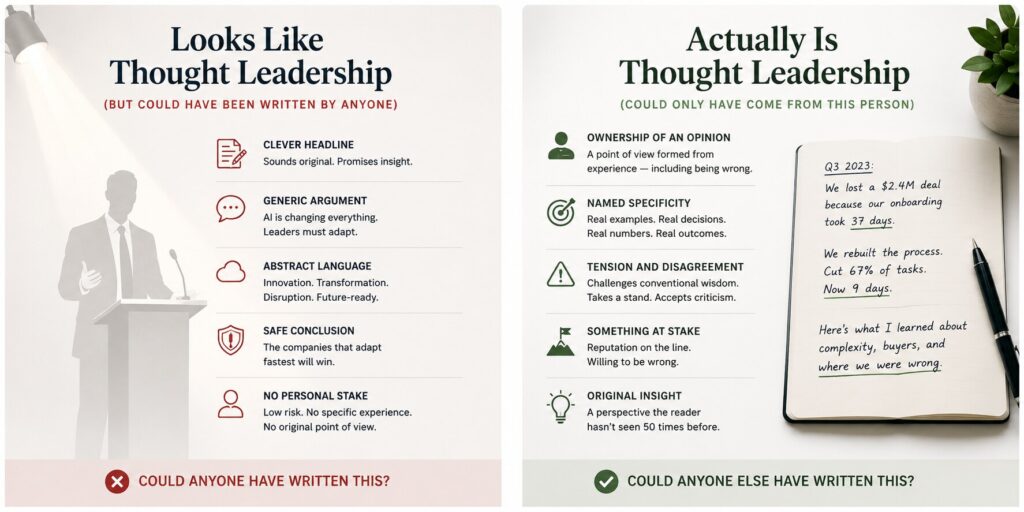
First, a genuine point of view. Not a position marketing has approved for brand safety. An actual opinion formed from experience, including the experience of being wrong, changing direction, and learning something specific from that failure.
Second, named specificity. The content that earns trust isn’t “many companies struggle with X.” It’s “we struggled with X in Q3, here’s what we tried, here’s what happened, here’s what we actually believe now.” That specificity is only possible from someone who was there. In nine years of interviewing C-suite executives, government officials, and industry leaders across defence, finance, and technology, I never once got a usable quote from a rehearsed answer. I got them from the follow-up question, when someone stopped reciting and started actually thinking out loud.
Third, something at stake. B2B thought leadership only works when the person publishing it has a reputation on the line. A content team member publishing under the company name has nothing personally at stake. A named leader does. Readers feel that difference immediately, and so do AI engines choosing what to cite.
Who Is Actually Qualified to Write B2B Thought Leadership?
Once you accept that leadership-sourced content is the real asset, a different question follows: who should be trusted to shape it into something publishable? The instinctive answer is whoever writes best. Strong vocabulary, clean structure, a résumé that looks good on paper. That instinct is wrong, and it’s the same instinct that produced the hedged, safe, forgettable content this article opened with.
Fluent writing and qualified writing are not the same skill. Someone can write a grammatically flawless paragraph about churn without ever having watched churn happen to a company they were responsible for. That paragraph will read fine and say nothing, because polish isn’t the same thing as having lived the problem.
Years of field experience is closer to the right answer, but it’s not sufficient on its own either. A leader with a decade of hard-won scars has the raw material. What they usually lack is the specific, separate skill of shaping a real opinion into a structure a stranger can follow in three minutes. I learned that skill by building it for other people first: leading a 25-person distributed editorial team across six cities, turning executive interviews into copy that held up to scrutiny, before I ever had to apply it to marketing content of my own. That’s a craft, not an accident of having opinions.
Training someone to sound like an expert runs into the same wall from the other direction. You can coach a writer to mimic tone, cadence, even specific phrases a leader uses. What you can’t coach is the actual experience underneath it. Trained-to-sound-like-an-expert content has the same tell as marketing-approved content: it’s structurally hollow the moment a reader who actually knows the space asks a follow-up question.
Here’s the part most companies underestimate: readers can tell.
Not always consciously, but they can. After years of editing other people’s writing, I can usually spot within a paragraph or two whether a piece came from someone who lived the problem or someone who researched it well enough to sound like they did.
The tell isn’t grammar or polish, a good editor fixes those regardless. It’s in the specificity that a smoothed-over piece can’t fake: the exact number instead of a rounded one, the detail that makes the writer look slightly worse rather than better, the aside that wasn’t necessary to include except that it’s true. No amount of editing manufactures that after the fact. It either came from somewhere real, or it didn’t.
This is why B2B thought leadership isn’t a democratic exercise where anyone on the team who writes well gets a turn. Content leadership, having a real point of view and putting it on the record, matters more than most companies treat it. But that doesn’t mean everyone in the building is equally suited to produce it. If quality and credibility are actually the goal, the question isn’t who’s available to write this week. It’s who has something real enough that even a great editor can’t manufacture its absence.
The honest answer is that the two skills need to stay separate and both need to be real. The leader supplies the lived experience and the specific opinion; nobody else has it to give. The person shaping it supplies the craft of extraction and structure, not a manufactured version of someone else’s expertise. The system below exists because trying to compress those two into one overworked person, or one under-informed ghostwriter, is exactly how you end up back at generic content.
How to Spot Fake B2B Thought Leadership Before You Publish It
Spend enough time reading executive bylines on LinkedIn and in business media, and a handful of patterns repeat so often they’ve become a genre of their own. None of it is badly written. Most of it is grammatically flawless. That’s exactly the problem: polish is doing the job that a real point of view is supposed to do.
The most common pattern is the false binary headline. “X isn’t Y, it’s Z.” AI isn’t about productivity, it’s about organizational capacity. Growth isn’t the goal, leadership is. The formula sounds profound because it sets up a dichotomy and then swaps in an abstract noun, but the body rarely earns the swap. Read past the headline and the argument underneath is often the conventional wisdom the headline claimed to reject.
A close cousin is the apocalyptic-headline-to-platitude gap. The title promises an existential threat, “AI is making founders obsolete,” and the piece resolves into something like “human skills still matter.” That’s an enormous rhetorical escalation for a fairly safe landing, and readers feel the mismatch even when they can’t name it.
Then there’s executive abstraction: an article built entirely out of nouns like clarity, resilience, execution, and leadership, with no attached moment where the author actually did something and it went well or badly. Abstraction sounds intelligent while giving the reader nothing to actually do with it. Compare “we need to reimagine engagement” with “we stopped measuring engagement by page views.” The first is a mood. The second is a decision, and decisions are what real experience actually produces.
Here’s the test I’d apply to anything before it goes out under a real name: swap the subject. Take the article, replace AI with cloud computing, or remote work, or Gen Z, or cybersecurity, and see if it still reads the same. “Leaders need to embrace [X]. The human element remains critical. The winners will be those who adapt.” If the piece survives the swap without needing a single word changed, there wasn’t much thinking in it to begin with, just a topical costume.
None of this means polished writing is suspect and rough writing is honest. Plenty of clean, well-edited executive content is genuinely earned. The tell isn’t the grammar. It’s whether you can find one sentence that only this specific person, having done this specific thing, could have written. If every sentence could have come from a competent marketing director briefed on the topic for an afternoon, the byline is decoration.
What AI Search Did to B2B Thought Leadership
This was already a problem before AI search. AI search made it urgent.
The paper that coined the term Generative Engine Optimization, researched by teams from Princeton, Georgia Tech, IIT Delhi, and the Allen Institute for AI, found that specific, verifiable, detailed content is disproportionately favored in what AI systems surface and cite. The researchers were writing about a genuine shift in how information gets found: “Generative engines can generate accurate and personalized responses, rapidly replacing traditional search engines.” — GEO: Generative Engine Optimization, arXiv
Generic best-practices content isn’t just less trusted by human readers. It’s structurally invisible to AI engines built to reward exactly the specificity that generic content avoids.
The market data backs this up from the buyer side too. Edelman and LinkedIn’s 2024 B2B Thought Leadership Impact Study found that 73% of B2B decision-makers trust thought leadership over product sheets as a signal of real capability, at a time when the report’s own authors noted that: “Most organizations say it is under-resourced, misused, and not measured appropriately.” — Edelman, 2024 B2B Thought Leadership Impact Report
Their 2025 follow-up, drawing on nearly 2,000 professionals, found that 74% of decision-makers say recognition as a leading expert in the field is a top factor when finalizing a purchase decision, and 64% trust B2B thought leadership more than product sheets or brochures when assessing what a vendor can actually do. The 2025 report frames the stakes plainly as: “The full-funnel, business-generating impact of strong thought leadership.” — Edelman, 2025 B2B Thought Leadership Impact Report
When a buyer asks ChatGPT or Perplexity which tools to evaluate in a category, the companies that get cited are the ones that have published specific, named, verifiable points of view. Not the ones with the biggest content calendar.
A leader’s real thinking — specific, named and backed by experience — gives AI engines stronger material to surface and cite as B2B thought leadership. A marketing team’s approximation of that thinking gives them far less to work with.
The System That Produces Real B2B Thought Leadership
The fix isn’t asking a content team to sound more like the founder or executive.
It’s building a lightweight system that extracts their real thinking and turns it into B2B thought leadership that could only have come from them. This is the same process I now run for the B2B SaaS and IT clients I work with, adapted from years of getting real answers out of people who didn’t have time to write them down themselves.
Three practical steps:
Step one: the 20-minute voice note. Not a brief, not a meeting. The leader records a voice note on their phone whenever they have a genuine opinion, after a customer call, after a board meeting, after reading something that made them angry or excited. Raw, unpolished, real. The content team transcribes and structures. Nothing is added. Nothing is softened.
Step two: the opinion interview. Once a month, a content person sits with the leader for 20 minutes with one question: what does most of our category get wrong that we get right? The answer, not paraphrased, not smoothed, becomes the article. The content team’s job is to ask the follow-up questions that make the answer specific, and to make the structure readable.
Step three: the named experience piece. Once a quarter, the leader publishes one piece that names a specific decision they made, what happened, and what they now believe differently. Not a success story. A learning. These are the pieces that get shared, cited, and remembered, because they’re the only B2B thought leadership in the category that’s actually honest.
The Test for Real B2B Thought Leadership
Before you publish anything under a leader’s name, ask one question: could this have been written by your competitor’s marketing team?
If yes, it shouldn’t be published.
Not because it’s bad writing. Because it isn’t B2B thought leadership. It’s content. And the market has enough content.
The content worth publishing is the content that could only have come from one company, one person, one specific set of experiences. That content is rare. It’s also the only content that builds the kind of authority that makes buyers choose you before they’ve spoken to your sales team.
Where to Start With Your Own B2B Thought Leadership
This same problem shows up elsewhere in SaaS marketing: companies treating content as a production quota rather than a defensible point of view. We’ve explored the sales-funnel side of that problem here.
And before deciding what your leadership should say next, it’s worth looking at what AI systems already say about your brand.
If setting up the voice-note-to-article system above feels like one more thing nobody has time for, that extraction and structuring work is exactly what our SaaS content marketing team is built to run for you, without asking your leadership to become writers.
FAQ: Five Questions on B2B Thought Leadership
Who should actually write B2B thought leadership?
The person with the real experience and opinion, not the best writer on the team. A specialist can extract, structure, and edit that experience into something publishable, but they can’t manufacture the experience itself. The two roles stay separate: one supplies the substance, the other supplies the craft.
Can a ghostwriter write authentic B2B thought leadership?
Yes, if the ghostwriter is extracting a real person’s real opinion rather than inventing one. The test is where the specificity comes from. A voice note, an interview, a named decision the leader actually made, that’s raw material a ghostwriter can shape. A brief asking someone to “sound like an expert on X” produces the hollow, generic version this article argues against.
Does AI-generated content count as B2B thought leadership?
Yes, but not on its own. AI can transcribe a voice note, tighten a structure, or draft around a founder’s real answers, and that’s useful. What it can’t do is supply the lived experience, the specific failure, the actual opinion formed under real stakes. Content built entirely from an AI’s general knowledge of a topic reads exactly like the generic, forgettable content this piece is arguing against, and both human readers and AI answer engines increasingly notice the difference.
How much time does real B2B thought leadership actually take from a leader?
Less than most founders assume, if the system is right. The three-step approach in this article, a 20-minute voice note, a monthly 20-minute interview, one named-experience piece a quarter, asks for roughly an hour of a leader’s direct time a month. The heavier lifting, transcription, structuring, editing, sits with whoever is running the system, not the leader.
What's the actual difference between content marketing and B2B thought leadership?
Content marketing answers what a reader needs to know about a topic; it’s comprehensive and useful, and it can be written by someone without direct experience in the subject. B2B thought leadership answers what someone with direct experience actually believes, and why that view differs from the conventional one. One informs. The other stakes a claim someone could be wrong about, which is exactly what gives it credibility.
Ready to Close the B2B Thought Leadership Content Gap?
Most B2B SaaS and IT companies aren't short on ideas. They're short on a system that gets a leader's real thinking onto the page before it gets smoothed into something forgettable.
That's the specific problem we solve. If you'd rather talk it through than set up the system yourself, get in touch, and we'll walk through what B2B thought leadership could look like for your team.