

SaaS Industry
A Go-to-Market Case Study on Reducing SaaS Buyer Uncertainty
Every agency eventually has one project that changes how it thinks. This was ours (Market Plus Solutions).
Here’s a thesis we didn’t arrive at in a boardroom. We arrived at it over four unpaid months with a client we almost turned away in 2024.
The fastest way to grow a startup isn’t to create more marketing. It’s to remove uncertainty from the buyer’s journey.
Put more precisely: startups rarely fail to close a deal because a buyer doesn’t understand the product. They fail because the buyer doesn’t yet trust the consequences of saying yes.
Everything below is one project’s proof of that. We don’t have the analytics anymore — this isn’t that kind of case study. What we have is a clearer memory of how our thinking changed than any dashboard could give us. One number we’re confident about, even without the analytics: we didn’t spend a single dollar on paid ads across the entire engagement. No media budget, no boosted posts, nothing. Everything below was earned, not bought.
A note on the client. This is an engagement from 2024. We’re not naming the company or linking to their site — they’re under NDA with us, a common arrangement for the small and early-stage companies we work with, who often don’t want investors or prospective customers to know their marketing is outsourced. We’re sharing what we’re allowed to share: the decisions, the timeline, and what it taught us. What we’re leaving out is theirs to keep private.
The Lead We Almost Ignored
The lead almost got deleted. One more inquiry in a pipeline our sales team was ready to clear — no obvious polish, no obvious budget. It should have been passed over.
They weren’t struggling to book demos. They were struggling to leave people with momentum afterward. Conversations stretched longer than they should have. Follow-up emails went unanswered. Buyers understood the product. They didn’t yet believe the business.
The founders had started to suspect the product wasn’t the problem. And, they were right.
Worth knowing upfront: their buyers weren’t large enterprises with a procurement department to absorb the risk. They were small operations, often still running older equipment, being asked to upgrade to something new from a vendor they’d never heard of. That’s a different kind of buying decision than an enterprise makes. A big company worries about internal politics and sign-off. A small one worries about something closer to survival: can we afford this, and what happens to us if it doesn’t work out. That distinction explains a lot of what follows — including why testimonials turned out to matter as much as they did.
It’s worth pausing on what that actually meant from the buyer’s side, since it’s easy to skip past. A SaaS buyer evaluating a small, relatively unknown vendor for a physical rollout usually isn’t asking “does this work in a lab.” They’ve often already seen it work — that’s why they took the meeting. What’s actually unresolved is closer to: if this company struggles or disappears in a year, who supports what’s already installed? Nobody says that out loud in a first call. It sits underneath the questions they do ask.
We asked for a closer look before we let the lead go.
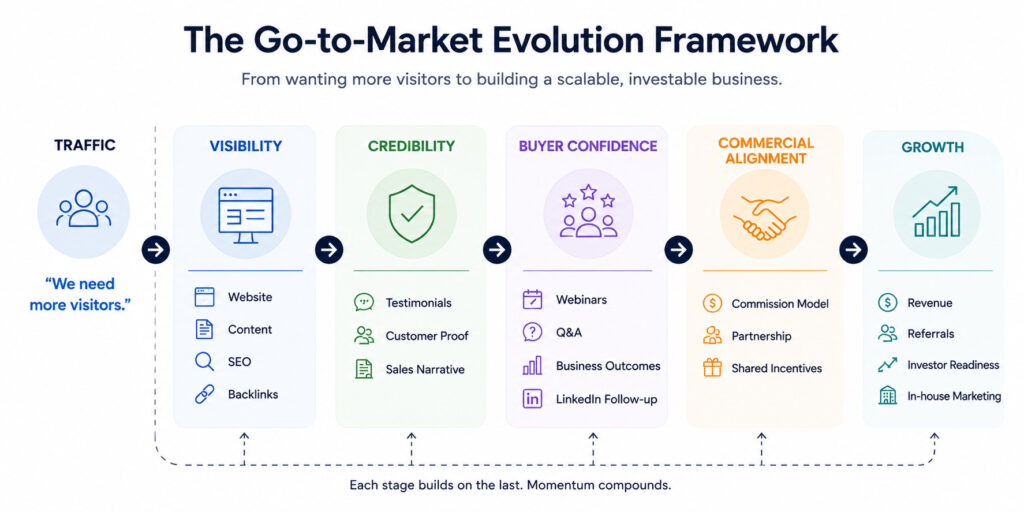
Phase One: Website and Content Realignment
The website said everything a product page is supposed to say, and communicated almost none of it. Dozens of pages, each one hedging toward a slightly different keyword, none of them answering a real question SaaS buyers would actually ask before spending money.
So we proposed archiving roughly 80% of it.
That’s an uncomfortable conversation to have with a founder. Every instinct in a growing company says more content means more surface area, more chances to be found. We were asking them to believe the opposite — that a smaller, sharper site would outperform a large, diffuse one. Not everyone on their side was convinced immediately, and we didn’t have data yet to prove we were right. We asked for the trial anyway.
What we rewrote, we built around one principle: the site had been answering questions Google’s crawlers cared about, not questions buyers cared about. So we went looking for the actual questions — not from keyword tools, but from public forums where people debate purchases out loud. Should we or shouldn’t we. Why does this matter now. What does it cost us if we wait.
Backlinks followed the same logic — earned through genuine exchange with adjacent sites, not bought for volume.
None of this fixed the actual reason the lead had nearly been dropped in the first place — a company that looked, on paper, unremarkable. But the page work started chipping at one specific kind of doubt: relevance uncertainty, whether this company understood a buyer’s actual situation at all. The deeper uncertainties — about the business itself, not just the content — were still ahead of us.
We get asked often whether we’re focused on rankings.
Of course we are.
But rankings have never paid an invoice.
Rankings simply make the conversation possible.
Everything that matters happens after someone clicks.
Phase Two: Earning Belief From SaaS Buyers, Not Just Attention
Visibility got people to look. It didn’t get anyone to believe a small, relatively unknown vendor over an established competitor. Earning the confidence of a buyer evaluating an early-stage technology company from a standing start turned out to be a slower, more manual job than any of the visibility work before it.
Testimonials were the hardest part of the engagement, and they revealed something about the client we hadn’t fully appreciated: the few existing customers were reluctant to be named publicly, for reasons of their own — a hesitation not unlike the confidentiality our own clients often ask of us. Friends and family of the founders were willing to help but carried little weight with someone deciding whether to sign a contract. So we did it the slow way. Phone calls. Careful questions written up from memory and sent back for approval before anything went live. This was credibility uncertainty — whether anyone besides the founders actually vouched for the company.
At the same time, we sat down with the founders and rebuilt their sales deck from scratch — and this is where the real translation work happened. A website earns attention. A sales deck has to convert belief, in real time, in front of a SaaS buyer who is also thinking about internal buy-in, procurement, and total cost of ownership, not just whether the technology performs. That meant taking language the founders used comfortably with each other and rewriting it as a business case for the people who’d actually sign off: what changes operationally, what the rollout looks like, and where the return shows up on their side of the ledger. That’s a different kind of uncertainty again — not whether the equipment works, but whether the business case survives being explained to someone else. It sounds like a small shift. It’s the difference between a meeting that impresses and a meeting that closes. That lesson quietly changed every piece of marketing we created afterwards.
Two months in, the numbers told an uncomfortable story: traffic climbing, inquiries increasing, almost nothing converting. We hadn’t been paid, and there was no guarantee we would be.
There were real doubts on our side, and I’ll be honest about what they sounded like. Had we just spent two months of a small team’s time on a company that was never going to convert? Was I the reason for that, because I’d pushed to take this client on for reasons that had more to do with me than with them?
Traffic isn’t money. We already knew that. We were relearning it under pressure.
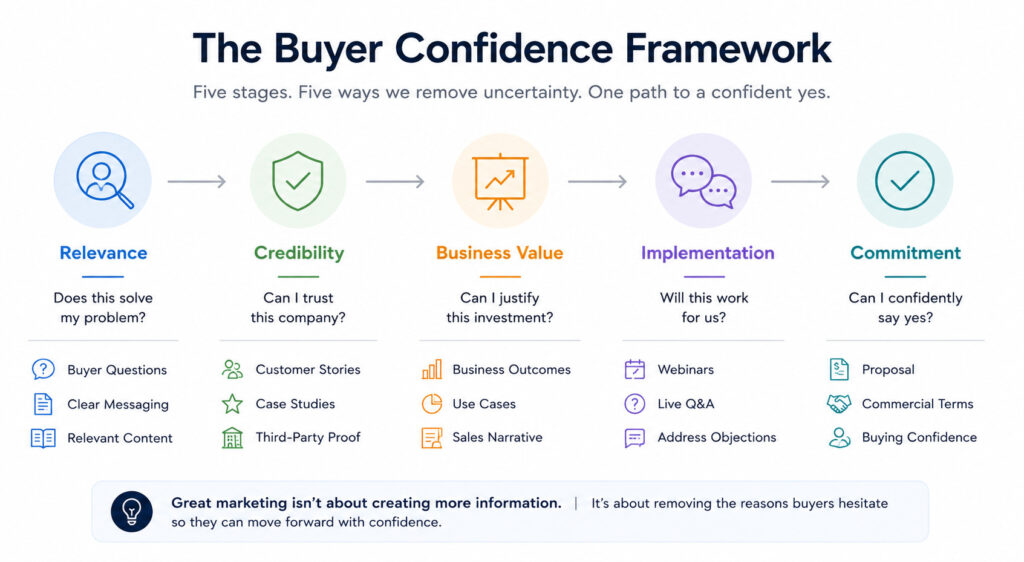
Phase Three: The Go-to-Market Pivot
Everything up to this point had been execution — better pages, better proof, a sharper pitch. The actual turning point was different: it was restrategizing the go-to-market model itself, not any single tactic inside it.
We started running small webinars, expecting a modest audience. The first one drew three attendees.
Three people isn’t much to show for the effort of running a webinar. But it produced our first real conversion — one new client, out of a room of three. That’s a strange, useful thing to learn early: a small room doesn’t mean nothing is happening in it.
We kept working the same way through the following weeks — blogging, backlinks, refining the pitch — and around the three-month mark, still without a formal invoice paid, the founders started half-jokingly calling me “champ” on calls. One conversion in, still unpaid, and the relationship had already shifted from vendor to something closer to a partner they trusted with judgment calls.
That was the point where we sat down and restructured the entire go-to-market arrangement: no flat marketing fee, a small commission on every conversion instead. It aligned what we wanted with what they wanted completely, and it’s a model we still offer clients today when the fit is right.
Part of that restructure was deciding what to stop doing.
The company had a young, ambitious internal team who’d been running the playbook they thought marketing was supposed to look like — cold calls, an endless cold-email cadence chasing anyone who’d take a meeting. We asked them to stop. Not because effort was the problem — because none of it was earning anything, and every hour spent broadcasting to strangers was an hour not spent on the handful of people already paying attention.
With incentives on both sides finally pointed the same direction, we changed how we approached LinkedIn outreach too. Instead of broadcasting to a wide list, we followed up personally with the people who had already shown engagement — attended a webinar, opened multiple emails, lingered on a pricing page. Broadcast less. Recognize more. It wasn’t a new channel. It was a different way of paying attention, and it showed almost immediately: a second webinar brought in real signups and another conversion, and a third — built on that same targeted follow-up — became the strongest one yet.
By month four, the pipeline had real, durable momentum behind it, and the commission structure meant the agency was finally earning alongside the client rather than waiting on a flat fee that hadn’t been justified yet.
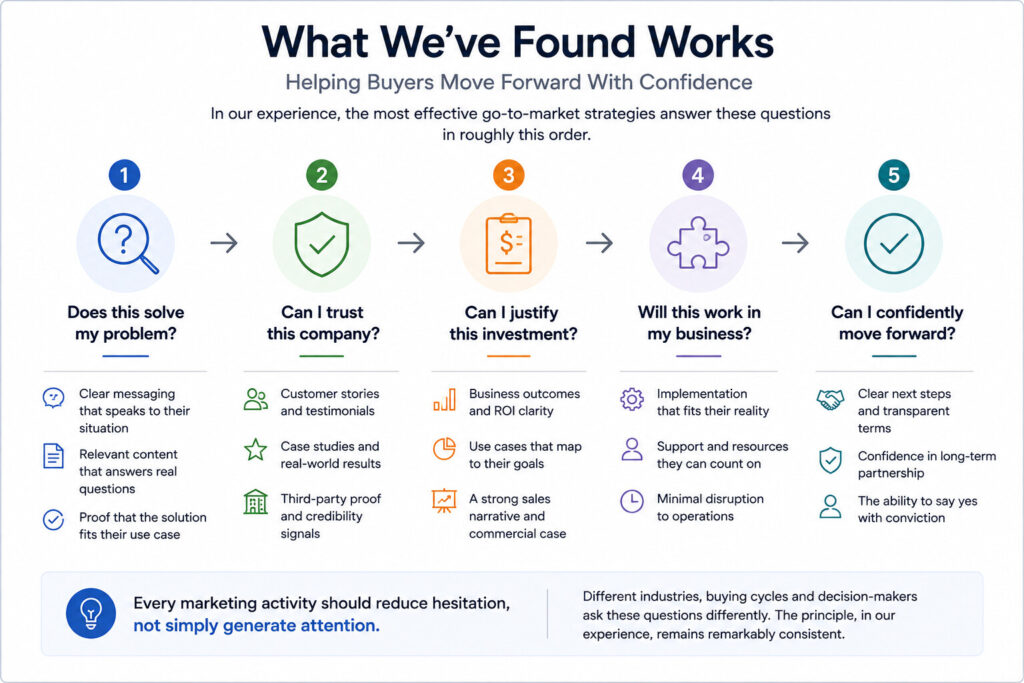
Where the Client Stands Today
To be clear upfront: we no longer work with this company. They’ve since secured investors, built out their own in-house marketing team, and grown into a business several times the size of the one we first met — the engagement did its job well enough to make itself unnecessary.
An NDA keeps the specifics private. What isn’t private is this: before we parted ways, we agreed to keep a small, trust-based commission on new business that still comes through their site. Nothing enforcing that particularly tightly. Just an understanding, built over ten months of working together, that we’d earned it.
That the company no longer needs us isn’t a loss for this story. It’s the point. We weren’t trying to build dependency. We were trying to remove enough uncertainty that they could eventually stand on their own.
The Go-to-Market Lesson We Still Apply
We don’t tell this story because 2024 was a remarkable year. We tell it because this project is where a principle we now apply to every engagement first became visible to us: startups rarely lose deals because of a weak product. They lose deals because a buyer never reached internal confidence — the point where a decision-maker is willing to put their own credibility behind the purchase.
SEO, testimonials, sales decks, webinars, targeted outreach — none of those are the work. They’re five different levers for the same outcome: closing the gap between what a buyer suspects and what a buyer, and the people they answer to, are willing to commit budget to. Earning the confidence of a B2B technology buyer, in our experience, is less a marketing campaign than a sequence of small, verifiable proof points — each one removing one more reason to hesitate, or to delay a decision to next quarter.
Looking back, calling this “marketing” undersells it. We changed messaging, positioning, pricing, incentives, and the sales process itself — that’s commercial strategy, not a content calendar. Every single thing we did — the archived content, the testimonials, the deck, the webinars, even the commission structure we eventually agreed to — was a way of moving risk off the buyer’s side of the table and onto ours. A commission-only fee is, among other things, a company betting on itself instead of asking the client to bet first. That’s not a coincidence. It’s the same move as everything before it.
What this project still teaches us
– Every SaaS buyer trusts a conversation more than a claim.
– One clear answer outperforms fifty optimized pages.
– Features explain the technology. Outcomes explain the decision.
– A small audience that stays engaged teaches you more than a large audience that stays silent.
– If a client no longer needs you, that’s not attrition. That’s the engagement working as designed.
– Not one dollar of that growth came from paid media. All of it came from removing reasons to hesitate.
Before this project, we thought our job was to generate demand. After it, we understood our job was to remove hesitation — and we’ve built every engagement differently since.
Marketing isn’t the art of attracting attention. It’s the discipline of removing doubt. Buyers rarely need more information. They need fewer reasons to hesitate. Everything else is just a technique.
What Is SaaS Buyers' Trust?
SaaS buyers’ trust is the confidence a prospective customer has that a technology vendor will deliver what it claims, remain in business long enough to support what’s been deployed, and treat their money and data responsibly — confidence that has to be earned before a contract is signed, not after. For early-stage or lesser-known vendors, this is usually the real bottleneck to closing, even when traffic, meetings, and stated interest all look healthy.
FAQ: Earning SaaS Buyers' Trust
Why don't more qualified meetings convert even when buyers seem interested?
Interest in the technology and confidence in the business are two different things. A buyer can be convinced a product performs and still hesitate to commit budget to a vendor they’re not sure will still be around, staffed, or reliable a year from now.
Can a startup earn SaaS buyer trust without existing case studies or big-name clients?
Yes, though it takes longer and looks less polished. Direct testimonials gathered through real conversations, a sales process that speaks to business outcomes instead of specifications, and consistent follow-through on small commitments all build trust incrementally — even without a marquee logo to point to.
Does SEO actually help build SaaS buyers trust?
Indirectly. Rankings get a company in front of the right decision-maker, but visibility alone doesn’t make someone believe a business is worth committing budget to. Trust is built after the click, through what the site, the sales process, and the follow-up actually demonstrate.
Can organic content marketing alone drive real go-to-market growth, without paid ads?
Yes, though it takes patience and consistency that paid channels don’t require. Content built around the actual questions buyers ask before spending money, combined with a sales process that reinforces the same message, can move a company from unknown to trusted without a media budget — it just takes longer to compound than a paid campaign, and it depends on the content actually answering real questions rather than chasing keywords.
What does restructuring a go-to-market strategy actually involve?
It’s rarely one change. In practice it means realigning what the website says, how the sales process presents the business case, what proof points exist for a skeptical buyer, and often the commercial terms themselves — pricing or fee structure — so that everyone’s incentives point toward the same outcome. The tactics (content, outreach, webinars) stay downstream of that realignment; changing them without changing the underlying strategy rarely moves the needle on its own.