

SaaS & IT Content Marketing
Why SaaS Buyers Are Researching Your Product on ChatGPT Before They Ever Visit Your Website
Picture this. A VP of Operations at a mid-size logistics company needs a new onboarding tool. She doesn’t open Google. She opens ChatGPT and types: “What’s the best SaaS onboarding platform for a 300-person operations team?”
ChatGPT gives her three names. Yours isn’t one of them.
She shortlists the three. Books demos. Buys one. Your sales team never gets a call. Your website never gets a visit. You never even knew she was looking.
This is not a hypothetical. [Forrester’s ongoing Buyers’ Journey research] has tracked a steady rise in B2B buyers naming generative AI as a more important research source than vendor websites or sales reps. Multiple 2026 industry analyses put ChatGPT usage during vendor evaluation at somewhere between two-thirds and three-quarters of B2B software buyers — the exact figure moves depending on the study, but the direction doesn’t: the majority of buyers are now querying AI tools before they query you.
The B2B Buyer Journey Has a New First Step
The traditional SaaS funnel assumed buyers started with a Google search or a word-of-mouth recommendation. They found your site, read your blog, downloaded a guide, booked a demo. That journey still exists — but it now has a phase before it that most SaaS marketing teams aren’t accounting for.
The 2026 buyer journey looks like this:
AI Research Phase → Awareness → Consideration → Decision → Purchase
The AI Research Phase precedes traditional awareness entirely. The buyer formulates a question, asks an AI assistant, gets a synthesised answer with two to seven vendor names, and builds a mental model of the category — before visiting any website, reading any blog post, or speaking to any salesperson.
B2B buying committees are also larger and slower-moving than they used to be: recent Gartner and Forrester research consistently describes groups of six to fourteen stakeholders working through double-digit numbers of touchpoints before a purchase decision, with a large share of that research now happening independently, off any channel a vendor can directly track. These are not early adopters experimenting with a new tool. This is embedded buying behaviour, and it is accelerating.
The practical consequence for SaaS companies: you can have perfect SEO, a high-converting website, and a well-trained sales team — and still lose deals before any of that ever gets a chance to work.
What SaaS Buyers Actually Ask ChatGPT (And What They Don't Ask Google)
Understanding what buyers ask AI tools is the first step to showing up in the answers. The query patterns are different from Google searches — and that difference matters.
Google queries tend to be short and keyword-driven: “best onboarding software” or “project management tool for remote teams.”
AI queries are conversational and context-rich: “What onboarding platform would work best for a 300-person logistics company that’s already on HubSpot and needs Slack integration?” Or: “Compare the top three SaaS tools for customer onboarding — what are the main differences and which is best for a mid-market B2B company?”
This matters because AI tools do not match keywords. They match context. A page that ranks well for “best onboarding software” may never appear in an AI answer about onboarding tools for HubSpot-integrated mid-market B2B teams — because it never specifically addressed that context.
The four query types SaaS buyers use most:
- Category queries: “What are the best tools for [problem] for a [company type]?”
- Comparison queries: “What’s the difference between [Tool A] and [Tool B]?”
- Use-case queries: “What should we use for [specific workflow] if we’re already on [existing stack]?”
- Validation queries: “Is [specific tool] good for [specific situation]?”
If your content doesn’t answer these questions directly and specifically, AI tools will recommend someone else’s content instead. Look at the chart below:
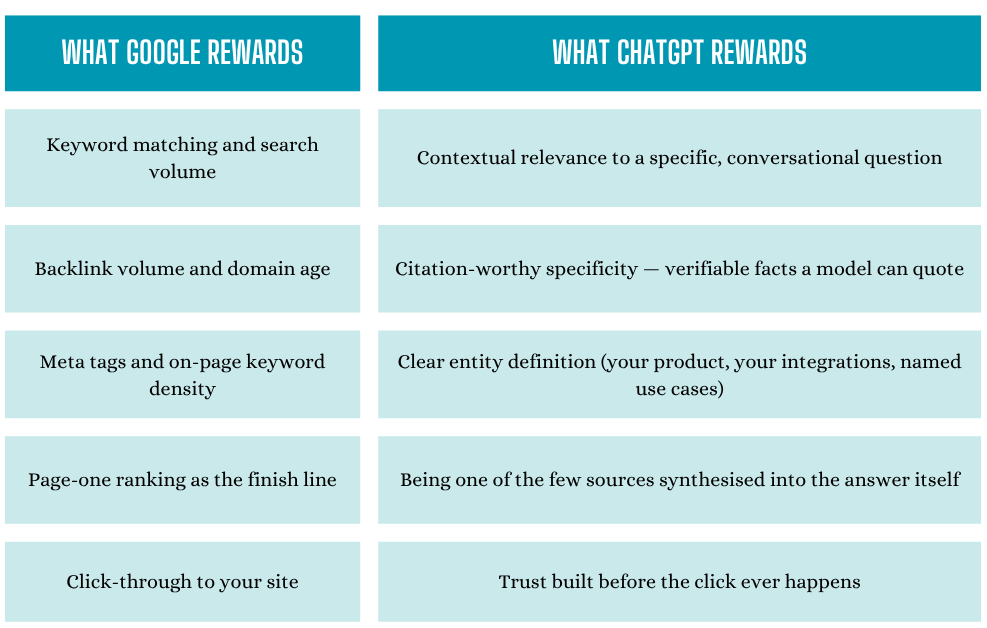
Why So Many SaaS Brands Are Invisible to AI Search Right Now
Most SaaS content was built for Google. It was built around keywords, search volume, and link acquisition. That content does not automatically translate into AI citations — and the gap between ranking well and getting cited is wider than most marketing teams expect.
AI engines like ChatGPT use a process called Retrieval Augmented Generation (RAG) to pull content from the web in real time. They don’t rank pages by inbound link volume the way Google does. They prioritise sources that are specific, verifiable, and cited by other authoritative content.
The practical implication: a smaller SaaS company with one sharp, specific, well-sourced page can out-cite a much larger competitor with ten vague ones. This is one of the few areas where size is not the deciding factor.
AI Search Converts at a Multiple of Google Organic — Here's Why That Matters
Here is the number that should change how SaaS marketing teams prioritise this.
[Exposure Ninja’s 2026 analysis] puts AI-referred traffic conversion at roughly 14.2%, against Google organic’s 2.8% — a rate that keeps showing up across several independent studies this year, even if the exact decimal varies by source. The reason is logical: a buyer who arrives at your website after an AI assistant recommended you is not browsing. They have already done significant evaluation work. The AI pre-qualified them. By the time they click through, they are further along the buying journey than almost any organic visitor from traditional search.That tracks with Forrester’s long-running finding that a large majority of the B2B buying journey — most estimates cluster around 60 to 80 percent — now completes before the buyer ever contacts a vendor. When AI tools are doing the shortlisting, that share is likely higher still, because the AI synthesises comparisons that previously required multiple site visits and hours of research.
The leads you are not getting are not people who visited your site and bounced. They are people who never arrived, because an AI assistant pointed them somewhere else first.
How ChatGPT Actually Decides Which SaaS Products to Recommend
The research here is specific enough to act on. The paper that introduced the term GEO — Generative Engine Optimization — came from Princeton, Georgia Tech, IIT Delhi, and the Allen Institute for AI, authored by Pranjal Aggarwal and colleagues and [published at KDD 2024]. The team built a 10,000-query benchmark and tested nine content strategies against a generative search system, then validated the results on Perplexity. The findings that matter most for SaaS companies:
- Citing external sources and adding direct, verifiable statistics were among the strongest levers tested, each improving citation visibility by roughly 30–40% over baseline content.
- Keyword density — the traditional SEO lever — made almost no difference, and in some cases performed worse than doing nothing.
- Clear entity definition — naming your product, your integrations, your use cases precisely — helped the model connect your content to relevant buyer queries.
What this means in practice: a product page that says “our platform offers robust security features” will not be cited. A product page that says “our platform is SOC 2 Type II certified and encrypts all data at rest using AES-256” gives an AI model something to verify and quote.
Specificity is the currency of AI citation. Vagueness is invisible.
The CITE Framework for SaaS AI Visibility
Pulling the research above into something you can actually apply, we use a simple four-part check with clients:
- C — Cite your sources. Every statistic, every research finding, every benchmark, linked to its origin. This is one of the highest-leverage changes you can make to existing content, and it’s the one most SaaS sites skip entirely.
- I — Identify entities precisely. Name your product, your integrations, and your use cases in plain language, not buried in a features PDF. AI tools match on named entities — if you don’t name them, you won’t be matched.
- T — Turn claims into verifiable numbers. “We help teams work better” gives an AI model nothing to cite. “Customers cut onboarding time by 40% within 30 days, based on data from 200 implementations” gives it something concrete.
- E — Engineer content around the actual question. Write for the conversational, context-rich questions buyers ask AI tools, not just the short-tail keywords they type into Google.
What Your SaaS Content Needs to Do Differently in 2026
The adjustment is not a complete rebuild. It is a sharpening of what you already produce — with AI query patterns in mind alongside traditional SEO.
Answer the specific question, not the keyword. Think about the buying committee member who asks “what project management tool should a 50-person SaaS company use if we’re scaling from 3 to 8 engineers this year?” — and write content that actually answers that.
- Make every claim verifiable. Vague positioning gives AI tools nothing to cite. Specific, sourced claims give them something concrete to pull into an answer.
- Cite your sources. This signals credibility to both AI models and human readers.
- Name your integrations and use cases explicitly.When a buyer asks “what CRM integrates with [your tool],” the answer should be in your content in plain language.
- Publish original data when you can. Customer case studies with real numbers, survey findings, benchmarks from your own dataset — original research is cited at far higher rates than commentary on other people’s research.
What Is Answer Engine Optimization, and How Is It Different From SEO?
If you’re wondering whether GEO and “Answer Engine Optimization” (AEO) are the same thing — broadly, yes, with a nuance. SEO optimises for ranking on a results page a human will scroll. GEO/AEO optimises for being one of the handful of sources an AI model actually pulls into a synthesised answer, which a human never scrolls past to find. The mechanics overlap (both reward genuine authority and clarity), but the target is different: a ranking position versus a citation.
The Four Pages Every SaaS Company Should Optimise for AI Citations First
- Comparison pages: “Tool A vs Tool B” pages get cited heavily because buyers ask AI tools for exactly this comparison. If you don’t have one, your competitor who does will be recommended instead.
- Use-case pages: pages built around specific customer scenarios (“how [company type] uses [your tool] to solve [specific problem]”) match the conversational query patterns AI tools respond to best.
- Integration pages: explicitly naming every integration, with a clear description of what each one enables, makes your product easy for AI models to connect to buyer queries about specific tech stacks.
- Pricing and packaging pages: buyers ask AI tools about pricing. If your pricing page is vague or gated, you will not be recommended. Transparency is a citation signal.
The Buyer Has Already Decided — The Question Is Whether You Were in the Room
The VP of Operations from the beginning of this article has already made her shortlist. She did it in a ChatGPT window, in a few minutes, before your sales team knew she existed.
That shift is not reversible. AI-assisted vendor research is now embedded in how B2B buyers work — across industries, company sizes, and buying committees. The question for every SaaS marketing team is not whether this is happening. It is whether your content is in the conversation when it does.
The SaaS companies that win in this environment are the ones whose content is specific enough, sourced enough, and clear enough to be recommended by an AI assistant to a buyer who has never heard of them. That is a higher bar than ranking on page one of Google. It is also a more valuable position to hold — because a buyer who arrives pre-qualified by an AI recommendation is already close to a decision.
The door is open. Most of your competitors are not walking through it yet.
Is Your SaaS Brand Showing Up in AI Search?
At Market Plus Solutions, we help small SaaS and IT businesses build content that earns citations from AI search tools — not just rankings on Google. If you want to know whether your content is showing up when your buyers ask ChatGPT who to work with, let's find out together.
Author: Andres Fehrenz