

SaaS Industry
The question at hand: Are SaaS ads profitable?
The short answer: SaaS ads can be profitable, but profitability depends on CAC, payback period, conversion rate, customer value, retention, and runway. For an early-stage SaaS company, the more useful question is whether paid acquisition is economically testable right now.
Are SaaS ads profitable? Sometimes. But if you’re an early-stage founder deciding whether to put your next €5,000 into Google or LinkedIn, “are SaaS ads profitable” isn’t a specific enough question to actually help you decide.
This is written for a specific reader: a founder or small team with somewhere between €0 and €10k a month available for marketing, no dedicated marketing department, limited historical conversion data, a B2B SaaS or IT product, a sales cycle that isn’t instant, and real uncertainty about whether paid acquisition should come before organic content, outbound, or referrals. If that’s not you, most of what follows still applies, but it was written with that founder in mind.
Byline: Andres Fehrenz
The SaaS Ad Benchmark Everyone Repeats Doesn't Actually Exist
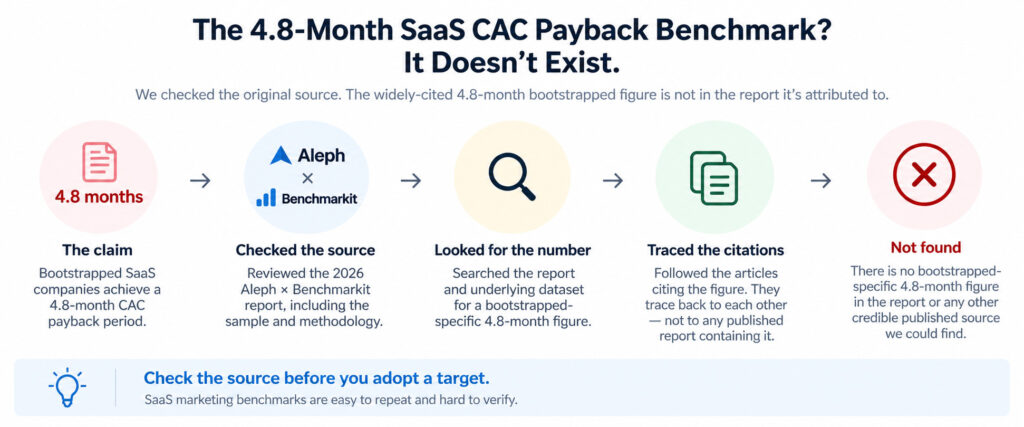
Search this question and you’ll find a specific number repeated constantly: bootstrapped SaaS companies achieve a 4.8-month CAC payback period. It sounds precise enough to trust, and it gets cited as if it comes from a real, named study.
It doesn’t. A verification effort by ivristech that went looking for the original source found no bootstrapped-specific figure in the 2026 Aleph × Benchmarkit dataset it’s usually attributed to, and traced the pages repeating the number back to each other rather than to any published report that actually contains it.
“The widely-cited 4.8-month bootstrapped benchmark does not appear in the report it is attributed to. Check the source before you adopt a target.” — CAC Payback Period Benchmarks: 16 Months Is the Median, ivristech
What We Checked
➜ The original Aleph × Benchmarkit report and its stated sample and methodology
➜ The source cited by articles repeating the 4.8-month figure
➜ Whether that figure appears anywhere in the underlying dataset (it doesn’t)
➜ Whether a genuine bootstrapped-specific segment exists in any credible published report (as of this writing, we found none)
We’re pointing this out because it matters for how you read everything that follows, including our own claims. A note on the numbers: SaaS marketing benchmarks are unusually easy to repeat and unusually difficult to verify. Wherever we use an external benchmark in this piece, we link to the original source. Where we’re describing something we’ve observed directly, we say so. And where the evidence doesn’t support a universal claim, we won’t pretend it does.
What the Real Data Actually Says
For a clearly sourced benchmark, we use the Aleph × Benchmarkit 2026 SaaS & AI Performance Benchmarks report, built on real, full-year 2025 data from 342 B2B SaaS and AI-native companies. It’s worth trusting specifically because it names its sample size, its methodology, and its data year, which most of the numbers circulating on this topic don’t.
“The median B2B SaaS company recovers its customer acquisition cost in 16 months.” — Aleph × Benchmarkit 2026 SaaS & AI Performance Benchmarks
The median alone tells you almost nothing useful, though. Inside that same report, top-quartile companies recover cost in 6 months or less. The bottom quartile takes 24 months or more. That spread, not the median, is the actual story.
What separates a 6-month payback from a 24-month one is mostly annual contract value, existing net retention, whether organic pipeline is already working, and how much runway is available to wait. Campaign optimization isn’t irrelevant here, a poorly targeted or badly written ad genuinely wastes money. But it’s downstream of economics a campaign can’t fix on its own. No amount of clever targeting turns a product with weak retention and a long sales cycle into a 6-month payback story.
Why CAC Payback Alone Doesn't Tell You Whether SaaS Ads Make Sense for You
A single benchmark number can’t answer this because it doesn’t know your specific constraints. Five things actually decide it:
➜ Can you survive the payback period? A 16-month median means little if your runway is 9 months.
➜ Do you already have a conversion path that works? Ads sending traffic to an unproven sales funnel generate expensive traffic, not profitable acquisition.
➜ Is your product’s value provable in the window a paid click gives you, and is there real product-market fit underneath the pitch? Complex, high-consideration purchases rarely convert the way a simple self-serve tool does, and no ad spend fixes a product the market hasn’t validated yet.
➜ Do you have organic or referral demand already validating the market? Investigate what’s generating that demand before buying cold traffic. It gives you evidence about who is interested, why they’re interested, and what actually converts. Once you know that, paid acquisition becomes a question of whether buying more of that same demand makes economic sense, not a guess about a channel you haven’t tested yet.
➜ What does a wrong answer actually cost you? A small team spending its entire monthly budget testing an unproven channel is taking on a different risk than a funded team running the identical test.
Should You Actually Run Ads Right Now? A Practical Way to Decide
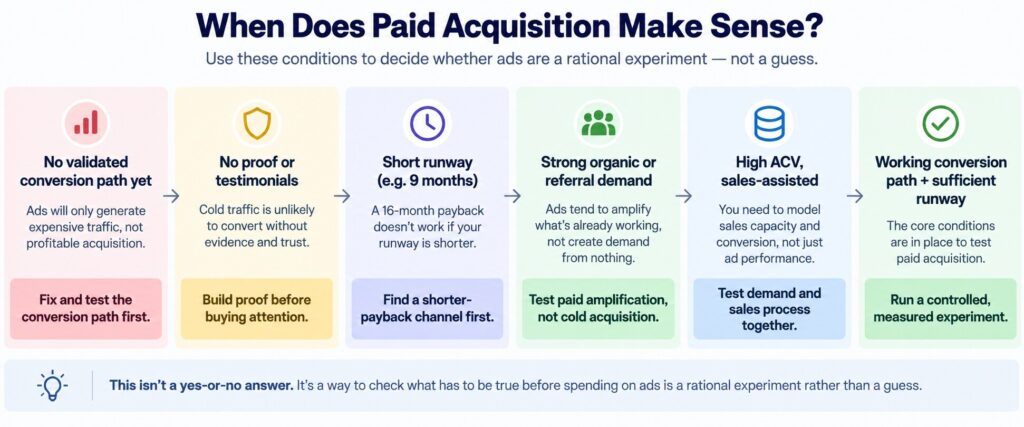
Rather than a yes-or-no answer, here’s a more honest way to check your own situation against the conditions above:
Your Situation | What It Means | What to Investigate Next |
No validated conversion path yet | Don’t make ads your first experiment | Fix and test the conversion path first |
No proof, no testimonials | Be cautious with cold traffic | Build proof before buying attention |
9 months runway, 16-month expected payback | Economics don’t work yet | Find a shorter-payback channel first |
Strong organic or referral demand already | Ads may amplify what’s already working | Test paid amplification, not cold acquisition |
High ACV, sales-assisted conversion | Model your sales capacity first | Test demand and sales process together |
Working conversion path, sufficient runway | Paid acquisition becomes testable | Run a controlled, measured experiment |
Notice what this table isn’t saying. It’s not “ads are good” or “ads are bad.” It’s asking what has to be true before spending on ads is a rational experiment rather than a guess. The framework below visualizes the same decision process:
What Happens When You Have No Ad Budget at All
One of our early-stage IT clients never spent a dollar on paid ads across the entire engagement, not by strategic choice at first, but because there was no marketing budget at all for the first several months. We wrote the fuller story in this case study; here’s the shape of it:
Client | Early-stage IT company |
Paid media spend | $0, across the entire engagement |
Initial constraint | No marketing budget for the first several months |
What changed | Testimonials, then sales deck, then a first webinar, then commission model, then more webinars and direct outreach |
First real conversion | A webinar with 3 attendees |
Meaningful momentum | Month 4 |
None of it was fast, and we’re not presenting this as proof that ads never work, or as a blueprint to copy. In our experience, profitability often depends less on which channel you pick than on whether the company already has the economics, the proof, and the conversion path needed to make that channel work at all. Paid acquisition wasn’t ruled out because it’s a bad channel. It wasn’t available, so the question became what else could substitute for it, and the answer turned out to be testimonials, a rebuilt sales deck, and eventually a commission structure that tied our incentive to the same outcome the client needed.
Google Ads, LinkedIn, Organic, or Outbound: Which One First?
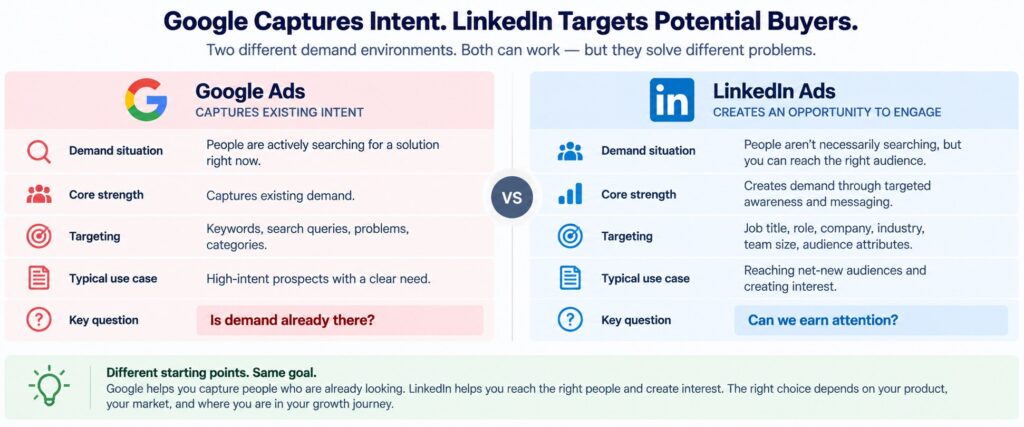
There’s no universal order, and Google and LinkedIn aren’t interchangeable just because both are “paid ads.” They’re fundamentally different demand environments, and each answers a different question.
Google captures existing search intent. The fundamental question it answers is: are enough of the right people already searching for this problem, product, or category? If the search volume for your specific problem is thin or nonexistent, Google Ads has little intent to capture, no matter how well the campaign is built.
LinkedIn lets you target an audience before they’ve necessarily started searching for anything. The fundamental question it answers is: can we identify the right audience and give them enough reason to stop, trust, and engage with something they weren’t already looking for? That’s a harder job, and it usually needs stronger proof and messaging to work at all.
If your sales cycle is long and high-touch, outbound and founder-led outreach usually teach you more per euro than either paid channel, because you get direct, immediate feedback on where a prospect hesitates. Whichever channel you pick, it tends to earn its place once you already know what converts and just need more volume of it, not while you’re still discovering what converts in the first place.
The Honest Answer
SaaS ads can be profitable. They’re also frequently not, and the difference has far less to do with the platform than with whether the company running them can survive the payback period, already has a working conversion path, and has enough proof to make a cold click trust a purchase decision.
There’s no blueprint that answers this for you in advance. There’s a set of honest questions, applied to your specific situation, tried, measured, and adjusted. It’s a less satisfying answer than a benchmark number. But it’s a more useful starting point for an actual decision.
Before You Spend €1,000, Know These Four Numbers
➜ First-year gross profit per customer
➜ Qualified visitor to customer conversion rate
➜ Expected customer acquisition cost for the channel you’re considering
➜ Maximum payback period your runway can actually tolerate
If you don’t know these yet, the problem isn’t that you haven’t found the right advertising platform. You don’t have enough information to make the advertising decision yet.
Common Questions on SaaS Ad Profitability
Why do SaaS ad benchmarks disagree so much?
Because they measure different populations under different definitions. CAC payback calculated with expansion revenue included can look 30 to 40 percent shorter than the same company’s numbers without it. Different reports use different formulas, different samples, and different years, and most articles repeating a stat don’t specify which version they’re citing.
Should an early-stage SaaS company with no budget consider ads at all?
Only after confirming a conversion path already exists to send that traffic to. Without one, ad spend typically produces expensive traffic to a page that wasn’t going to convert regardless of where the visitor came from.
What’s a realistic CAC payback period to expect?
Directionally, per ScaleXP’s 2025 SaaS Benchmarks, which segments by ACV rather than company size: 8 to 12 months for SMB SaaS under $15K ACV, 14 to 18 months for mid-market ($15K-$100K ACV), 18 to 24 months for enterprise (above $100K ACV). This is a different, separately sourced breakdown from the Aleph × Benchmarkit figure above, not the same study cut a different way. Treat both as reference ranges, not targets that guarantee anything for your specific company.
Is there a proven alternative to paid ads for early-stage SaaS companies?
Not a universal one, but a documented pattern: earned trust through real proof, direct outreach to people who’ve already shown interest, and content built around the specific objections buyers raise, worked without any paid spend in the engagement described above. That’s one case, not a rule.
Where to Go From Here
If you’re working through this exact decision while marketing a SaaS company with limited resources, getting this wrong is a more expensive mistake than it is for a funded team, which is exactly why it’s worth getting right before you spend anything. If you want someone to pressure-test these four numbers with you before you commit budget, that’s a conversation we’re happy to have.
Before You Spend That Next €1,000!
If you're weighing paid ads against everything else pulling at a limited budget, we're happy to pressure-test your CAC, payback period, and conversion math with you before you commit anything, and just as happy to tell you honestly if ads aren't the right move yet.