

SaaS Industry
Have You Noticed That All SaaS Content Sound the Same?
Try this experiment.
Open ten B2B SaaS homepages in ten tabs. Strip out the logo, the screenshot, the pricing. Just read the words.
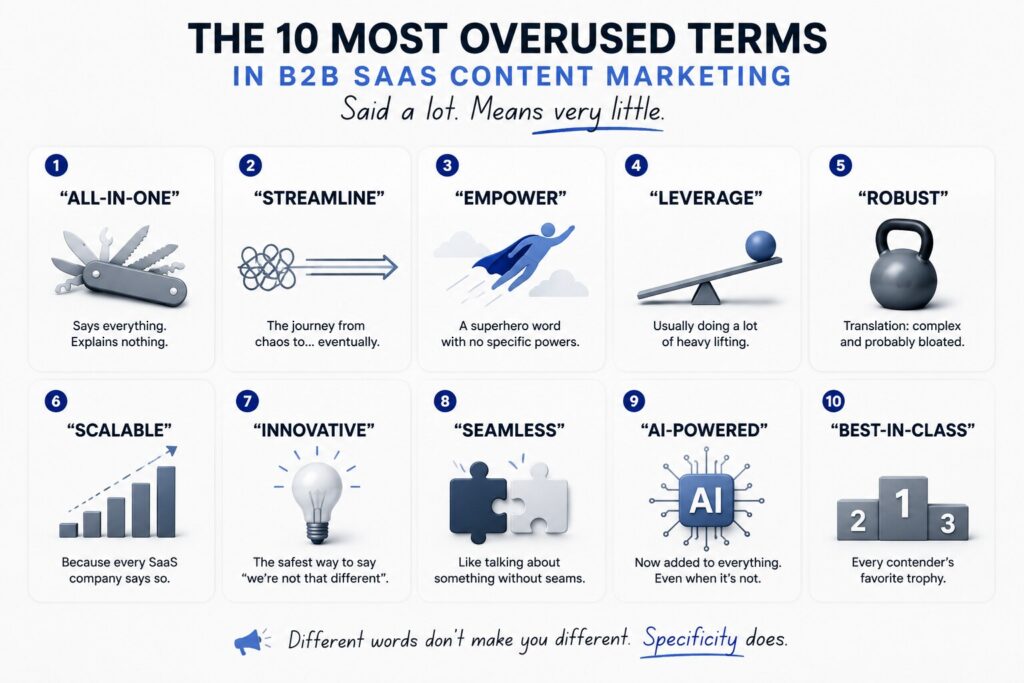
“The all-in-one platform for modern teams.”
“Streamline your workflow.”
“Work smarter, not harder.”
“Built for teams that move fast.”
Now close your eyes and try to remember which tab said which. You can’t. Nobody can.
Turns out this isn’t just a feeling. It’s been measured. A June 2026 audit of 100 B2B SaaS and AI companies, scored against eight recognised brand-distinctiveness factors, found that only one company in the entire sample — the cybersecurity platform Wiz — reached what the researchers classified as genuinely “ownable.” Seventy-eight landed in the “generic” band. Two were rated “invisible” — strip the name off the homepage, and even their own prospective customers couldn’t identify them. That’s four out of every five B2B SaaS brands producing content that sits somewhere between forgettable and interchangeable.
So why does this keep happening — and is AI making it better or worse?
What Makes B2B SaaS Content Actually Stand Out?
The audit was run by positioning consultant Louis Grenier and built on brand researcher Jenni Romaniuk’s distinctive-asset framework from the Ehrenberg-Bass Institute — one of the most rigorous bodies of research on brand memorability in existence. Each company was scored on eight recognisable assets: colour, logo, a distinctive visual device, typography, taglines, a human identity (mascot or founder face), a signature product interface detail, and sound. Every asset was rated from 0 (absent) to 3 (recognisable without the logo attached).
The clearest finding wasn’t which company won. It was where the entire sample clustered.
Grenier’s write-up put it plainly: eighty percent of the brands studied were “generic or invisible” by the study’s own scoring bands, and the assets companies actually invested in were the ones least likely to make their B2B SaaS content memorable. Colour was the highest-scoring asset across the cohort — and that’s exactly the problem: when every company in a category nails the same handful of blues, the colours cancel each other out.
The asset with the most room to differentiate barely exists at all. Ninety-one of the hundred companies scored zero for sound — no sonic logo, no recognisable audio motif, nothing you’d know with your eyes shut. Human identity — a mascot, a character, a visible founder — fared only slightly better, with just fourteen companies scoring a 2 or above.
“A distinctive asset only works once the positioning underneath it is sharp — the asset makes a brand retrievable, but the positioning is what makes it worth retrieving.” — Louis Grenier, State of B2B Brand Distinctiveness 2026
Is AI Making B2B SaaS Content More Generic, or Just Faster?
Well, here’s the finding that matters most if your team has leaned on AI tools to keep pace with B2B SaaS content output: it didn’t help.
The same 2026 audit split its sample into companies founded during the AI era (2021 onward) and those that predate it. The AI-native companies averaged 10.88 out of 24 on the distinctiveness scoring. The pre-AI companies averaged 10.58. The gap is inside the noise — statistically, there’s no meaningful difference. Faster tools and faster funding didn’t translate into more distinctive B2B SaaS content. If anything, they gave more companies the means to produce more of it that looks and sounds like everyone else’s, just quicker.
That tracks with a controlled academic finding published in Science Advances. Researchers Anil Doshi and Oliver Hauser ran an experiment where some writers received story ideas from an LLM and others didn’t. The result was double-edged: AI assistance made individual stories better and more enjoyable, but the AI-assisted stories were more similar to each other than stories written by humans alone.
“Every individual writer does better, while the collective pool of ideas gets narrower at the same time.” — Anil Doshi & Oliver Hauser, Science Advances (peer-reviewed, 2024)
Content Marketing Institute’s newly released 2026 B2B Content and Marketing Trends report — a survey of 1,015 B2B marketers fielded in mid-2025 — shows the same tension playing out inside real B2B SaaS content teams right now. Eighty-nine percent say their organisation uses AI tools for content creation. Fifty-eight percent say B2B SaaS content quality has improved as a result. But twelve percent say it’s gotten worse — and “differentiating content from competitors” ranks as a top-three challenge for nearly a quarter (24%) of B2B marketers surveyed, the same as it did the year before AI tools were anywhere near this widespread.
“AI is like handing every marketer a turbo-charged typewriter — faster output, but the real work of thinking is still the part nobody’s tool can do for them.” — Ann Handley, Chief Content Officer, MarketingProfs (CMI 2026 report)
“Human skills can’t be replaced — creativity and critical thinking are what’s left after the typing gets automated away.” — Molly Soat, American Marketing Association (CMI 2026 report)
What Generic B2B SaaS Content Actually Costs You
This isn’t just an aesthetic complaint. Sameness has a direct commercial cost, and it shows up in exactly the place a founder cares about most: pricing power.
B2B research firm Wynter studied why so many companies stay generic and concluded the bar for standing out is lower than most teams assume — but the downside of not clearing it is real: different, in their analysis, is a company’s only real shot at being remembered. When a buyer can’t tell your B2B SaaS content apart from three other vendors on the page, they stop evaluating your value and start comparing your price.
When messaging doesn’t differentiate, a buyer’s takeaway is nothing more than another checkbox on a feature sheet — at which point they’ll compare every vendor feature-for-feature and pick whichever is cheapest. Generic B2B SaaS content, as one marketer studying this problem put it, builds transactions, not relationships.
That’s the trap.
You didn’t set out to compete on price. The copy did it for you, quietly, one safe sentence at a time.
Why Does B2B SaaS Content Keep Getting More Generic?
It’s rarely one glaring mistake. It’s a handful of small, familiar habits that compound — and the 2026 brand audit points at the real reason teams don’t fix them: risk.
- Features instead of outcomes. SaaS teams write proudly about what they built — “automated reporting,” “real-time collaboration,” “custom dashboards” — because that’s what the engineering team is proud of. But visitors don’t buy features. They buy what changes for them if they use the product.
- Borrowed metaphors and templates. When every company in a category reaches for the same imagery — robots, rockets, ecosystems — or the same dark-mode, dashboard-screenshot homepage layout, jumping in doesn’t make a brand feel modern. It erases whatever made it recognisable in the first place. A design-studio analysis of this pattern found it bluntly: “B2B SaaS brands all look the same because they all copied each other.”
- No stated point of view. Read the “About” page of ten B2B SaaS companies back to back, and you’ll find the same voice on every one — polished, professional, and entirely forgettable. The fix isn’t a better adjective. It’s finishing a sentence like “we believe most software in our category gets X wrong, and here’s what we do instead,” and letting that conviction shape every page of your B2B SaaS content downstream, the same discipline behind who should actually be writing your B2B thought leadership in the first place.
- Distinctiveness feels like a risk nobody wants to own. This is the honest answer the brand audit gives for why so few companies clear the bar. Building B2B SaaS content a competitor can’t comfortably copy means committing before you can prove it will work — and that means someone senior has to put their name behind a choice that might look unusual at first.
A Test You Can Actually Run on Your B2B SaaS Content This Week
Here’s the practical version of the exercise that opened this piece, and it takes about twenty minutes.
Pull up your last three blog posts or your homepage copy. Remove the logo, the product screenshots, and your company name from the text. Hand it to a colleague who isn’t close to the brand and ask a single question: could this B2B SaaS content have been written by any of your competitors?
If the honest answer is yes, the fix isn’t a rewrite from scratch — it’s usually three moves:
- Run a real messaging audit before you write anything. Read your top five competitors’ homepages back to back and write down every phrase that shows up more than once. That list is now off-limits for your B2B SaaS content.
- Write the belief statement first, the copy second. A homepage without an underlying point of view is a product with a logo — polished, on-brand, and saying nothing.
- Source your claims from actual customers, not the feature list. Pull language directly from sales calls, support tickets, and reviews. It reads like a person, because it is one — and it’s very hard for a competitor to accidentally copy a sentence that came from your specific customer’s mouth.
What Strong B2B SaaS Content Actually Looks Like
Take a sentence that could sit on almost any onboarding or workflow tool’s homepage today: “Our all-in-one platform helps teams streamline their workflow and work smarter, not harder.”
Every word is true. None of it is specific. A competitor could paste this exact line onto their own homepage tomorrow and lose nothing in translation.
Here’s the same claim, rebuilt from an actual customer conversation instead of a features list: “A 40-person ops team at a logistics company cut new-hire ramp time from six weeks to eleven days by moving onboarding checklists out of spreadsheets and into their platform. No new headcount. No new process. Just one system nobody had to be told twice how to use.”
Nobody else can paste that second version onto their homepage. It names a company size, an industry, a specific number, and a specific before-and-after. That specificity is exactly what a reader remembers — and it’s also exactly what an AI engine synthesising an answer needs in order to cite your B2B SaaS content instead of a competitor who never got that specific.
As GEO research from Princeton, Georgia Tech, and IIT Delhi confirmed: specificity and verifiable claims are among the strongest signals for AI citation. Vague B2B SaaS content is not just forgettable to humans — it is invisible to AI search engines too.
Everyone's Suddenly Writing About This. That's Not a Coincidence.
Since this was first published, a wave of new posts on the exact same problem has shown up across LinkedIn, Medium, and agency blogs. That’s not a sign the conversation has moved past this piece. It’s confirmation of the argument itself: when a problem is this widespread, everyone eventually notices it, and most of what gets published about it repeats the same observation without new data behind it. The audit numbers, the AI-similarity research, and the CMI findings above are still the same real evidence they were when this went live, and they’re still doing more work than another generic “everyone sounds the same” take.
Frequently Asked Questions
Is it actually possible for a small B2B SaaS company to sound different from larger competitors?
Yes, and team size has little to do with it. The audit’s most distinctive brand wasn’t the biggest company in the sample. Distinctiveness came from a specific, consistently applied choice, not a marketing budget.
Does using AI writing tools make B2B SaaS content more generic?
The data suggests it doesn’t help, and can quietly work against you. AI-assisted writing tends to produce individually stronger sentences that are also more similar to everyone else’s, which is the opposite of what differentiation requires.
What's the fastest way to check if your content sounds like your competitors'?
Strip your company name and logo from your last three pieces of content and hand them to someone unfamiliar with your brand. If they can’t tell it apart from a competitor’s, that’s your answer, and it usually takes about twenty minutes to find out.
Does differentiation still matter if your product is genuinely similar to competitors'?
Yes, arguably more. When the product itself doesn’t differentiate, messaging is the only lever left, which is exactly the scenario the audit’s data describes.
Your B2B SaaS Content Doesn’t Need to Be Radical. It Needs to Be Yours.
None of this requires reinventing SaaS marketing. It requires refusing two forces currently pulling every piece of B2B SaaS content toward the same centre: a decade of copywriting advice that’s been followed so widely it cancelled itself out, and AI tools that — the data now shows — reward the safest, most statistically average version of every sentence by default, whether the company writing it was founded in 2015 or 2025. The same logic applies whether you’re a well-funded team or marketing a SaaS company with limited resources: specificity beats broad, generic claims regardless of budget.
The fix isn’t more B2B SaaS content. The CMI research shows teams are already producing more of it than ever, and differentiation is still stuck at the same 24% challenge ranking it held before AI tools were mainstream. The fix is being willing to write the sentence a review committee might flag, sourcing your proof from your own customers instead of your competitors’ homepages, and picking at least one asset — a voice, a stated belief, a visual detail — that almost nobody in your category has bothered to own.
Out of a hundred real B2B SaaS companies studied this year, only one cleared that bar. That’s a low bar to clear, and almost nobody’s clearing it — which is exactly why clearing it is still worth the effort.