

SaaS & IT Content Marketing
SEO vs. GEO: Why Small SaaS and IT Business Decision-Makers Need Both to Win in 2026
A client called us last month, the head of marketing at a small IT staffing firm serving mid-size manufacturers, and she sounded rattled in a way you don’t usually hear from someone whose numbers look good.
“Our rankings look great,” she said. “We’re page one for our top three keywords. I check every week.” Then came the part that had actually prompted the call. Out of curiosity, she’d opened ChatGPT the night before and typed something close to what she figured her own prospects were typing: “Who are the best IT staffing companies for mid-size manufacturers?” Her company didn’t come up. Two competitors did. One of them had roughly a third of her headcount and, by her own admission, a website that hadn’t been touched in two years.
That’s not a glitch. It’s a sign of where buying decisions are heading, and it’s showing up first in small businesses like hers, the SaaS and IT companies whose buyers have started letting an AI assistant do the shortlisting for them.
Buyers still search, but a growing number of them are also asking an AI assistant to do the research first and acting on whatever it recommends. For a small SaaS or IT company competing against bigger names with bigger budgets, that shift cuts both ways: it’s a real risk if you’re invisible to it, and a real opening if you’re not. That doesn’t mean SEO stopped working. It means SEO stopped being the whole picture.
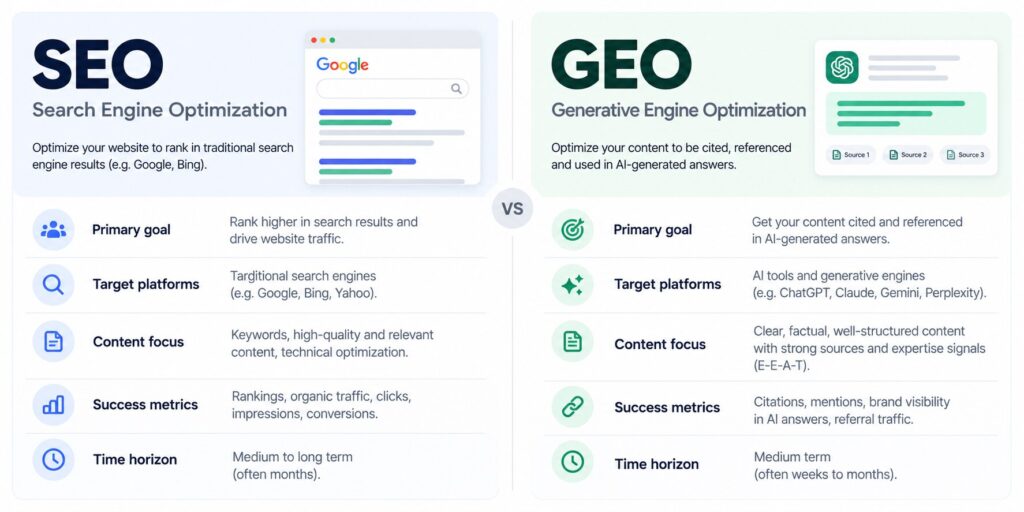
What SEO Still Does Better Than AI Search
Let’s be clear about something, because a lot of the current hype gets this wrong: SEO is not dying, and anyone telling you to abandon it is selling you something.
Search engines still send far more traffic to most websites than AI tools do, by a wide margin. Google is still where most buyers start their research, and for a small SaaS or IT company, it’s still the foundation everything else in your marketing stands on. You don’t get to skip it just because GEO is the newer conversation.
Take a small accounting software company we talked to earlier this year, a business with a marketing team of two. Their organic traffic from Google was still doing the bulk of the work, filling their demo calendar month after month, long before AI tools ever entered the conversation. Their SEO wasn’t broken. It just wasn’t the only door buyers were walking through anymore.
A slow website, thin content, or a weak domain won’t earn AI citations, no matter how cleverly it’s structured. The small SaaS and IT companies doing well in AI search right now are, almost without exception, the same ones that already had strong SEO underneath them. GEO doesn’t replace that groundwork; it’s built on top of it, and for a smaller company without a large content team, that groundwork is worth protecting before adding anything new on top.
If your SEO fundamentals aren’t solid, that’s step one. Everything else in this article assumes you’re already handling that well.
What Is GEO? Where Generative Engine Optimization Enters the Picture
Here’s what’s new. When a buyer opens ChatGPT or Perplexity and asks who they should work with, the tool doesn’t hand back ten blue links. It hands back an answer, usually built from a small handful of sources it trusts enough to cite.
Generative Engine Optimization, or GEO, is the discipline of earning a spot as one of those sources.
It’s a different game than ranking. Search engines reward you for matching a keyword closely enough to earn a position. AI engines reward you for being clear, specific, and credible enough to get quoted inside someone else’s answer. A page can rank well and still never get picked up by an AI summary. Ranking and getting cited are related, but they aren’t the same achievement, and they don’t happen for the same reasons.
This is where GEO becomes especially interesting for small businesses.
Ranking well historically took a domain with age, backlinks, and scale, all things larger competitors typically have more of. Getting cited by an AI model runs on a different currency: clarity and specificity. A small IT services company with one sharp, well-written page can out-cite a much bigger competitor with a vague one.
We saw that play out with two competing IT services companies with almost identical Google rankings for “managed IT services for small business.” One had a blog post that opened with a vague line about comprehensive solutions tailored to your needs. The other opened with a specific claim: their average client cuts help-desk response time to under 15 minutes. Guess which one showed up when we asked ChatGPT to recommend a managed IT provider. It wasn’t the one ranking a notch higher on Google, and it wasn’t the bigger company either.
Why SEO and GEO Both Matter to the Person Signing the Marketing Budget
Here’s the part worth sitting with if you’re the one deciding where a limited marketing budget goes this year.
Visitors who arrive at a website after getting a recommendation from an AI tool tend to convert at noticeably higher rates than visitors who arrive from a standard search result. That tracks: they didn’t stumble onto your site. An assistant they trust already vetted you and pointed them in your direction, so a lot of the selling has already happened by the time they land. For a small SaaS or IT company with a lean sales team, that’s not a nice-to-have. It’s a way to close deals without adding headcount to your funnel.
The data backs this up. [6sense’s 2025 Buyer Experience Report] found that 95% of the time, the vendor that ultimately won the deal was already on the buyer’s shortlist from day one, before a single sales conversation had happened. And according to [Gartner’s most recent B2B buyer survey], a growing share of buyers now use AI directly during a purchase decision. As Gartner analyst Alyssa Cruz put it, buyers are “progressing through critical buying tasks in more autonomous ways,” and sellers can no longer count on static collateral alone to shape that process.
We saw this play out with a small SaaS company that builds onboarding software, a ten-person team competing against category leaders with ten times their marketing spend. Their sales team kept getting inbound calls from prospects who already knew, before the first call, exactly which competitor they were being compared against and exactly why. It turned out prospects were asking AI assistants to compare onboarding tools before ever filling out a contact form. The sales team wasn’t losing those deals in the sales process. They were losing them, or winning them, before the process started, and a smaller team can’t afford to lose deals it never even saw happening.
If your competitor is the name the AI reaches for and you’re not, you didn’t lose a click. You lost a conversation that never happened.
What Gets a Business Recommended by ChatGPT, Perplexity, and AI Search Tools
There’s real research behind this now, not just agency theory. The paper that coined the term, GEO: Generative Engine Optimization, came out of Princeton, Georgia Tech, IIT Delhi, and the Allen Institute for AI, led by researcher Pranjal Aggarwal. The team tested specific content changes against real AI search systems and measured what actually moved the needle. Citing outside sources lifted visibility by as much as 115% for content that wasn’t already ranking well. Adding direct, verifiable quotations improved it by close to 28%. Writing with concrete statistics performed even better in some categories, and keyword stuffing, the classic SEO shortcut, actually made results worse.
None of that requires the budget of a large enterprise marketing team. It requires being specific instead of vague, which is a fix a small marketing team can make without hiring anyone.
A quick comparison makes this concrete. One version of a sentence: “Our platform offers robust security features to protect your data.” Another version: “Our platform is SOC 2 Type II certified and encrypts data at rest using AES-256.” Both sentences are saying roughly the same thing. Only one of them gives an AI model, or a careful reader, anything to actually verify. That’s the version that tends to get cited, and it costs nothing but specificity to write.
None of that is a trick to game an algorithm. It’s close to what makes writing trustworthy to a person in the first place. AI models were trained on how people write and evaluate credibility, so the signals that build trust with a reader and the signals that earn an AI citation overlap more than most GEO advice admits, which is genuinely good news for a small business without a large content budget.
Write clearly enough, specifically enough, and honestly enough that a person would trust it, and you’ve done most of the work an AI model needs to trust it too.
We look at how buyers use these tools in how SaaS buyers research vendors in ChatGPT, and at what they find about your company in what AI tools find about your SaaS company.
How ChatGPT, Perplexity, and Google AI Overviews Handle GEO Differently
ne thing worth knowing before a small SaaS or IT company builds a strategy around this: ChatGPT, Perplexity, and Google’s AI Overviews don’t behave identically.
Perplexity is built to show its sources and does so in nearly every answer it gives. It tends to reward pages with a clean structure and a confident, well-organized answer near the top, which favors smaller companies willing to write plainly rather than pad a page for length. ChatGPT cites sources far less consistently and blends live search results with what it already learned during training, so a strong existing reputation across the web tends to help more here than a single well-optimized page. Google’s AI Overviews lean heavily on whatever is already ranking well organically, which is one more reason your SEO foundation still matters, especially if you’re a small business without the domain authority of a larger competitor.
We’ve watched the same piece of content get cited by Perplexity within a week of publishing, while it took months to show up in a Google AI Overview for a similar query. That’s not a failure on the content’s part. It’s just three different systems working from three different sets of rules.
The practical takeaway isn’t to optimize for all three equally. It’s that no single checklist gets you cited everywhere. Small SaaS and IT companies that take this seriously build content strong enough on fundamentals to perform across all three, then refine from there based on where their actual buyers are asking questions.
SEO vs. GEO: Bringing It Back to the Buyer
Every small business founder we work with eventually asks some version of the same question: do we chase SEO or do we chase GEO?
It’s the wrong split. Both are points along the same path a buyer walks: they search, they read, sometimes they ask an AI assistant instead of scrolling through results, and eventually they decide who to trust. SEO gets you in front of that person. GEO gets you recommended by the assistant they increasingly trust more than a results page. Neither works especially well without the other standing behind it, and for a small SaaS or IT company, doing both well is a genuine competitive advantage against bigger rivals who are slower to adapt.
Underneath both is the thing that actually never changes: write something genuinely useful, say it clearly, back it up with real specifics, and put a real person’s name behind it. Search engines have rewarded that for two decades. AI engines are simply the newest ones learning to reward it too.
Author: Andres Fehrenz